
Do This Now
- 1 Put a low-pass filter inside the feedback loop. Without one, high feedback repeats harsh transients until the mix erupts.
- 2 Use dotted eighth timing, 1.5 times an eighth note, so repeats land in the gaps instead of doubling every hit.
- 3 Anything under 20ms is not an echo, it is comb filtering. Sweep 1ms to 15ms and you have a static flanger.
- 4 Modulate the delay time slightly. Mathematically exact repeats sit stiff against the groove.
- 5 Drive the input stage when you want delay as saturation, so the repeats answer the line as a darker instrument.
Playing connects you to YouTube, which may set cookies.
Delay is the most misunderstood spatial effect in modern music production. Most amateur engineers treat a delay plugin exclusively as a way to create an echoing vocal tail at the end of a phrase. This fundamentally ignores the immense power of time-based processing for shaping rhythmic momentum, generating synthetic environments, and altering the perceived tone of a source signal.
Treating delay strictly as an echo implies a static, uncreative workflow that relies on basic preset manipulation. Delay should be viewed as a destructive synthesizer that reshapes audio dynamically over time. This masterclass breaks down exactly how to construct complex rhythmic beds, manipulate perceived depth without algorithmic reverb, and use delay as a destructive saturation tool.
The Core Mechanisms of Delay
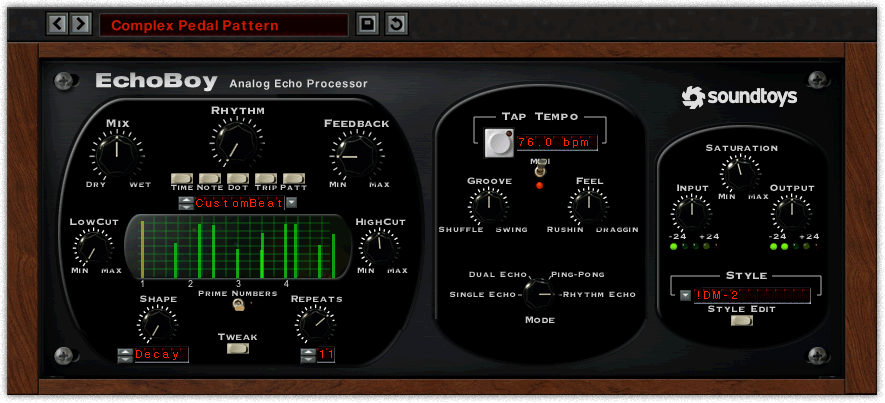
Before attempting aggressive sound design, you must understand the signal path within a modern digital delay unit. The audio feeds into a buffer memory block that holds the signal for a specified millisecond duration. This buffered signal then routes through a filtering circuit and a modulation block before looping back into the input stage based on the feedback parameter.
If you blindly increase the feedback parameter without low-pass filtering the return signal, the delay will endlessly repeat piercing, harsh transients until the mix erupts in a wall of resonant digital feedback. You must manage the frequency content of the repeating signal aggressively.
The Physics of Perceived Depth
A standard algorithmic reverb plugin works by simulating millions of microscopic delay lines hitting your ear simultaneously. It creates a wash of sound that represents a physical room. By contrast, a single delay line represents a discrete echo bouncing off a hard, flat surface.
Delay creates an illusion of immense depth without washing out the original source signal. The human ear uses the temporal gap between the original sound and the first reflection to calculate the size of the room. A longer gap equals a larger perceived space. Using a discrete delay line allows the lead vocal to sit perfectly dry in the foreground while the delayed signal places it in a cavernous stadium.
Comb Filtering and Micro-Delays
When a delay time is shorter than 20 milliseconds, the human ear cannot perceive the delayed signal as a separate echo. Instead, the delayed waveform physically interacts with the dry waveform, creating aggressive phase cancellation. This phenomenon is known as comb filtering.
Comb filtering drastically alters the frequency response of the original signal. By carefully sweeping a delay time between 1 and 15 milliseconds, you effectively create a static flanger that hollows out or boosts specific resonant frequencies. This technique transforms a sterile synthesizer patch into a metallic, aggressive, resonant texture that instantly cuts through dense metallic percussion elements.
- Under 20ms
- Comb filtering, not echo
- Sweep range
- 1ms to 15ms
- Result
- Static flanger, hollowed resonance
- Best on
- Sterile synth patches
Modulating the Time Constant
Hardware analog and tape delays exhibit a crucial structural flaw: their timing mechanisms are never perfectly stable. The motor on a tape delay fluctuates, creating microscopic changes in the physical tape speed. These tiny fluctuations modulate the pitch of the delayed signal constantly.
A pitch-modulated delay line creates immediate width and interest in a mix. If you only use perfectly syncopated digital delay plugins, the repeats are mathematically exact and rhythmically stiff. Introducing random modulation to the delay time parameter forces the echo to constantly waver inside the pocket of the groove, adding humanity and organic movement to an otherwise static digital track.
Delay as Rhythmic Synthesis
Delay is an entirely rhythmic instrument. It takes a static, boring 16th-note hi-hat sequence and forcibly synthesizes polyrhythms beneath it. This is how modern electronic producers generate dense, percolating percussion beds out of a single drum sample.
If you just run a standard quarter-note delay on a drum loop, it simply clutters the beat by doubling every snare hit endlessly. You must utilize dotted or triplet timing values to interject new rhythmic subdivisions between the existing hits.
The Dotted Eighth Poly-Rhythm
The dotted eighth-note delay is the single most powerful rhythmic tool available to an electronic producer or guitarist. It calculates a delay time equal to 1.5 times the length of an eighth note. When you feed a straight 16th-note sequence into a dotted eighth delay, the repeats fall into the gaps between the original hits.
This generates a cascading, galloping rhythm that transforms a simple, static arpeggio into a massive rolling soundscape. The crucial requirement here is precise rhythmic playing. If the original performance is off-grid, the dotted eighth delay will create an immediate trainwreck of conflicting transients.
- Dotted eighth
- 1.5x an eighth note
- Feed it
- Straight 16th sequences
- Repeats land
- In the gaps between hits
- Requires
- Tight, on-grid playing
Ping-Pong Delay and Stereo Momentum
A static delay line firing straight up the middle of the stereo field is usually boring and crowds the lead vocal or kick drum. A ping-pong delay completely alters the stereo momentum of a track. It routes the delayed signal sequentially to the extreme left and right speakers on alternating repeats.
This aggressive panning creates a swirling, dizzying sense of motion that immediately pulls the listener's attention away from the center of the mix. Use a ping-pong delay on a sterile lead synth in the pre-chorus to build tension rapidly. As the sequence hits the left and right extremes, the stereo field widens dramatically before dropping into the mono kick drum of the chorus.
Feedback Loop Mangling
The feedback parameter on a delay plugin routes the output signal back into the input buffer block endlessly. Setting the feedback to 100 percent creates a permanent, non-decaying loop of audio. This transforms the delay plugin into a rudimentary looping sampler.
Start a feedback loop running infinitely in the background of your track. Route an auxiliary automation curve to the delay time parameter and manipulate it aggressively in real-time. Pitching the delay time down lowers the pitch of the entire loop dramatically, creating alien, groaning tape-stop effects that fill the gaps between musical phrases. Pitching it up creates hysterical, screeching rises that build massive tension.
Utilizing Delay as Saturation
Vintage delay hardware is structurally incapable of reproducing high-frequency transients perfectly. Analog bucket-brigade (BBD) delay chips degrade the audio heavily with every repetition, rolling off high frequencies while simultaneously introducing aggressive mid-range harmonic distortion.
Modern producers utilize delay plugins specifically for this destructive tone-shaping quality, not for the echo itself. A BBD emulation run as an insert transforms a sterile digital lead into a warm, raspy, analog-sounding instrument.
Driving the Input Stage
Analog delay units characteristic sound comes from the input pre-amplifier stage being pushed into heavy saturation. You must purposefully clip the input of your delay plugin to recreate this effect. Many plugins provide an "input drive" knob specifically for this destructive workflow.
Drive the input signal hard until the delay tail sounds heavily distorted and gritty. The resulting repeats will no longer sound like an exact replica of the pristine source audio. They will sound like a completely different, darker, grittier instrument answering the initial melody line in the background.
Filtering the Repeated Transients
A bright, high-fidelity echo often sounds distracting and artificial. An echo should feel like it is receding physically into the distance. This means it must gradually lose high-frequency energy with each repetition as if the sound is being absorbed by real-world physical boundaries.
Insert a low-pass filter specifically in the feedback loop of the delay plugin. As the audio repeats, the high frequencies will be continuously shaved off, turning a bright pristine echo into a dark, warm, muted wash. This warm wash supports the dry lead vocal effortlessly without competing for the same frequency space. The dry vocal sits distinctly in front, while the echoes bloom invisibly behind it.
By breaking free from the static, mechanical application of echoes, you unlock delay as an entirely new form of destructive synthesis and spatial manipulation. It is a powerful tool requiring precision, aggression, and extreme rhythmic control.
Related Articles
The 7 Best Tape Delay Plugins for Authentic Analog Echo
Discover the 7 best tape delay plugins for analog warmth, vintage degradation, and dub-style echo. Validated in real mixing sessions.
Best Creative Delays (2026): Sound Design
More than just echo. We review delays that pitch, filter, and mangle (EchoBoy, Timeless) to create unique rhythmic textures.
Frequently Asked Questions
What delay time should I use to make a part feel wider without an echo?
Under about 40 ms, with the delay panned opposite the source. At those times the ear fuses the two signals into one wider image rather than hearing a repeat, which is the Haas effect. Above roughly 50 ms it separates into an audible echo.
Why does my delay make the mix muddy?
Because the repeats carry the same full-range content as the source and stack up in the low mids. High-pass the delay return around 300 Hz and low-pass it around 5 kHz; the repeats will still read as ambience while leaving the source its clarity.
Should delay go before or after reverb?
Delay first, in almost all cases. Feeding delay into reverb lets each repeat generate its own tail, which is how real spaces behave. Reverb into delay repeats the tail itself, which quickly turns into an unreadable smear.
What is the difference between analog, digital and tape delay?
Digital delay repeats the signal unchanged; analog (bucket-brigade) darkens and distorts each repeat; tape adds wow, flutter and saturation on top of that darkening. The choice is about how quickly you want the repeats to fall away behind the source, not about accuracy.
More Guides
All Guides →A Producer's Guide to Tape Emulation and Saturation
How tape emulation works and how to use it: tape speed, bias, wow and flutter, harmonic saturation, and where tape belongs on tracks, buses and the mix.
How to Choose Sample Libraries for Professional Film Scoring
A practical, technical guide to selecting orchestral and hybrid virtual instruments without wasting money or destroying system resources.
Understanding MIDI CCs for Orchestral Programming: CC1, CC11, and Beyond
CC1 crossfades a library's dynamic layers and changes its tone. CC11 only changes volume. How to ride both, plus CC21 vibrato and CC64 sustain.
New reviews, no noise
Occasional email when we publish something worth your time. No daily digest, no vendor press releases.
We store only your address, never sell it, and delete it as soon as you unsubscribe. See our privacy policy.

Ewan Clarke
Ewan is a sound designer whose patches have appeared in major wavetable synths and cinematic scoring libraries. A self-confessed modular addict, he bridges the gap between West Coast experimentation and pop-ready polish. He believes every preset should tell a story.