

Tested in our studio
The only instrument here that covers both halves of this page's test well, at a CPU cost you will notice.
How it scored
- Sound Design Range 9.2
Granular, wavetable and virtual analog in one, all legible.
- Cue Coverage 9.4
Metallic clouds for the ambient cue, hard digital for the trailer. Best here.
- Workflow Speed 8.0
The visual feedback is what keeps a deep synth usable on a deadline.
- CPU Footprint 6.0
Expensive once several instances are open.
Why we picked it
Sound designers who need visual feedback. The granular engine allows you to turn simple samples into complex, metallic Blade Runner clouds instantly.
Who should skip it
You are looking for classic analog simplicity. This is a complex digital powerhouse that demands deep diving.
The good
- Incredible visual feedback
- Versatile granular engine
- Easy modulation routing
The bad
- Can be CPU intensive
- Overwhelming for beginners
- Bright, digital character
- Engine
- VST/AU/AAX
- Type
- Polychrome Synth
- Size
- 4 GB
- Price
- $199
Why it scored that way
The best all-rounder for visualizing your dystopia.
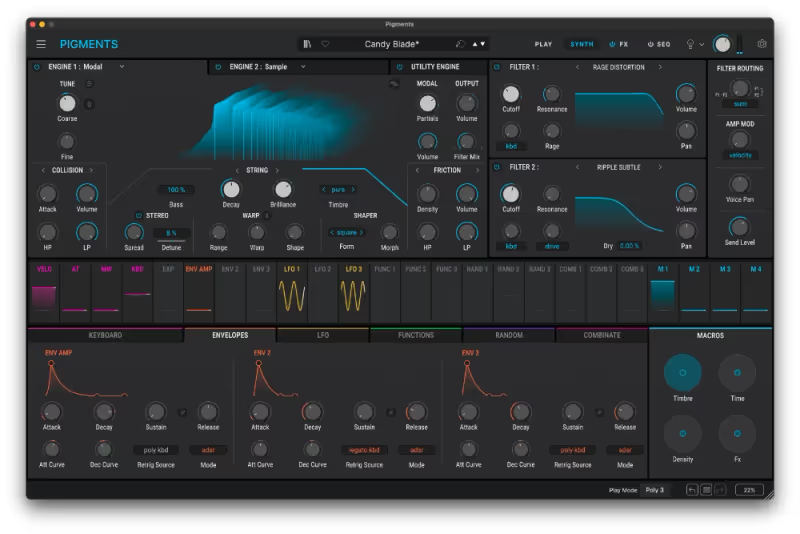
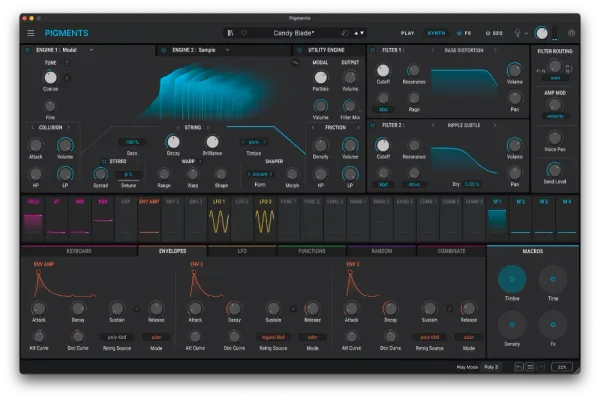
Pigments is a sound designer's dream primarily because it lets you see the chaos you are creating in real-time. For cyberpunk production, the "Granular" engine is the absolute star of the show. I love taking a clean, organic source-like a violin bow scrape or a vocal whisper-and disintegrating it into a cloud of metallic grains. It creates that specific "Blade Runner" holographic reverb effect where the sound feels like it's dissolving into rain. It turns the abstract concept of 'cyberpunk' into a tangible, playable texture.
The modulation system is color-coded and instant, which encourages happy sound morph from a clean sub-bass to a screaming metallic lead instantly. On a recent sci-fi short, I used the "Harmonic" engine to create a bell tone that slowly detuned over time, simulating a failing computer system, and it bridged the gap between musical note and sound effect perfectly. It allows for a level of expressiveness that static samples can never achieve.
Playing connects you to YouTube, which may set cookies.