

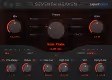
Best Convolution Reverbs (2026): Real Spaces

Real spaces are hard to beat. When algorithmic tails just won't glue your orchestra together, these convolution engines bring the actual sound of legendary halls into your DAW.

Last Updated: January 2026
Louis Raveton
By Louis Raveton

Louis works across immersive scores (Venice Biennale, LVMH) and animation (Canal+), while producing Downtempo and Electro-Dub as Monsieur Shwill and Flagada. He treats his sample drive like a record collection, constantly hunting for the perfect 'imperfect' texture

Algorithmic reverbs are fantastic for lush, artificial tails, but when you need to place a dry sample into a specific concert hall, nothing beats convolution. By using Impulse Responses (IRs): sonic fingerprints of real rooms: convolution reverbs allow you to "record" your VSTs in the world's most famous studios and cathedrals.

For composers, the best convolution reverbs for realistic spaces are essential for blending dry close mics with wet orchestral libraries. Whether you are matching dialogue for post-production or creating a unified room sound for a disparate sample template, finding the right scoring verbs for kontakt and other engines is key to a professional mix.

Quick Summary

  1. 1. Spaces II Best for Orchestral Mixing
  2. 2. VerbSuite Classics Best for Pop Mixing
  3. 3. IR1 Convolution Reverb Best for Sound Design
  4. 4. MConvolutionMB Best for Multiband FX
  5. 5. Convolver Best for Utility Mixing
  6. 6. Altiverb 7 Best for Post Production
  7. 7. Seventh Heaven Best for Lead Vocals
Read more →

Methodology

Who is this for

Working composers and producers who need reliability, speed, and character for professional scoring tasks.

Our testing process

We test every library in actual production scenarios—ranging from writing rapid sketches to delivering commercial pitches. We evaluate how they perform in a dense template, not just in isolation.

Why you should trust us

We buy most reviewed plugins ourselves. Occasionally we receive NFRs for evaluation, but this never guarantees a review or positive verdict. We may earn commissions from links, but our editorial choices are never for sale.

Also considered

For every category, we audition the top 8 to 15 standard options, discarding any that suffer from poor scripting, slow load times, or uninspiring sampling.

Top Picks

EastWest Sounds

Spaces II

Best For: Orchestral Mixing
Engine VST/AU/AAX
Type True Stereo Convolution
Size 20 GB
Price $89

The composer's standard for instant realism.

My Experience:
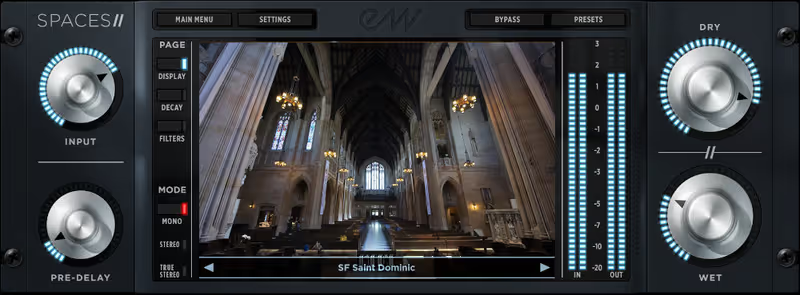
I have used Spaces II on almost every orchestral mock-up I have delivered in the last two years. Unlike other convolution engines that give you thousands of mediocre rooms, Spaces II focuses on a curated list of pristine, "True Stereo" locations. The hallmark of this plugin is the "S. Cal Hall" (a pseudonym for a very famous scoring stage), which instantly glues dry strings into a cohesive, Hollywood-sounding ensemble. It just works.

Deeper Look:
The interface is utilitarian but effective. You aren't meant to tweak these IRs heavily; you are meant to load them and mix. The "True Stereo" engine captures the complex interaction between source position and microphone array, meaning that panning an instrument into the reverb triggers the correct early reflections for that specific spot in the room. This makes it undeniably one of the best convolution reverbs for "setting and forgetting" an orchestral stage.

Spaces II

Our Verdict

Why we love it

Best for instantly gluing orchestral samples together because of its industry-standard hall IRs.

Who should skip

Skip this if you want to perform extreme sound design or heavily manipulate the envelopes of your reverb tails.

The Good
  • + Incredible True Stereo realism
  • + Zero-latency option for tracking
  • + Includes famous scoring stages
× The Bad
  • - Limited envelope shaping controls
  • - Large install size (several GBs)
  • - iLok required
Famous Uses:
Hollywood Film Scores AAA Game Soundtracks Trailer Music Mixing
Slate Digital

VerbSuite Classics

Best For: Pop Mixing
Engine VST/AU/AAX
Type Classic Hardware IRs
Size 10 GB
Price $149

The sound of the 80s and 90s hardware in one plugin.

My Experience:
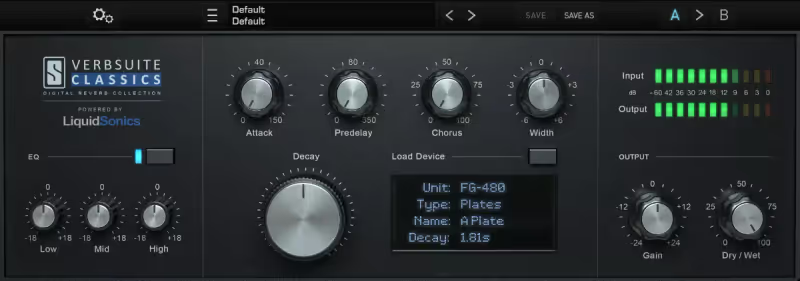
Verbsuite Classics is unique because instead of capturing real rooms, it captures the Impulse Responses of legendary hardware units like the Lexicon 480L and the Bricasti M7. In my mixing template, this is my go-to for adding that specific "glossy" sheen that you hear on top 40 records. It manages to bridge the gap between the static nature of convolution and the modulation of algorithmic units using LiquidSonics' Fusion IR technology.

Deeper Look:
The workflow is incredibly fast. You select a hardware model (like the "FG-480") and then browse its presets. The "Fusion IR" tech is the real winner here; standard convolution can often sound static or "frozen," but Verbsuite captures the evolving modulation of the original hardware tails. It is indispensable for pop vocals and drums where you want the character of a vintage box without the hassle of maintenance.

Why we love it

Best for pop and rock mixing because it gives you the sound of ten legendary hardware units in one interface.

Who should skip

Skip this if you specifically need the sound of realistic concert halls or post-production foley spaces.

The Good
  • + Access to Bricasti M7 sounds
  • + Modulated tails sound alive
  • + Very simple interface
× The Bad
  • - Not designed for post-production
  • - Requires iLok
  • - Limited parameter tweaking
Famous Uses:
Modern Pop Vocals Rock Drums Electronic Music
Waves

IR1 Convolution Reverb

Best For: Sound Design
Engine VST/AU/AAX
Type Standard Convolution
Size 4 GB
Price $129

A flexible workhorse that has stood the test of time.

My Experience:
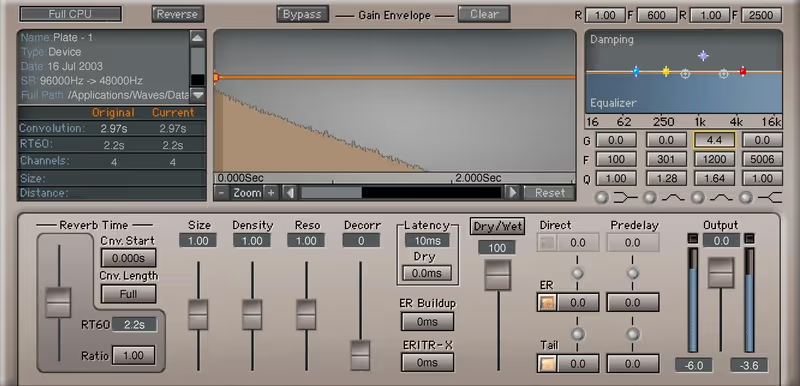
The Waves IR1 has been around for a long time, but it remains a staple in many studios because of its efficiency and control. While newer plugins focus on massive libraries or 3D positioning, IR1 gives you traditional ADSR controls over the impulse response itself. I often use this when I have a weird, specific IR (like a vacuum cleaner tube or a resonant glass jar) that I want to capture and then sculpt into a musical envelope.

Deeper Look:
One of the strongest features is the ability to import your own IRs and then manipulate their length and shape easily. It’s less about "putting you in a hall" and more about using convolution as a sound design tool. It’s light on CPU, comes with a decent library of famous venues (like the Sydney Opera House), and is constantly on sale, making it a great entry point for convolution mixing.

Why we love it

Best for sound design and sculpting because it allows extensive ADSR manipulation of the impulse response.

Who should skip

Skip this if you want the absolute cutting-edge in 3D realistic room simulation.

The Good
  • + Very low CPU usage
  • + Detailed envelope shaping
  • + Import custom IRs easily
× The Bad
  • - Dated interface
  • - Stock library counts are lower
  • - Waves Update Plan usually required
Famous Uses:
Electronic Music Production Broadcast Mixing Legacy Sessions
MeldaProduction

MConvolutionMB

Best For: Multiband FX
Engine VST/AU/AAX
Type Creative Multiband
Size 500 MB
Price $22

The most flexible convolution tool for creative sound design.

My Experience:
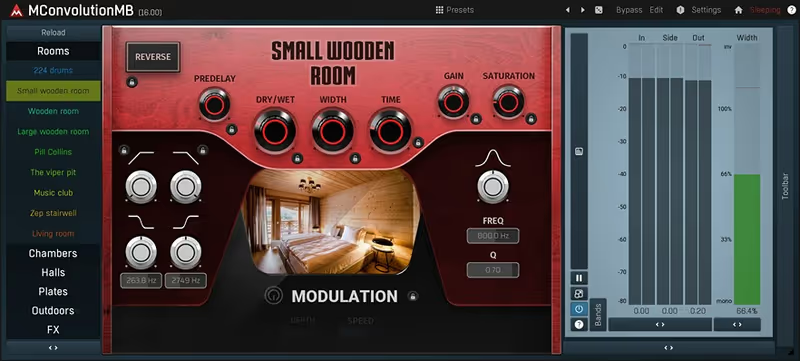
MeldaProduction plugins are known for being bottomless pits of features, and MConvolutionMB is no exception. This isn't just a reverb; it's a multiband processor where you can apply different IRs to different frequency bands. I use this for creative sound design: for example, putting a massive lush hall on the high end of a synth while keeping the bass completely dry or running it through a tight, muffled room IR.

Deeper Look:
The plugin comes with a surprisingly good library of natural and artificial spaces, but the real power is the modulation system. You can modulate the reverb parameters with LFOs, envelope followers, and randomizers. If you are a sound designer looking to create textured, evolving drones or unique spatial effects that realistically change over time, this is the best convolution reverb for your toolkit.

MConvolutionMB

Our Verdict

Why we love it

Best for creative sound design because of its multiband architecture and endless modulation options.

Who should skip

Skip this if you get overwhelmed by complex interfaces and just want a simple 'hall' knob.

The Good
  • + Multiband processing is unique
  • + Extremely customizable
  • + Huge library of IRs
× The Bad
  • - Steep learning curve
  • - UI is cluttered
  • - Overkill for simple mixing
Famous Uses:
Game Sound Design Experimental Electronic Complex Mixing
Kilohearts

Convolver

Best For: Utility Mixing
Engine VST/AU/AAX
Type Snapin Convolution
Size 100 MB
Price $39

Simple, fast, and light as a feather.

My Experience:
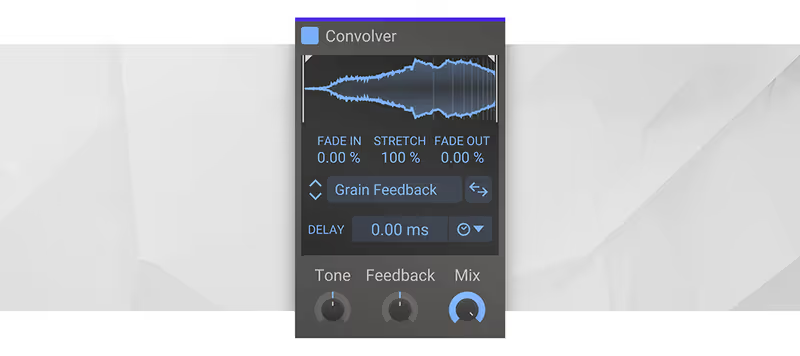
Sometimes you don't need a massive 50GB library; you just need to load an IR and keep moving. Convolver is my favorite utility reverb. It loads instantly, uses almost no CPU, and lets me drag and drop any sample to use as an IR. I use this heavily within Kilohearts' Snap Heap or Phase Plant to add body to synths or to create spectral resonances by loading samples of metallic textures as IRs.

Deeper Look:
The interface is tiny but functional. You have start and end controls, a stretch parameter (which is great for pitch-shifting the room tone), and a tone EQ. It’s not meant to compete with Altiverb for film scoring realism; it is meant to be a creative workhorse for electronic producers and sound designers who treat reverb as part of the synthesis process.

Convolver

Our Verdict

Why we love it

Best for fast creative workflows because of its lightweight CPU footprint and drag-and-drop simplicity.

Who should skip

Skip this if you are mixing a 100-piece orchestral score and need true stereo positioning for every section.

The Good
  • + Incredibly lightweight
  • + Snapin integration is great
  • + Dead simple to use
× The Bad
  • - Very basic library
  • - No true stereo or positioning
  • - Basic visualizer
Famous Uses:
Phase Plant Patch Design EDM Production Glitch & IDM
Audio Ease

Altiverb 7

Best For: Post Production
Engine VST/AU/AAX
Type Post-Production IRs
Size 7 GB
Price Check Site

If you work in post, you simply need this.

My Experience:
Altiverb is legendary for a reason. In post-production, when I need to place ADR dialogue into the backseat of a 2004 Toyota Camry or a massive cathedral, Altiverb is the only plugin that has the specific IRs to do it convincingly. The library is massive and painstakingly recorded. It is the gold standard for matching production audio and creates the most convincing "real" spaces I have ever heard.

Deeper Look:
Beyond the library, the "Stage Position" tool is incredibly useful for orchestral composers. You can drag your sound source around the room in the GUI, and the engine adjusts the early reflections and delay times accordingly. While it is one of the most expensive plugins on this list, it is an investment in unparalleled realism vs lower-end alternatives. The browser is also excellent, letting you find rooms by size, brightness, or reverberation time.

Altiverb 7

Our Verdict

Why we love it

Best for post-production and film sound because of its unmatched library of real-world static spaces.

Who should skip

Skip this if you are a bedroom producer on a budget, as the price tag is significantly higher than the competition.

The Good
  • + Unrivaled library depth
  • + Excellent positioning tool
  • + Regular free IR updates
× The Bad
  • - Very extremely expensive
  • - Dongle often required
  • - GUI is showing its age
Famous Uses:
Major Motion Pictures TV Dialogue Editing Orchestral Mockups
LiquidSonics

Seventh Heaven

Best For: Lead Vocals
Engine VST/AU/AAX
Type Bricasti M7 IRs
Size 10 GB
Price Check Site

The closest you can get to a $4,000 hardware unit.

My Experience:
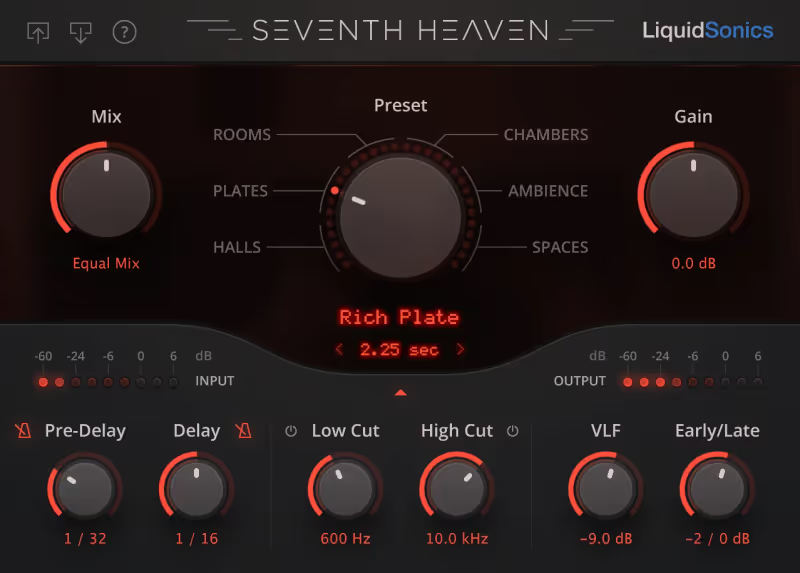
The Bricasti M7 is arguably the best-sounding hardware reverb ever made, renowned for its lush, dense tails that never muddy a mix. Seventh Heaven is not just a collection of samples; it captures the exact behavior of the M7. I use this on almost every lead vocal and piano track. It provides a sense of depth and three-dimensionality that even other high-end convolution reverbs struggle to match.

Deeper Look:
LiquidSonics uses the same "Fusion IR" technology found in Slate's plugin (they developed it), but Seventh Heaven goes much deeper into the Bricasti architecture. You get control over the very specific low-frequency decay times and roll-offs that make the hardware so coveted. It is an essential tool for anyone who wants that expensive "sheen" on their tracks without buying the physical rack unit.

Seventh Heaven

Our Verdict

Why we love it

Best for vocals and main instruments because it perfectly replicates the dense, lush sound of the Bricasti M7.

Who should skip

Skip this if you prefer gritty, vintage spring or plate sounds; this is all about pristine modern luxury.

The Good
  • + Indistinguishable from hardware
  • + Beautiful, modern interface
  • + More affordable than hardware
× The Bad
  • - Only does one thing (M7)
  • - Can be CPU intensive
  • - iLok required
Famous Uses:
Grammy-winning mixes Orchestral Halls Ambient textures
Written By

Louis Raveton

Louis works across immersive scores (Venice Biennale, LVMH) and animation (Canal+), while producing Downtempo and Electro-Dub as Monsieur Shwill and Flagada. He treats his sample drive like a record collection, constantly hunting for the perfect 'imperfect' texture