

The MGM Scoring Stage room tone baked into every sample makes this the easiest cello to blend into a dense orchestral mix, at the cost of never sounding truly dry.
How it scored
- Realism 8.5
The room tone and Adaptive True Legato are convincing.
- Legato & Playability 8.0
Adaptive engine reads phrasing speed. Minimal keyswitching.
- Mic Options 6.5
The MGM room is baked in. Limited control over the space.
- CPU & RAM Footprint 5.0
40 GB. The largest library in this roundup.
Why we picked it
Best for traditional cinematic scoring where blending with an orchestra is key.
Who should skip it
Skip this if you need dry studio samples. The MGM room sound is baked in.
The good
- Legendary MGM room tone
- Adaptive Legato is smart
- Great orchestral blend
The bad
- Hard to get 'dry'
- Vibrato control is limited
- Older interface
- Engine
- Kontakt Player
- Type
- Cinematic Solo
- Size
- 40 GB
- Price
- $399
Why it scored that way
The sound of Hollywood's golden age.
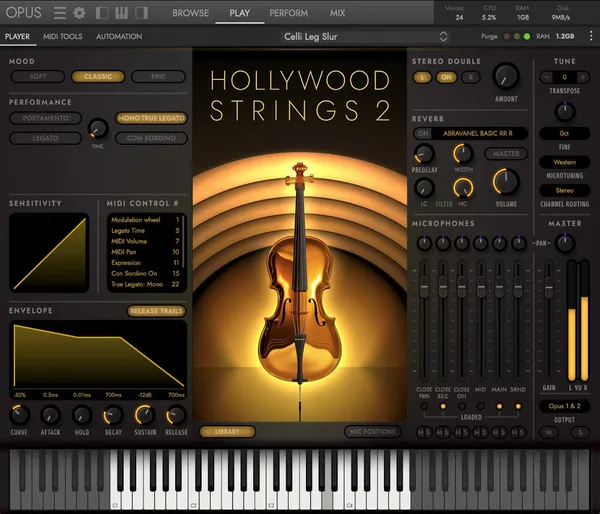
My Experience: If you want the specific acoustic signature of your favorite film scores, this is it. Recorded at the MGM Scoring Stage (Sony Pictures), CineStrings Solo carries that unmistakable "Hollywood" room sound in every sample. The cello patch is robust and focused. What makes it stand out is the "Adaptive True Legato" engine. It feels surprisingly intelligent: if I play fast, it triggers agile intervals. If I play slow, it drags the bow with emotion. It doesn't require constant keyswitching to interpret my phrasing correctly.
Deeper Look: The "Infinite Bow" feature is a lifesaver for long, tension-building pads where you don't want to hear a bow change. I also love the "Hairpin" creator, which allows you to program realistic crescendos and decrescendos automatically. While it may not have the hyper-detailed "fragility" of Emotional Cello, it sits in a dense orchestral mix better than almost anything else because the room tone is just so perfect and familiar.
Playing connects you to YouTube, which may set cookies.