

Best Cinematic Synths (2026): Hybrid Scoring & Sound Design

If you want to score the next 'Dune', a preset surfer won't cut it. You need synthesis that breathes with the picture.

Last Updated: January 2026
Louis Raveton
By Louis Raveton

Louis works across immersive scores (Venice Biennale, LVMH) and animation (Canal+), while producing Downtempo and Electro-Dub as Monsieur Shwill and Flagada. He treats his sample drive like a record collection, constantly hunting for the perfect 'imperfect' texture

Let's be blunt: modern film scoring is 50% orchestra and 50% synth patch that sounds like a dying whale in a cathedral. If you are still relying solely on Kontakt strings to carry your emotional weight, you are fighting with one hand tied behind your back. The best cinematic synths aren't just about buzzsaw leads or EDM drops; they are texture generators, atmosphere builders, and sub-bass monsters that glue your live players together.

I have spent the last decade chasing the ghost of Vangelis and the shadow of Zimmer. I have bought every plugin that promised "instant cinematic depth," and most of them just clogged my SSD with 4GB of useless whooshes. The synths on this list are the ones that actually stayed in my template. They offer the modulation depth to evolve over a 2-minute cue without boring the director to tears. Whether you need hybrid scoring textures or analog warmth for sci-fi, these are the tools that pay the rent.

Quick Summary

  1. 1. Pigments 7 Best for Hybrid Scoring
  2. 2. Analog Lab Pro Best for Vintage Textures
  3. 3. Signal Best for Tension Underscore
  4. 4. Omnisphere 2 Best for Everything
  5. 5. Diva Best for Nostalgic Scores
  6. 6. Serum Best for Sound Design
  7. 7. Zebra HZ Best for Action Trailers
Read more →

Methodology

Who is this for

Working composers and producers who need reliability, speed, and character for professional scoring tasks.

Our testing process

We test every library in actual production scenarios—ranging from writing rapid sketches to delivering commercial pitches. We evaluate how they perform in a dense template, not just in isolation.

Why you should trust us

We buy most reviewed plugins ourselves. Occasionally we receive NFRs for evaluation, but this never guarantees a review or positive verdict. We may earn commissions from links, but our editorial choices are never for sale.

Also considered

For every category, we audition the top 8 to 15 standard options, discarding any that suffer from poor scripting, slow load times, or uninspiring sampling.

Top Picks

Arturia

Pigments 7

Best For: Hybrid Scoring
Engine VST/AU/AAX
Type Polychrome Synth
Size 4 GB
Price $99

The modern modulation powerhouse.

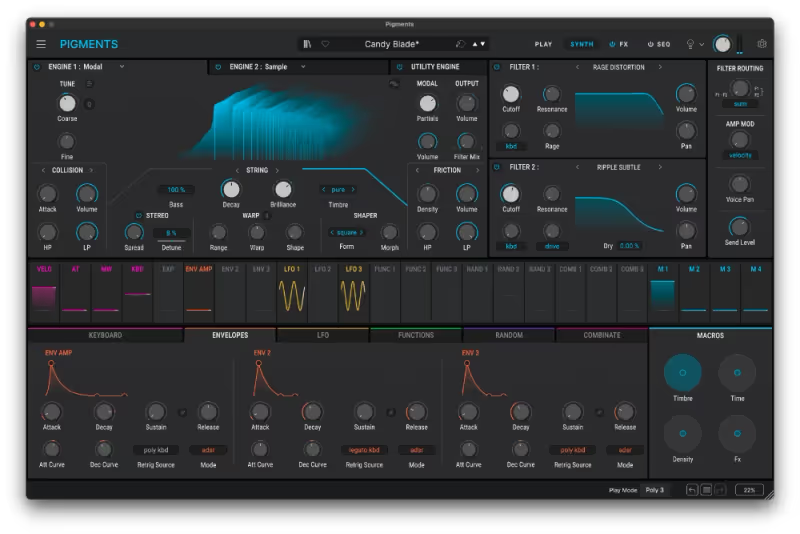
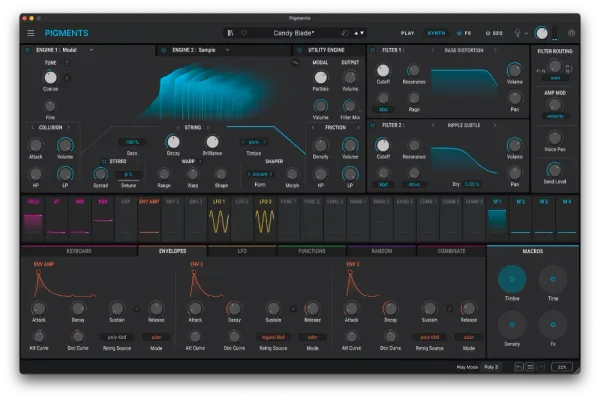
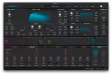
Pigments has rapidly become the Swiss Army knife of my scoring template. While everyone else was arguing about analog authenticity, Arturia quietly built a machine that makes motion effortless. The visual feedback on the modulation routing is technically brilliant; you can see exactly what your LFO is doing to that wavetable position, which stops you from staring blankly at a static patch wondering why it sounds dead. I used this recently on a short film that needed 'cyberpunk but organic,' and the granular engine let me turn a cello recording into a terrifying, glitchy wash that sat perfectly under dialogue.

It is not just about the flashy visuals, though the interface effectively prevents menu-diving headaches. The harmonic engine is a secret weapon for creating bell-like, glass tones that cut through a dense orchestral mix without fighting the violins. It is clean, precise, and incredibly CPU efficient for what it does. If you are tired of synths that sound like they are trying too hard to be huge, Pigments offers a refreshing level of detail and control. It is less about instant 'trailer impact' and more about intricate, evolving textures that keep a scene interesting.

Pigments 7

Our Verdict

Why we love it

Best for modern, evolving sound design because the visual modulation system makes complex motion easy to program.

Who should skip

Avoid if you want a simple 'preset player' without any desire to tweak parameters.

The Good
  • + Incredible visual feedback
  • + Deep granular engine
  • + Versatile synthesis types
× The Bad
  • - Can be CPU heavy in granular mode
  • - Library is huge to download
  • - Complex interface for beginners
Famous Uses:
Modern Game Scores Electronic Underscore Sound Design
Arturia

Analog Lab Pro

Best For: Vintage Textures
Engine VST/AU/AAX
Type Preset Collection
Size 4 GB
Price $199

The ultimate preset browswer.

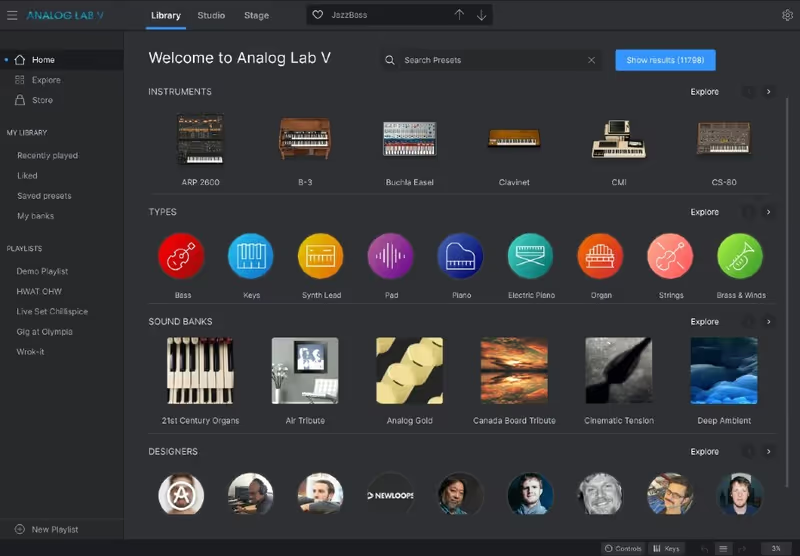
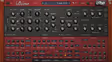
Sometimes you don't have time to program a patch from scratch because the director just changed the scene from 'hopeful' to 'tragic' and needs the cue in an hour. That is where Analog Lab Pro saves my life. It is effectively a curation of the greatest hits from synthesis history-CS-80s, Jupiters, Prophets-: all mapped to a unified interface. I treat this as my 'ideation' machine. I can flick through thirty different pad textures in a minute, find one that inspires the melody, and hit record.

The limitation is obviously that you are tweaking macros rather than the deep synth architecture, but in a deadline crunch, that restriction is a feature, not a bug. You are not getting stuck in an LFO matrix; you are writing music. The sound quality is identical to the full V Collection instruments, which means you get that authentic, drifting analog behavior that warms up a cold digital mix. For adding vintage flavor to a modern score without the hassle of patching cables, it is indispensable.

Analog Lab Pro

Our Verdict

Why we love it

Best for rapid sketching and finding vintage colors quickly without deep editing.

Who should skip

Avoid if you need deep, surgical control over every synthesis parameter.

The Good
  • + Massive sonic variety
  • + Instant load times
  • + Uniform macro controls
× The Bad
  • - Limited editing depth
  • - Can settle for 'good enough' presets
  • - No deep synthesis control
Famous Uses:
TV Drama Pop Production Retro Scoring
Output

Signal

Best For: Tension Underscore
Engine Kontakt Player
Type Pulse Engine
Size 20 GB
Price $99

The pulse engine king.

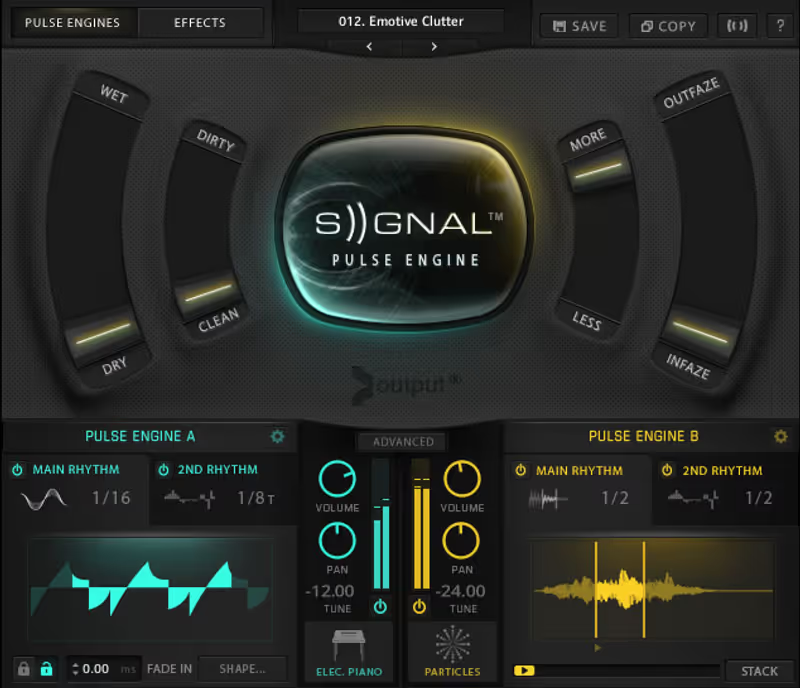
Signal stops you from writing boring, static root notes. In cinematic music, momentum is everything, and Signal is basically 'momentum in a box.' It combines fat analog synths with organic instruments like harps and guitars, then forces them through a dual-rhythm engine that creates complex, interlocking pulses. I use this constantly for underscore - those scenes where characters are just walking and talking, but the audience needs to feel a sense of urgency. You hold one note, and suddenly the scene has forward motion.

What I appreciate most is the macro system. The presets are designed with four distinct 'states' that you can slide between, meaning you can automate the intensity of the pulse over time. It creates dynamic shape without needing to automate twenty different filter cutoffs manually. It is admittedly a 'preset machine' and can sound a bit recognizable if you don't tweak it, but for laying down a bed of rhythmic tension that sits under dialogue without getting in the way, it is incredibly effective.

Signal

Our Verdict

Why we love it

Best for creating instant rhythmic tension and underscore beds.

Who should skip

Avoid if you need a traditional synthesizer for leads or basses.

The Good
  • + Instantly useful rhythms
  • + Great macro control
  • + Organic/Synth blends
× The Bad
  • - Can sound same-y
  • - Heavy on RAM
  • - Limited melody capability
Famous Uses:
Reality TV Crime Thrillers Documentaries
Spectrasonics

Omnisphere 2

Best For: Everything
Engine VST/AU/AAX
Type Power Synth
Size 60 GB
Price 0

The industry standard for a reason.

You knew this was coming. Omnisphere is the 800-pound gorilla of the film scoring world, and frankly, you can't really ignore it. The library is so absurdly vast that you could score entire careers using nothing else. From granular psychoacoustics to burning burning pianos, it covers every sonic food group. I admit I have a love-hate relationship with it; the library is so huge that browsing can kill your vibe, but when you find that patch: the one that sounds like a choir of angels inside a jet engine: you forgive it immediately.

Where it truly excels is in its 'psychoacoustic' sound sources. Spectrasonics went to the trouble of sampling burning pianos and stalactites, giving you textures that feel organic and real, unlike pure mathematical synthesis. I use it primarily for 'beds': giant, atmospheric pads that fill the frequency spectrum and establish the mood of a cue instantly. It is expensive, it eats hard drive space for breakfast, but it is also the most professional-sounding instrument available. It just works.

Omnisphere 2

Our Verdict

Why we love it

Best for massive, evolving atmospheres and having a limitless palette of sounds.

Who should skip

Avoid if you have limited hard drive space or a slow computer.

The Good
  • + Unmatched library depth
  • + Hardware synth control
  • + Incredible audio quality
× The Bad
  • - Expensive
  • - Overwhelming browser
  • - Massive disk space required
Famous Uses:
Every Blockbuster TV Scoring Game Audio
u-he

Diva

Best For: Nostalgic Scores
Engine VST/AU/AAX
Type Virtual Analog
Size 50 MB
Price $179

The closest you'll get to real hardware.

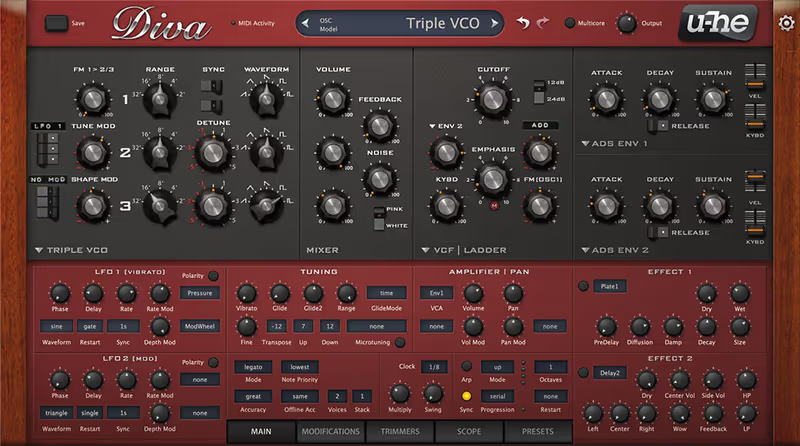
Digital synths often sound 'plastic': too clean, too perfect. Diva is the antidote to that. It models the actual electrical components of classic synths (Minimoog, Jupiter-8, Juno-60) and allows you to mix and match them. It is hungry; it eats CPU cycles like I eat studio catering. But the sound is worth it. It has that thick, creamy low-mid weight that usually only comes from expensive hardware. I use it for leads and basses where the synth needs to be the main character, not just background texture.

The 'Trimmer' page allows you to detune voices and add slop, mimicking the behavior of aging circuits. This is crucial for emotional scoring. A perfectly tuned oscillator sounds cold; a slightly drifting one sounds human. When I need a simple, poignant synth melody that feels nostalgic and warm: like something from a A24 film: Diva is the first thing I reach for. It doesn't have a million features, but it does one thing perfectly: it sounds real.

Diva

Our Verdict

Why we love it

Best for authentic, warm analog tones that need to sit prominently in the mix.

Who should skip

Avoid if you are running an older computer with limited CPU power.

The Good
  • + Best-in-class analog sound
  • + Mix and match filter types
  • + Beautiful interface
× The Bad
  • - Very CPU intensive
  • - No modern wavetables
  • - Pricey
Famous Uses:
Stranger Things Style Synthwave Modern Drama
Xfer Records

Serum

Best For: Sound Design
Engine VST/AU/AAX
Type Wavetable Synth
Size 200 MB
Price 0

The visual learning tool.

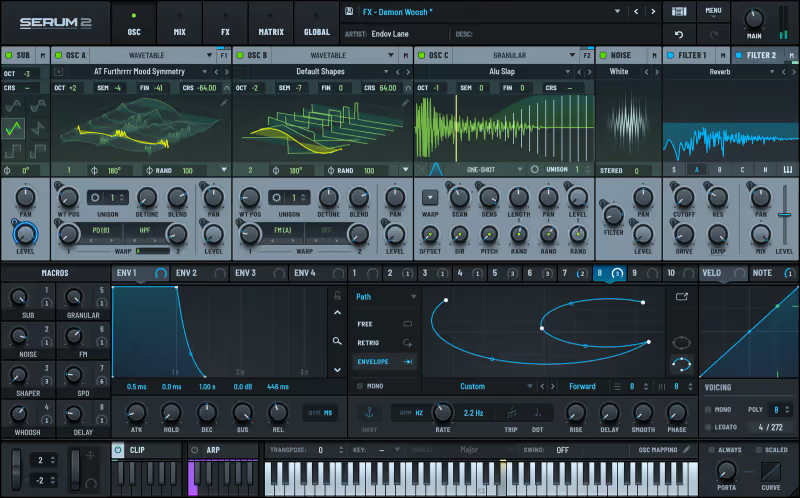
Serum is often pigeonholed as a 'dubstep synth,' which is unfair. Yes, it can make aggressive growls, but its true power lies in its transparency. It is the cleanest, most surgical synth on the market. In a cinematic context, I use it for 'ear candy': precise, technical sounds like UI effects, high-frequency plucks, and robotic textures. The ability to import your own audio as a wavetable means you can turn a recording of a violin bow scrape into a playable, pitch-tracked instrument.

The visual feedback is unmatched. Being able to see the waveform warp in real-time teaches you synthesis better than any textbook. It is incredibly snappy and stable; I have never had it crash a session. While it lacks the 'warmth' of Diva or the 'grit' of Zebra HZ right out of the box, expansive third-party preset libraries can push it into cinematic territory. It is a workhorse utility synth that handles the precise, digital side of your score with absolute clarity.

Serum

Our Verdict

Why we love it

Best for surgical sound design and creating custom wavetables from audio.

Who should skip

Avoid if you are looking for instant vintage warmth without processing.

The Good
  • + Visual workflow is genius
  • + Import your own audio
  • + Massive user community
× The Bad
  • - Can sound cold/digital
  • - Filters can be harsh
  • - Steep learning curve
Famous Uses:
Electronic Music Sci-Fi Films Game UI
u-he

Zebra HZ

Best For: Action Trailers
Engine VST/AU/AAX
Type Semi-Modular
Size 200 MB
Price 0

The literal sound of Batman.

If you are chasing the Hans Zimmer sound, stop looking for 'epic' sample libraries and just buy the synth he actually uses. Zebra HZ is the steroid-injected cousin of standard Zebra, featuring Diva filters that add a gritty, analog weight to the otherwise pristine digital engine. I have this loaded in every single action template I own. The ability to route signal through those darker, nonlinear filters turns a simple saw wave into a menacing, brass-like growl that shakes the subwoofer. It feels weighty in a way that most soft synths simply don't.

The workflow is admittedly a bit dense; it looks like a spreadsheet from 2005. But once you get past the utilitarian GUI, the sound is undeniable. I rely on it for those pulsing, rhythmic bass lines that need to lock in with orchestral cellos. Unlike newer, flashier synths that rely on loads of reverb to sound big, Zebra HZ sounds massive completely dry. It pushes air. It is not the prettiest plugin to look at, but when you need that specific, Hollywood blockbuster darkness, nothing else sounds quite as authoritative.

Zebra HZ

Our Verdict

Why we love it

Best for dark, cinematic action scores because it combines digital precision with analog-modeled filter grit.

Who should skip

Avoid if you are intimidated by complex, modular-style routing matrices.

The Good
  • + Unbeatable analog filter sound
  • + Huge low-end weight
  • + Used on endless blockbusters
× The Bad
  • - Interface is dated
  • - Steep learning curve
  • - Not NKS native
Famous Uses:
The Dark Knight Rises Dune Blade Runner 2049
Written By

Louis Raveton

Louis works across immersive scores (Venice Biennale, LVMH) and animation (Canal+), while producing Downtempo and Electro-Dub as Monsieur Shwill and Flagada. He treats his sample drive like a record collection, constantly hunting for the perfect 'imperfect' texture