Best Epic Brass VSTs (2026): Trailer & Action

If your neighbors aren't complaining, your brass isn't loud enough. In the world of trailer music, subtlety is the enemy. You need a Wall of Sound.

Louis Raveton
By Louis Raveton Composer & Lead Editor at MODWHEEL

ModWheel is reader-supported. When you buy through links on this page we may earn an affiliate commission, at no extra cost to you. This never influences which products we recommend, read our testing methodology.

Prices come from the store's own feed and were last checked 1 September 2026. We don't issue discount codes — the price you see is the store's own.

Pick one in 10 seconds

Short version

Compare all 9

CineBrass Core 8.5
Engine
Kontakt Player
Type
Cinematic Brass
$259 $399 View price
CineBrass Pro
2. CineBrass Pro Cinesamples
7.9
Engine
Kontakt Player
Type
Low Brass Expansion
$259 $399 View price
Engine
Kontakt Player
Type
Hybrid Brass
Engine
Kontakt Player
Type
Hybrid Synth/Brass
Engine
Kontakt Player
Type
Orchestral Brass
$59 $99 View price
Engine
Opus Engine
Type
Full Orchestra
$239 $399 View price
7. Trailer Brass Audio Imperia
7.9
Engine
Kontakt Player
Type
Processed Brass
8. Symphobia 1 ProjectSAM
7.8
Engine
Kontakt Player
Type
Ensemble Effects
9. Jäger Audio Imperia
7.2
Engine
Kontakt Player
Type
Full Orchestra

Let's be honest: you aren't looking for a p dynamic layer. You want the BRAAAM. You want twelve french horns blasting at full lung capacity until the microphone diaphragm gives up.

Epic brass is not about realistic concert hall balance. It is about hyper-realism. It needs to be wide, saturated, and punchy enough to cut through a mix of hybrid synths and impacts. We tested the heaviest brass libraries on the market to see which ones can actually deliver the goods without sounding like a cheap keyboard.

Brass is one department of a trailer cue rather than the commission. Best VST Libraries for Trailer Music (2026) covers the all-in-one libraries built for the whole thing.

Brass and choir do the same job in a trailer cue and compete for the same space when both are wide open, because the low male voices sit exactly where the horns and trombones already are. The usual fix is to give each a register rather than more level. Best Epic Choirs (2026): Trailer Vocals covers the second half of that pairing.

Top Picks

01 Cinesamples

CineBrass Core

Best for Blockbuster Films

The most recognisably cinematic brass here, in a room you are not permitted to leave.

Score
8.5
out of 10

How it scored

  • Dynamic Range 8.5

    Holds together at fff without turning to noise.

  • Attack Speed 8.0

    Shorts are tight. The adaptive legato is the real achievement.

  • Tone 9.4

    The literal Hollywood sound. Best on this page.

  • Footprint 8.0

    11 GB under Kontakt Player, with the room baked in.

Why we picked it

Best for composers who want the literal sound of Hollywood films.

Who should skip it

Skip this if you want a dry, controlled sound. The room is baked in.

The good

  • The perfect room sound
  • Adaptive legato is magic
  • Twelve Horns patch

The bad

  • Baked-in room reverb
  • Can be expensive
  • Older GUI
Engine
Kontakt Player
Type
Cinematic Brass
Size
11 GB
Price
$259
Why it scored that way

The definitive Hans Zimmer tone.

My Experience: If you check the template of any working composer in LA, CineBrass is in there. Why? Because it was recorded at the Sony MGM Scoring Stage, which is arguably the best-sounding room in the world. It has that sound immediately. You play a triad, and it sounds like a $100 million movie. The "Twelve Horn Ensemble" patch is legendary for a reason. It is wide, noble, and ridiculously loud. It captures that golden age Hollywood sound that simply cannot be replicated with artificial reverb.

Deeper Look: The scripting is effortless. The "CineSymphony" map means you don't even need keyswitches. It detects your playing speed to switch between legato and shorts. It saves me hours of MIDI programming. Core is the one to start with, since it covers horns, trombones, trumpets and tuba in the ensemble and solo patches most cues actually need. It is not the newest library, but it is unmatched for pure tone. It remains the gold standard against which all other brass libraries are measured.
Heard on
Every modern action movie Avengers trailers AAA Games
Check price $259 (was $399)
02 Cinesamples

CineBrass Pro

Best for Trailer Cues

Not tested by us, assessed from specs and documented behaviour

The best low brass weight on this list, sold at full price to people who must already own Core.

Assessed score
7.9
out of 10

How it scored

  • Dynamic Range 9.0

    Monster Low Brass at fff is the reason this exists.

  • Attack Speed 7.5

    Low brass is slow by nature and this does not pretend otherwise.

  • Tone 9.0

    Same room and scripting as Core, so it layers seamlessly.

  • Footprint 6.0

    Not standalone. Budget for Core alongside it.

Why we picked it

Best for trailer and action composers who need low brass weight rather than melodic range.

Who should skip it

Skip this if you do not already own Core, since the ensemble patches live there.

The good

  • Monster Low Brass is genuinely huge
  • Same room and scripting as Core
  • Fills the bottom octave properly

The bad

  • Not a standalone library
  • Same price as Core
  • Narrower use case
Engine
Kontakt Player
Type
Low Brass Expansion
Requires
CineBrass Core recommended
Price
$259
Why it scored that way

The growl that Core deliberately leaves out.

My Experience: Pro is not a replacement for Core, it is the second half of the same library, and the distinction matters because they cost the same. Core gives you the noble, wide Hollywood ensemble. Pro is where the "Monster Low Brass" patches live, which are the growling, earth-shaking bottom notes that a trailer cue leans on when the picture needs weight rather than melody. Buying Pro first leaves you without the ensemble patches most cues open with.

Deeper Look: The same MGM room and the same CineSymphony scripting carry across, so nothing about the workflow changes when you add it. What you gain is range at the bottom and a set of aggressive, low-register articulations that Core simply does not contain. If your work is trailer and action rather than traditional orchestral scoring, this is the expansion that earns its price fastest. If you write mostly melodic brass, Core alone will serve you for a long time.

Heard on
Trailer houses Action scoring AAA Games
Check price $259 (was $399)
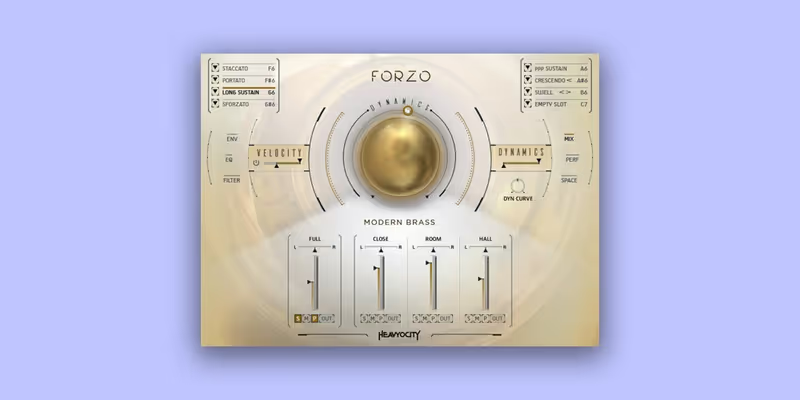
03 Heavyocity

FORZO Modern Brass

Best for Trailer Design

The fastest route to trailer tension here and no help at all if the cue needs a tune.

Score
7.8
out of 10

How it scored

  • Dynamic Range 9.2

    Built to be pushed. Aggressive all the way to the top.

  • Attack Speed 8.8

    Shorts are sharp, and the loop engine adds rhythm you did not program.

  • Tone 7.5

    Very specific and very modern. Traditional writing will fight it.

  • Footprint 5.5

    16 GB and demanding once the sound design layers are running.

Why we picked it

Best for trailer composers who need to generate tension and braaams quickly.

Who should skip it

Skip this if you need to write a traditional John Williams-style melody.

The good

  • Incredible sound design tools
  • Rhythmic loop engine
  • Very aggressive tone

The bad

  • Not for traditional melody
  • Very specific sound
  • CPU intensive
Engine
Kontakt Player
Type
Hybrid Brass
Size
16 GB
Price
$549
Why it scored that way

Half orchestra, half synthesizer.

My Experience: Heavyocity doesn't make "traditional" instruments. They make weapons. Forzo captures a massive brass section, but then runs it through their "Evolve" engine. This allows you to mangle the organic samples into rhythmic pulses, distorted pads, and cinematic risers. It is my secret weapon for "hybrid" scores where orchestral brass needs to blend with synths. It essentially turns the brass section into a massive, breathing synthesizer that retains organic weight.

Deeper Look: The core orchestral patches are surprisingly good. Very punchy and aggressive. They lack the noble legato of CineBrass, but they make up for it with sheer aggression. But the "Loop Designer" is the star. You can instantly create complex, syncopated brass rhythms that would take hours to program manually. It fills the frequency spectrum in a way standard libraries can't. It is designed for maximum impact with minimal fuss, perfect for modern trailer workflows.

Playing connects you to YouTube, which may set cookies.

Heard on
Sci-Fi Scores Horror Trailers Hybrid Action
Check price $549
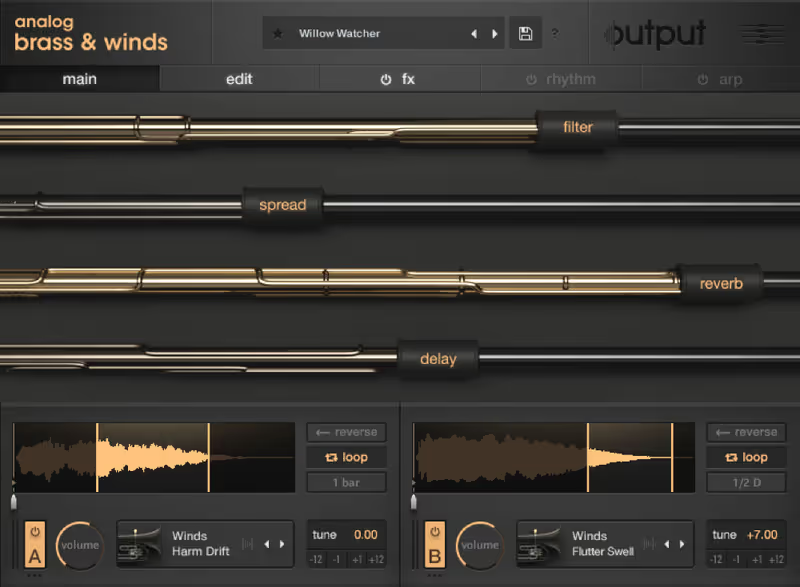
04 Output

Analog Brass & Winds

Best for Hybrid Trailers

A hybrid instrument that happens to contain brass, which makes it inspiring to write with and wrong for an orchestral cue.

Score
7.0
out of 10

How it scored

  • Dynamic Range 7.0

    Synth layers cap out before real brass would. Not an fff library.

  • Attack Speed 8.0

    The loop engine handles rhythm better than the samples handle shorts.

  • Tone 7.5

    Genuinely fresh, and audibly not an orchestra.

  • Footprint 5.5

    17 GB and CPU-hungry with the engine running.

Why we picked it

Best for hybrid scoring and sound design-heavy tracks.

Who should skip it

Skip this if you want a purely traditional orchestral sound.

The good

  • Unique hybrid sound
  • Incredible loop engine
  • Fresh and modern

The bad

  • Not for traditionalists
  • CPU intensive
  • Large library
Engine
Kontakt Player
Type
Hybrid Synth/Brass
Size
17 GB
Price
$199
Why it scored that way

The sound of modern hybrid scoring.

My Experience: Output changed the game with this library. It isn't just samples. It is a sound design engine. They sampled an 18-piece brass section at the dizzying BMC Hall in Budapest, but they also sampled legendary synths like the CS-80 and Oberheim. The result is "Analog Brass & Winds". A tool that lets you blend raw organic power with fat analog grit. I use this for "Tenet" style scores where you can't tell if the sound is a horn or a synthesizer. It is unique, fresh, and incredibly inspiring.

Deeper Look: The reverse engine is fantastic for creating tension swells that lead into a drop. The "Flux" sequencer allows you to create rhythmic pulses that lock to your DAW tempo, turning a simple chord into a driving action bed. It breaks the rules of traditional orchestration, which is exactly why it fits so well in modern trailers. If you want to sound different from the "standard" Hollywood mockup, this is your secret weapon.

Heard on
Tenet Style Scores Modern TV Drama Electronic Fusion
Check price $199
05 Soundiron

Hyperion Brass Elements

Best for Pop/Epic Production

The best brass per pound on this page, from a section small enough that you will hear where the money went.

Score
8.1
out of 10

How it scored

  • Dynamic Range 7.0

    A smaller section runs out of weight before the big libraries do.

  • Attack Speed 8.8

    Genuinely agile. Shorts are punchy and the legato keeps up.

  • Tone 7.5

    Drier and more modest. Takes reverb well because of it.

  • Footprint 9.2

    5 GB. The lightest serious option here.

Why we picked it

Best for producers on a budget who need professional, punchy brass.

Who should skip it

Skip this if you need 12 mic positions and surround mixing.

The good

  • Unbeatable price
  • Agile legato
  • Sound design patches

The bad

  • Fewer articulations
  • Dryer tone
  • Smaller section
Engine
Kontakt Player
Type
Orchestral Brass
Size
5 GB
Price
$59
Why it scored that way

The best bang-for-buck brass on the market.

My Experience: Soundiron is known for their "human" approach to sampling, and Hyperion Brass is no exception. While it is marketed as a "starter" or "elements" library, the tone is shockingly pro. It has a dry, punchy sound that sits right in your face. Perfect for pop production or aggressive trailer tracks where you don't want a washed-out hall sound. The "True Legato" is responsive and agile, allowing for fast runs that many expensive libraries struggle with.

Deeper Look: The "Space" control (built-in convolution reverb) allows you to push the brass back into a cathedral or keep it dry for a studio feel. It includes "Sound Design" patches that take the brass samples and warp them into drones and pads, adding extra value. For the price (often under $100), it punches way above its weight class. It is the perfect layer to add definition to muddier, larger libraries.

Playing connects you to YouTube, which may set cookies.

Heard on
Budget Scoring Pop Brass Stabs Game Audio
Check price $59 (was $99)
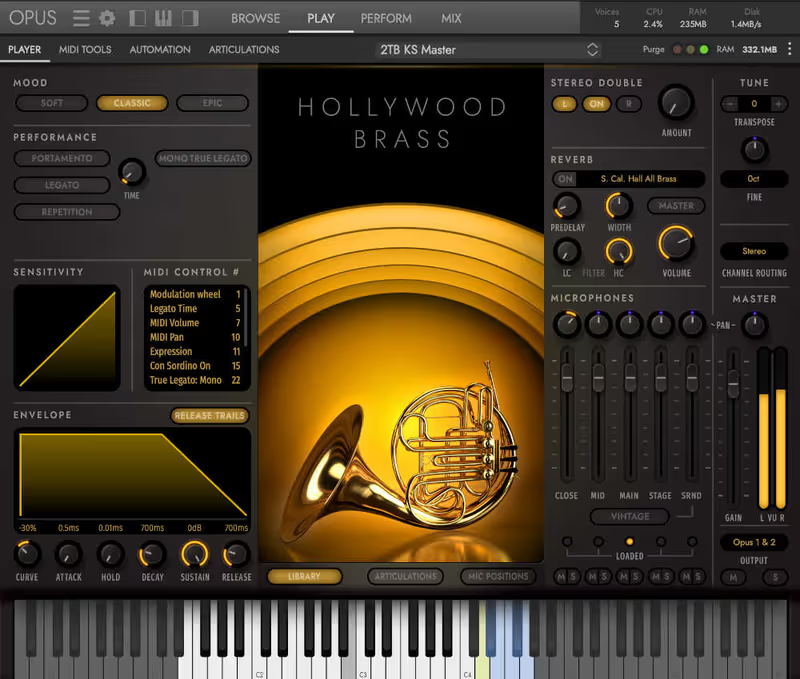
06 EastWest Sounds

Hollywood Orchestra Opus Edition

Best for Professional Scoring

The deepest brass writing available to anyone willing to program it, and the largest install on this page by two orders of magnitude.

Score
7.1
out of 10

How it scored

  • Dynamic Range 9.5

    Captured further into fff than anything else here. Best on the page.

  • Attack Speed 8.0

    The samples are there. Getting them to sound unstiff is your job.

  • Tone 8.5

    Excellent once programmed, and it will not flatter a rushed part.

  • Footprint 2.5

    944 GB and a subscription. Lowest here by a wide margin.

Why we picked it

Best for composers who want total control and are willing to program carefully.

Who should skip it

Skip this if you want instant results. It requires tweaking to sound great.

The good

  • Infinite articulations
  • Powerful new engine
  • Mic control

The bad

  • Steep learning curve
  • Can sound stiff
  • Subscription model
Engine
Opus Engine
Type
Full Orchestra
Size
944 GB
Price
$239
Why it scored that way

The workstation choice.

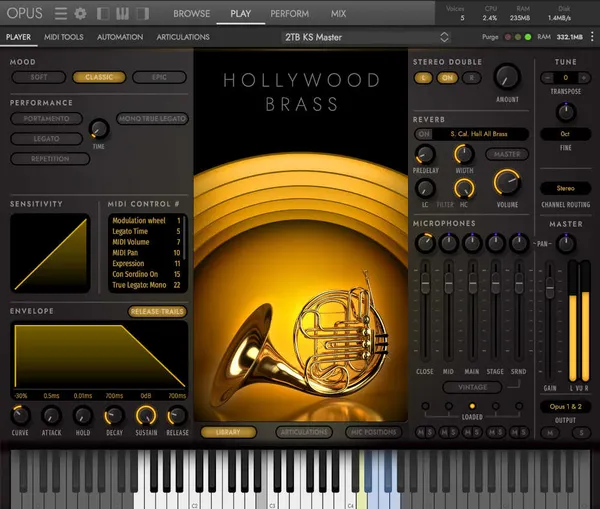
My Experience: Hollywood Brass has been around for over a decade, but the simple fact is: it works. The new Opus engine finally fixes the terrible interface of the past. It gives you more control over vibrato intensity and separate mic positions than any other library. If "CineBrass" is the instant gratification tool, Hollywood Brass is the surgeon's scalpel. It allows you to construct a performance that is indistinguishable from reality because you control every single parameter.

Deeper Look: The sheer number of articulations is overwhelming. Rips, shakes, trills, flutter-tongue. Everything is there. The "Moods" feature in Opus allows you to instantly change the mix from "Classic" to "Soft" or "Epic," which is a huge timesaver. It requires patience to program, but if you put in the work, it can sound more realistic than anything else because you have control over every detail. It rewards the composer who is willing to treat MIDI programming as an art form in itself.

Playing connects you to YouTube, which may set cookies.

Heard on
Academy Award Winning Films TV Series Mainstream Pop
Check price $239 (was $399)
07 Audio Imperia

Trailer Brass

Best for Modern Trailers

The tightest shorts on this page and the least dynamic range, which is exactly the trade a deadline wants.

Score
7.9
out of 10

How it scored

  • Dynamic Range 5.5

    Pre-compressed and deliberately narrow. Weakest against this page's test.

  • Attack Speed 9.4

    Tight and punchy. Best shorts here, and mix-ready on arrival.

  • Tone 7.0

    Sterile next to the sampled rooms. Not a classical sound.

  • Footprint 9.5

    2 GB. The smallest library on this page.

Why we picked it

Best for working trailer composers on tight deadlines.

Who should skip it

Skip this if you need a classical, warm orchestral tone.

The good

  • Mix-ready sound
  • Tight and punchy
  • Great FX included

The bad

  • Can sound sterile
  • Not very classical
  • Limited dynamic range
Engine
Kontakt Player
Type
Processed Brass
Size
2 GB
Price
Check site
Why it scored that way

The modern hype sound.

My Experience: Audio Imperia has mastered the "modern" trailer sound. Unlike CineBrass which is warm and roomy, Trailer Brass is sharp, bright, and incredibly punchy. It sounds "produced" right out of the box. You don't need to add EQ or compression. It's already done. The "Giant Brass" patch is exactly what it says on the tin. It slams through the speakers with a transients response that is perfect for aggressive sync points in an edit.

Deeper Look: It is incredibly playable. The response time is tight, making it great for fast, rhythmic ostinatos that would blur in a wetter library. It also includes amazing FX clusters and risers that are pre-synced. If your job is to turn around a trailer cue in 2 hours, this is the library you load. It just sits in the mix perfectly. It sacrifices some naturalism for sheer effectiveness, which in the trailer world is a trade-off worth making.

Playing connects you to YouTube, which may set cookies.

Heard on
Marvel Trailers Sports Promos High Energy Action
Check price
08 ProjectSAM

Symphobia 1

Best for Horror Scores

Still the best ensemble glue anyone has recorded, and useless the moment you need to write a second horn part.

Score
7.8
out of 10

How it scored

  • Dynamic Range 8.5

    Ensemble recordings carry real weight at the top.

  • Attack Speed 6.5

    Ensembles move together and slowly. Lowest here.

  • Tone 8.8

    The classic dark ProjectSAM sound. Nothing glues like it.

  • Footprint 7.5

    12 GB, and priced as though it were new.

Why we picked it

Best for massive ensemble chords and scary, atonal textures.

Who should skip it

Skip this if you need to orchestrate individual instrument lines.

The good

  • Unmatched glue
  • Classic dark tone
  • Inspiring Multis

The bad

  • Limited flexibility
  • No individual sections
  • Pricey for its age
Engine
Kontakt Player
Type
Ensemble Effects
Size
12 GB
Price
Check site
Why it scored that way

The library that started it all.

My Experience: Symphobia changed the game by sampling sections playing together (e.g., horns and trombones in unison). This creates a glue and power that independent samples can't replicate. Even 15 years later, the "Brass Clusters" and distinct chord stabs in Symphobia are legendary. They have a "darkness" and cinematic weight that is unique. It sounds like a horror movie score before you even press a key, capturing a mood that cleaner libraries struggle to find.

Deeper Look: I don't use this for melody. I use it for impact. The low brass staccatos are thick and heavy. The "Multis" (layered patches) are instant inspiration. ProjectSAM recently updated it with a new interface and cleaner samples, breathing new life into it. It is an ensemble library, so you can't write independent lines for Horns vs Trombones easily, but for big block chords, it dominates. It is the texture bed upon which you can layer more detailed instruments.

Playing connects you to YouTube, which may set cookies.

Heard on
The Dark Knight Video Game Soundtracks TV Suspense
Check price
09 Audio Imperia

Jäger

Best for Hybrid Scoring

The most sensible first orchestra here, and the one you will replace section by section as you learn what you want.

Score
7.2
out of 10

How it scored

  • Dynamic Range 8.0

    Solid to fff without the character of a dedicated brass library.

  • Attack Speed 8.2

    Shorts are responsive across the whole orchestra, not just brass.

  • Tone 7.5

    Very clean and very polished, which is another way of saying anonymous.

  • Footprint 5.0

    60 GB to cover everything, most of which is not brass.

Why we picked it

Best for beginners or pros who want a versatile, modern orchestral sketchpad.

Who should skip it

Skip this if you already own dedicated libraries for every section.

The good

  • Incredible value
  • Covers everything
  • Great polished sound

The bad

  • Less character than specialized libs
  • Very clean sound
  • Vocals are limited
Engine
Kontakt Player
Type
Full Orchestra
Size
60 GB
Price
Check site
Why it scored that way

The all-in-one powerhouse.

My Experience: If I could only take one library to a desert island (assuming the island has a power outlet and a deadline), it might be Jäger. It covers the whole orchestra, but the brass is the highlight. It features the same punchy Audio Imperia sound but with more flexibility than "Trailer Brass." It includes vocals, guitars, and sound design, making it a "trailer in a box." It is arguably the most versatile single-purchase library for modern cinematic music currently on the market.

Deeper Look: The brass allows for actual melodic playing, unlike many "epic" libraries that only do staccatos well. The "MerTHE" (Mezzo-Forte to Fortissimo) dynamic layers are perfectly balanced for rising tension. It is polished, clean, and ridiculously easy to use. It is the perfect starting point for anyone getting into epic music production. While it lacks the deepest character of a dedicated library, it makes up for it with sheer usability and speed.

Playing connects you to YouTube, which may set cookies.

Heard on
YouTube Orchestral Community Library Music Game Scores
Check price
Read more →

Methodology

Who is this for

Working composers and producers who need reliability, speed, and character for professional scoring tasks.

Our testing process

Where we have tested a product, we do it in actual production scenarios, ranging from rapid sketches to commercial pitches, and we evaluate it in a dense template rather than in isolation. Where we have not, the product card says so and the assessment is drawn from specifications and documented behaviour instead.

Why you should trust us

We buy most reviewed plugins ourselves. Occasionally we receive NFRs for evaluation, but this never guarantees a review or positive verdict. We may earn commissions from links, but our editorial choices are never for sale.

Also considered

For every category, we audition the top 8 to 15 standard options, discarding any that suffer from poor scripting, slow load times, or uninspiring sampling.

Frequently Asked Questions

What is a braam and how do I make one?

A braam is the sustained, distorted low brass hit that opens most modern trailers. It is built rather than played: low brass at their loudest dynamic, layered with a synth an octave below and driven through saturation until the attack breaks up. The brass supplies the character and the synth supplies the weight the samples cannot reach.

Why does my brass sound weak at full volume?

Because the library was probably not sampled at a genuine fortissimo, and turning up a mezzo-forte sample gives you a loud mezzo-forte rather than a loud section. Check whether your library has a dedicated fff layer, and if it does not, layer a second library or a synth to supply the aggression rather than pushing the fader.

Should I layer synths under orchestral brass for trailers?

Yes, and almost every trailer you have heard does. Sampled brass runs out of weight below the bass trombone and runs out of aggression at the top, and a synth layer covers both without being audible as a synth. Keep the synth an octave down and low-passed so it adds size rather than a second timbre.

How do I stop brass burying the strings?

Separate them by register and by rhythm rather than by level. Brass in the same octave as the string line will always win, so move one of them, or write the brass to answer the strings instead of playing with them. Sustained brass under a moving string figure is the arrangement that survives a loud mix.

Written By

Louis Raveton

Louis works across immersive scores (Venice Biennale, LVMH) and animation (Canal+), while producing Downtempo and Electro-Dub as Monsieur Shwill and Flagada. He treats his sample drive like a record collection, constantly hunting for the perfect 'imperfect' texture

Related Guides

All Guides →

New reviews, no noise

Occasional email when we publish something worth your time. No daily digest, no vendor press releases.

We store only your address, never sell it, and delete it as soon as you unsubscribe. See our privacy policy.