

Best Analog Emulations (Jupiter-8, Juno-106) for Producers

Anyone can sample a waveform. But capturing the chaotic, unpredictable electricity of a vintage analog circuit? That is art.

Ewan Clarke
By Ewan Clarke Synth Specialist & Sound Designer

What changed: The page now answers the questions readers ask about the category, in a FAQ section at the foot of it.

ModWheel is reader-supported. When you buy through links on this page we may earn an affiliate commission, at no extra cost to you. This never influences which products we recommend, read our testing methodology.

Prices come from the store's own feed and were last checked 8 September 2026. We don't issue discount codes — the price you see is the store's own.

Pick one in 10 seconds

Short version
  • You want one synth covering Moog, Roland and Korg ground Check your CPU headroom before committing a template to it. Diva
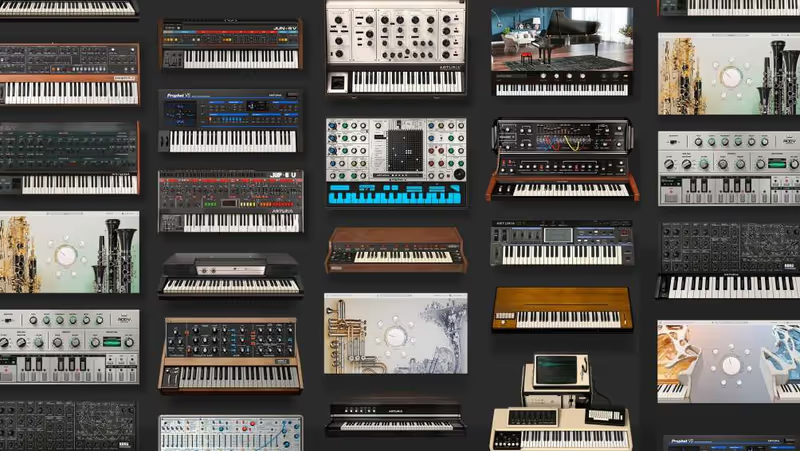
  • You want the whole history of synthesis in one purchase V Collection 11 Pro
  • You only ever need the Juno sound, on a modest machine TAL-U-NO-LX
  • You need fat Moog bass that moves air The Legend HZ
  • You want wide, expensive-sounding pads and brass stabs Oberheim OB-E

Compare all 7

Diva
1. Diva u-he #4 bestseller at Plugin Boutique
7.6
Engine
VST/AU/AAX
Type
Virtual Analog
Size
200 MB
Engine
VST/AU/AAX
Type
Synth Bundle
Size
30 GB
Engine
VST/AU/AAX
Type
Juno-106 Emulation
Size
300 MB
$49 $159 View price
Oberheim OB-E
4. Oberheim OB-E GForce Software
7.5
Engine
VST/AU/AAX
Type
OB-E Emulation
Size
200 MB
Polymode
5. Polymode Cherry Audio
7.1
Engine
VST/AU/AAX
Type
Polymoog Emulation
Size
100 MB
6. The Legend HZ Synapse Audio
7.3
Engine
VST/AU/AAX
Type
Minimoog Emulation
Size
100 MB
7. TAL-U-NO-LX TAL Software
6.7
Engine
VST/AU/AAX
Type
Juno-60 Emulation
Size
50 MB

Digital synthesis is cleaner, but analog is alive. The slight detuning of the oscillators, the saturation of the filter, the noise floor-these "imperfections" are what make analog synths sit so well in a mix.

In 2026, Component Modeling technology has reached a point where it is nearly impossible to tell a plugin from a $15,000 vintage unit.

We tested the heavyweights of the industry to find the plugins that don't just sound like analog synths, but behave like them.

The opposite instinct, chasing the hard edges and channel limits of 8-bit hardware rather than the warmth of analog, is covered in our Best Chiptune VSTs (2026): 8-Bit Nostalgia roundup.

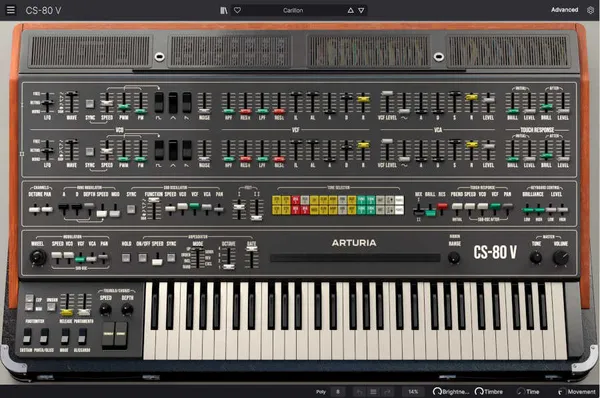
One instrument dominates this category on reputation alone, and it earns a treatment of its own in our Best 'Blade Runner' Synths: Top CS-80 Emulations roundup.

Top Picks

01 u-he

Diva

Best for Everything

Tested in our studio

#4 bestseller at Plugin Boutique

Still the best-sounding virtual analogue there is, and the CPU bill is the honest price of that filter modelling.

Tested score
7.6
out of 10

How it scored

  • Sound Design Range 9.2

    Mix-and-match modules cover three manufacturers convincingly.

  • Preset Quality 8.5

    Strong factory bank that shows the engine off properly.

  • CPU Footprint 4.5

    Notoriously hungry, and Divine mode is punishing. Worst here.

  • Modulation Depth 8.0

    Deep, though the routing takes a while to internalise.

Why we picked it

The absolute best choice for producers who want one synth to rule them all. It covers Moog, Roland, and Korg styles flawlessly.

Who should skip it

Avoid if you have an older computer. Diva is notoriously hungry for CPU cycles, especially in 'Divine' mode.

The good

  • Unmatched sound quality
  • Mix-and-match modules
  • Beautiful UI

The bad

  • CPU heavy
  • Complex routing
  • Interface is small
Engine
VST/AU/AAX
Type
Virtual Analog
Size
200 MB
Price
$179
Why it scored that way

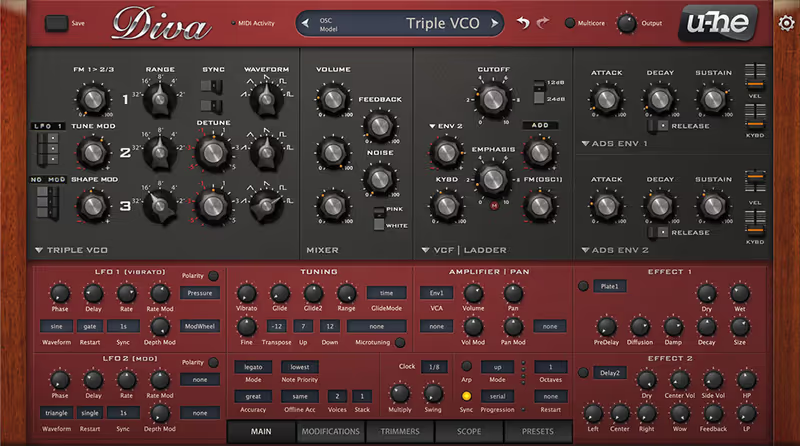
Diva stands for 'Dinosaur Impersonating Virtual Analogue'.

Diva is widely considered the best sounding analog emulation on the market, and it has replaced almost every hardware synth I own for studio work. Its unique "Mix-and-Match" design allows me to route a Moog oscillator through a Roland Juno filter, creating hybrid textures that simply aren't possible on physical gear. I recently used the "Divine" mode on a film score to create a slowly evolving pad, and the zero-delay feedback filters handled the rapid modulation without a single digital artifact or stair-stepping effect.

It is famously CPU-hungry, but that's the price of perfection. I treat it like a real instrument. I record the audio rather than keeping it live as MIDI. The "Trance" envelope model is particularly snappy-I used it to program a rolling bassline that felt indistinguishable from a Minimoog. If I could only take one plugin to a desert island, it would be Diva, simply because it can be any synth I need it to be.

Playing connects you to YouTube, which may set cookies.
Heard on
Hans Zimmer Techno Production Film Scores
Check price $179
02 Arturia

V Collection 11 Pro

Best for Synthwave

Tested in our studio

The best value per synth on the market, and the right first purchase if you do not yet know which vintage sound you need.

Tested score
8.4
out of 10

How it scored

  • Sound Design Range 9.4

    Thirty-plus instruments. Nothing else here comes close on breadth.

  • Preset Quality 9.0

    A genuinely good browser, which matters at this library size.

  • CPU Footprint 7.0

    Reasonable per instrument, though quality varies across the bundle.

  • Modulation Depth 8.2

    Modern modulation grafted onto the vintage models throughout.

Why we picked it

Essential for any producer who needs a complete museum of vintage synths at their fingertips. The best value for money on the market.

Who should skip it

Skip if you get overwhelmed by choice. Having 30+ synths can sometimes lead to 'preset paralysis.'

The good

  • Huge variety
  • Great preset browser
  • Modern features added

The bad

  • Varying quality per synth
  • Large install size
  • Expensive bundle
Engine
VST/AU/AAX
Type
Synth Bundle
Size
30 GB
Price
$699
Why it scored that way

The V Collection is the history of synthesis in one box.

The V Collection is essentially the history of synthesis in a single box, and I consider it the starting point for any serious producer. Arturia has meticulously modeled every classic synth ever made-from the Jupiter-8 to the CS-80-and the latest updates have improved the filter behavior significantly. I used the Prophet-5 V on a recent synth-pop track to create punchy brass stabs, and the ability to now add modern effects like shimmer reverb directly inside the plugin made the sound sit perfectly in the mix instantly.

What I love most is the sheer breadth of inspiration. Whenever I am stuck on a production, I just start browsing the presets of the "CMI V" or "Synclavier V," and I inevitably find a sound that sparks a new idea. It isn't just about emulating the past. Features like the granular engine update in the pigments of these classics allow me to take vintage tones into completely new, futuristic territory.

Playing connects you to YouTube, which may set cookies.

Heard on
Pop Production Indie Rock Electronic Music
Check price $699
03 Softube

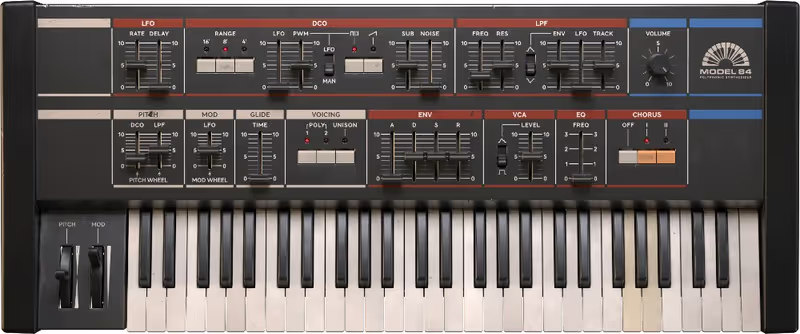
Model 84 Polyphonic Synthesizer

Best for 80s Pads

Tested in our studio

The most accurate Juno-106 you can buy, and its limits are the instrument’s limits rather than the developer’s.

Tested score
7.0
out of 10

How it scored

  • Sound Design Range 5.8

    A deliberately narrow palette. That is the Juno, faithfully.

  • Preset Quality 8.2

    Well judged and idiomatic to the hardware.

  • CPU Footprint 8.8

    300 MB and light in a big session.

  • Modulation Depth 5.0

    One envelope, no matrix. Authentic, and still a limit.

Why we picked it

The best Juno-106 emulation, period. Perfect for 80s synthwave, pop pads, and that classic 'stranger things' arpeggio sound.

Who should skip it

Don't buy this if you need complex modulation matrices or FM synthesis. The Juno is famous for being simple and limited.

The good

  • Perfect emulation
  • Simple interface
  • Great presets

The bad

  • Limited sonic palette
  • No arpeggiator (original behavior)
  • One envelope only
Engine
VST/AU/AAX
Type
Juno-106 Emulation
Size
300 MB
Price
$49
Why it scored that way

Softube proves that doing one thing perfectly is better than doing ten things adequately.

By focusing strictly on the Juno-106, they nailed every single nuance, including the famous noisy chorus and the specific bass boost of the high-pass filter. I A/B'd this plugin against a real Juno-106 in a friend's studio, and we genuinely couldn't tell them apart once the chorus was engaged. The way the resonance screams when you push the filter is terrifyingly accurate.

I used Model 84 exclusively for the pads on a recent 80s-inspired project. The factory presets are instantly usable, but the real magic is in the simplicity of the interface. I could dial in a lush, swirling pad in ten seconds flat. It captures that "instant nostalgia" sound better than any other emulation I've tried, and it sits in a mix with that specific mid-range warmth that digital synths usually lack, making the whole track feel authentically analog.

Playing connects you to YouTube, which may set cookies.

Heard on
Synthwave The Weeknd style Tame Impala style
Check price $49 (was $159)
04 GForce Software

Oberheim OB-E

Best for Brass Stabs

Tested in our studio

Nothing else here makes a pad sound this expensive, and the per-voice panel is the tax you pay for it.

Tested score
7.5
out of 10

How it scored

  • Sound Design Range 8.5

    Enormous width and detune control. It sounds orchestral.

  • Preset Quality 7.8

    Good, though the dense panel makes editing them slow.

  • CPU Footprint 5.5

    Hungry once all voices are live.

  • Modulation Depth 8.0

    True per-voice architecture, which is the whole point of the OB.

Why we picked it

Ideal for massive, wide pads and brass stabs that need to sound 'expensive' and orchestral.

Who should skip it

Skip this if you hate tweaking 8 different knobs to change one parameter. The per-voice architecture is complex.

The good

  • Approved by Oberheim
  • Incredible width
  • Detune controls

The bad

  • Complex workflow
  • CPU hungry
  • Dense front panel
Engine
VST/AU/AAX
Type
OB-E Emulation
Size
200 MB
Price
$169
Why it scored that way

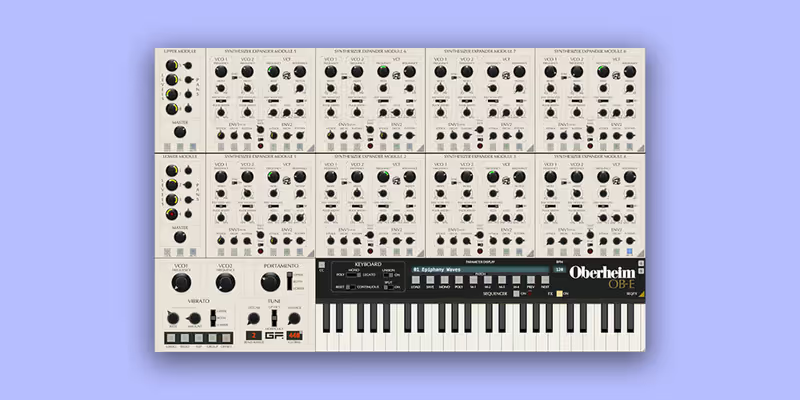
The OB-E is a beast of a synth with a massive sound.

Endorsed by Tom Oberheim himself, the OB-E allows you to program each of the 8 voices separately, just like the original hardware. This sounded daunting to me at first, but once I started slightly detuning each voice and panning them across the stereo field, the result was a pad sound so wide it felt like it was wrapping around my head. I used it to recreate the famous "Jump" brass sound for a cover band project, and the sheer rasp and size of the oscillators were undeniable and absolutely massive.

It captures the "bigness" of Oberheim synths better than anything else I have used. While the interface is dense, the "Vintage" control knob is a lifesaver-it instantly introduces subtle pitch drift and envelope variances that make the synth feel alive and old. When I need a pad that is going to be the main emotional carrier of a song, I reach for OB-E every single time.

Playing connects you to YouTube, which may set cookies.

Heard on
80s Pop Jump (Van Halen) Prince style
Check price $169
05 Cherry Audio

Polymode

Best for Vintage Pads

Tested in our studio

Worth having precisely because it is not another Juno or Moog, but it will never be your bass synth.

Tested score
7.1
out of 10

How it scored

  • Sound Design Range 6.8

    The resonator section is unusual. It can also sound thin.

  • Preset Quality 7.2

    The string and organ presets are where it makes its case.

  • CPU Footprint 8.5

    100 MB and undemanding.

  • Modulation Depth 6.0

    Modest, in keeping with the original instrument.

Why we picked it

Great for producers looking for a unique, slightly weird vintage texture that isn't just another Juno or Moog.

Who should skip it

Avoid if you want a punchy bass synth. The Polymoog was designed for strings and organs.

The good

  • Unique resonator section
  • Very affordable
  • Great string sounds

The bad

  • Specific sound
  • Can sound thin
  • Niche usage
Engine
VST/AU/AAX
Type
Polymoog Emulation
Size
100 MB
Price
$39
Why it scored that way

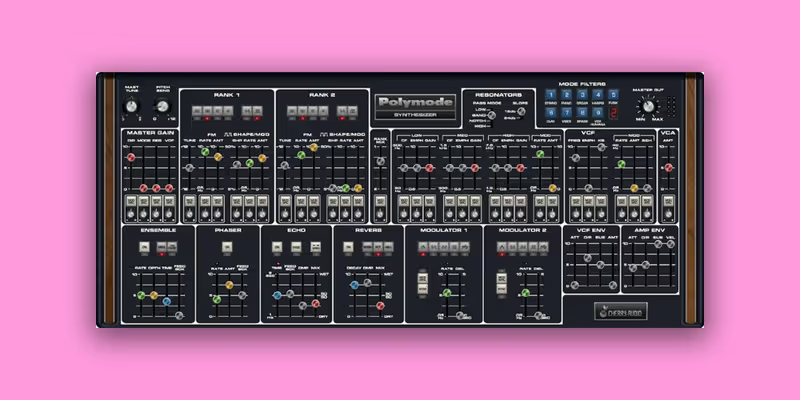
Cherry Audio excels at bringing obscure synths back to life.

Inspired by the rare Polymoog, this synth is a dedicated pad machine that brings a completely different flavor to my productions. The Polymoog was known for its "Resonator" section, and Cherry Audio has modeled this perfectly. I used it on a psychedelic rock track to create a swirling, vocal-like string sound that sat behind the guitars. It added a psychedelic texture that a standard Prophet or Jupiter emulation simply couldn't achieve.

It excels at being "weird" and organic. The "Vox Humana" preset is famous for a reason (think Gary Numan), and having that instant access to such a specific cultural touchstone is invaluable. While it isn't a "do-everything" synth, whenever I need a texture that sounds vintage but slightly unsettling or unique, the Polymode is the first plugin I open. It brings obscure history back to life.

Playing connects you to YouTube, which may set cookies.

Heard on
Gary Numan Psychedelic Rock Dream Pop
Check price $39
06 Synapse Audio

The Legend HZ

Best for Moog Bass

Tested in our studio

The Moog to own if you want the bass to shake the room, provided you accept a deliberately simple architecture.

Tested score
7.3
out of 10

How it scored

  • Sound Design Range 7.0

    Subtractive and mono-focused. Fat, but not versatile.

  • Preset Quality 8.8

    The Zimmer bank is the reason many people buy it.

  • CPU Footprint 8.0

    100 MB and efficient given the zero-delay filters.

  • Modulation Depth 5.5

    Simple by design. There is no digital modulation to speak of.

Why we picked it

The go-to plugin for classic Moog bass and leads. If you need that distinct 'fat' sound that shakes the walls, this is it.

Who should skip it

Avoid if you need complex digital modulation. This is a subtractive powerhouse designed for fat analog tones.

The good

  • Shockingly realistic
  • Hans Zimmer presets
  • Zero delay filters

The bad

  • Simple architecture
  • UI is small
  • Monophonic focus
Engine
VST/AU/AAX
Type
Minimoog Emulation
Size
100 MB
Price
Check site
Why it scored that way

Developed with Hans Zimmer, this is the ultimate Moog.

The Legend HZ is arguably the most accurate Minimoog emulation ever created, and the addition of polyphony and Hans Zimmer's personal patch library takes it to another level. I used this on a cinematic trailer to create a low, rumbling drone that shook the walls of my studio, feeling physically powerful. The filter drive is incredibly musical. Unlike other plugins that just get harsh when you push them, The Legend gets "creamy" and thick, retaining that expensive analog weight.

The fact that it was developed with Hans Zimmer is evident in the preset design-these are sounds meant to fill a cinema. I particularly love the six-oscillator mode, which allows me to create massive unison detuned leads that cut through absolutely anything. It is a subtractive powerhouse that makes my DAW feel like it's connected to a $50,000 modular wall. It has become my default plugin for bass lines.

Playing connects you to YouTube, which may set cookies.

Heard on
Funk Hip Hop Cinematic Bass
07 TAL Software

TAL-U-NO-LX

Best for Indie Pop

Tested in our studio

Ninety-nine percent of the Juno for a fraction of the price and the CPU, which makes the remaining one percent hard to argue for.

Tested score
6.7
out of 10

How it scored

  • Sound Design Range 5.5

    One sound, well done. Do not expect it to travel.

  • Preset Quality 7.0

    Serviceable. The chorus does most of the persuading.

  • CPU Footprint 9.5

    50 MB and it will run on almost anything. Best here.

  • Modulation Depth 4.8

    Minimal, and the noisy chorus is part of the character.

Why we picked it

The working producer's workhorse. It sounds 99% as good as expensive emulations but runs on a toaster.

Who should skip it

Skip if you already own Softube Model 84, as they cover very similar ground.

The good

  • Very low CPU
  • Cheap
  • Great chorus

The bad

  • Old UI
  • Simple features
  • Chorus is noisy
Engine
VST/AU/AAX
Type
Juno-60 Emulation
Size
50 MB
Price
Check site
Why it scored that way

You don't need to spend a fortune to get the Juno sound.

TAL-U-NO-LX has found its way into countless hit records (including mine) due to its unbelievably low CPU usage and perfect sound. It captures the 'chunk' and punch of the Juno-60 specifically-which is punchier than the 106-perfectly. I often use this on my laptop when I'm traveling because it is so lightweight, yet it sounds professional enough to make the final mix. The envelope response is snappy and aggressive, making it perfect for tight bass plucks.

The chorus section is, in my opinion, the best emulation of the Juno chorus in the industry. I often use the plugin just as an effects unit to run other audio through it. On a recent indie-pop track, I used TAL-U-NO-LX for every single synth part-bass, keys, and pads-and the track had a cohesive, vintage glue that sounded exactly like a record from 1982. It is the working producer's absolute workhorse.

Playing connects you to YouTube, which may set cookies.

Heard on
Bedroom Pop Chillwave Live Keys
Check price

What didn’t make the list

3 cut
  • Repro-5 u-he

    A superb Prophet-5 model from the same house as Diva, left out only because Diva already covers this list’s remit more broadly.

  • Mercury-6 Cherry Audio

    Excellent Jupiter-6 character at a low price, though it lands close to ground the Oberheim and Juno entries already hold.

  • Monark Native Instruments

    Still one of the better Minimoog models, but it needs Reaktor and The Legend HZ beats it on raw filter behaviour.

Read more →

Methodology

Who is this for

Working composers and producers who need reliability, speed, and character for professional scoring tasks.

Our testing process

Where we have tested a product, we do it in actual production scenarios, ranging from rapid sketches to commercial pitches, and we evaluate it in a dense template rather than in isolation. Where we have not, the product card says so and the assessment is drawn from specifications and documented behaviour instead.

Why you should trust us

We buy most reviewed plugins ourselves. Occasionally we receive NFRs for evaluation, but this never guarantees a review or positive verdict. We may earn commissions from links, but our editorial choices are never for sale.

Also considered

For every category, we audition the top 8 to 15 standard options, discarding any that suffer from poor scripting, slow load times, or uninspiring sampling.

Frequently Asked Questions

What does oscillator drift actually do to a sound?

It detunes each oscillator slightly and independently, and it keeps moving. Two oscillators that are never exactly in tune beat against each other, and because the drift is unpredictable no two chords are identical, which is most of what people mean when they call analog sound alive. Emulations model it deliberately rather than by accident.

Why do emulations sometimes sound thin next to the hardware?

Usually the filter rather than the oscillators. A real filter distorts as it is driven and its resonance interacts with the input level in ways a simple digital filter does not, so an emulation that gets the waveform right can still miss the weight. This is why filter modelling, not oscillator modelling, is where these plugins compete.

What is zero delay feedback and does it matter?

It is a filter design technique that solves the one sample delay a naive digital filter introduces in its feedback path. In practice it means resonance behaves correctly at high cutoff frequencies and self oscillation stays musical instead of turning brittle. You will hear it at extreme settings rather than in the middle of the range.

Should I buy a bundle or individual emulations?

A bundle if you want coverage and a single instrument if you want one sound to be right. Bundles are excellent value and generally trade some depth per instrument, whereas developers who model one synth at a time tend to go further into the circuit. Most working templates end up with a bundle plus one or two specialists.

Written By

Ewan Clarke

Ewan is a sound designer whose patches have appeared in major wavetable synths and cinematic scoring libraries. A self-confessed modular addict, he bridges the gap between West Coast experimentation and pop-ready polish. He believes every preset should tell a story.

Related Guides

All Guides →

New reviews, no noise

Occasional email when we publish something worth your time. No daily digest, no vendor press releases.

We store only your address, never sell it, and delete it as soon as you unsubscribe. See our privacy policy.