
Do This Now
- 1 Count your library's round robins before you write. Four at semiquavers and 150bpm means the same sample returns every 0.4 seconds.
- 2 Spread velocity across at least 20 points on repeated shorts. A flat velocity line defeats round robins that are keyed to dynamic layers.
- 3 Vary note length, not just velocity. Real repeated bowing shortens under pressure, and 10 to 20 percent length variation reads as effort.
- 4 Find your library's round robin reset and stop it firing mid-phrase. A reset on transport stop is fine, a reset per note is a machine gun.
- 5 Split a long ostinato across two tracks with different libraries and alternate bars. Two sample sets beat any amount of humanising on one.
Playing connects you to YouTube, which may set cookies.
Ostinatos are where sample libraries get caught. A sustained line hides a lot, because the ear is listening to the shape rather than the sample. A repeated quaver figure gives the ear nothing to listen to except the sample, twelve times a bar.
And once you have heard the machine gun in your own cue, you cannot stop hearing it.
Count Your Round Robins Before You Write
A round robin is a second, third or fourth recording of the same note, cycled automatically so consecutive repeats are not identical. Most orchestral libraries have some. Fewer have enough.
Do the arithmetic before you commit to a tempo. At 150bpm, semiquavers arrive ten times a second, so a library with four round robins returns to its first recording every 0.4 seconds. That is fast enough that the ear hears the cycle as a pattern rather than as variety, and the pattern is what reads as mechanical.
Six to eight round robins pushes the return out past a second, which is roughly where it stops being audible as repetition. Libraries that have gone to that trouble say so, and libraries that stay quiet about it usually have two.
The friction is that the number is often undocumented and occasionally wrong. The honest way to find out is to play the same note twenty times at a constant velocity, bounce it, and look at the waveform for the point where the shapes start repeating.
Spread the Velocity, But Know What It Controls
The standard advice is to vary velocity, and it is half right.
It works when the library maps velocity to separate recordings, because moving velocity around pulls in genuinely different samples and multiplies your effective round robin count. It does nothing when velocity is wired to volume, which is common on short articulations, because you get one recording at several levels.
Find out which you have. Play the same note at velocity 40 and velocity 110 and listen for a change in tone rather than only in loudness. Tone change means layers, which means velocity is doing real work.
- Velocity spread on shorts
- 20 points minimum
- Timing offset after quantise
- 3 to 6ms
- Note length variation
- 10 to 20 percent
- Round robins for fast work
- 6 to 8
Where it works, spread across at least 20 velocity points and do not centre the spread. Real repeated playing drifts, it does not oscillate around a mean, so let the line wander up over four bars and back down rather than jittering.
Playing connects you to YouTube, which may set cookies.
Vary Length, Which Almost Nobody Does
Here is the one that costs nothing and gets skipped.
A player repeating a short note under pressure does not produce identical note lengths. The bow shortens as the passage tightens, and lengthens slightly when there is room, and that variation is a large part of what the ear reads as a human being working.
In your DAW, take the ostinato and vary note lengths by 10 to 20 percent across the phrase. Not randomly, in a shape: shorter through the crescendo, longer as it settles. On a sampled short this changes which part of the release you hear, which changes the tail of every note.
The annoyance is that it interacts badly with some libraries. A few short patches ignore note-off entirely and play the whole sample regardless of length, in which case this does nothing and you have wasted ten minutes finding that out. Test with two notes before you edit forty.
Find the Round Robin Reset
Every sampler has a rule for when the round robin cycle returns to position one, and the default is frequently wrong for ostinatos.
Kontakt libraries commonly expose a reset on transport stop, which is what you want: the cycle continues through the phrase and starts fresh when you do. Some libraries reset on every new note, or on a change of velocity layer, and either of those hands you the same sample far more often than the round robin count suggests.
Look for it in the library's own interface rather than in your DAW. It is usually a small menu labelled reset, cycle or RR, and it is usually not on the front panel.
The friction is real and specific: if the reset happens on transport stop and you are working in short loops, every loop pass starts on sample one, so the first few notes of your ostinato are always identical while everything after them is fine. You will hear the problem at the loop point and nowhere else, and chase it in the wrong place for an hour.
Alternate Two Libraries Across the Bar
When a passage genuinely will not sit, stop trying to fix one sample set and use two.
Put the ostinato on two tracks with different libraries, and alternate: bars one and three from the first, bars two and four from the second. Two different rooms, two different sections, two different sets of recordings, and the ear stops hearing a loop because there is no longer one loop to hear.
Keep the two at slightly different levels rather than matched, with the second maybe 1.5dB under, so the alternation reads as texture rather than as a switch.
The catch is reverb. Two libraries recorded in different halls will announce themselves at the swap unless you commit both to a shared reverb and pull their built-in room back, which is work you have to actually do rather than assume.
When to Give Up and Buy the Phrase
There is a point where the honest answer is that you are asking sampled shorts to do something they were not recorded to do.
Phrase-based ostinato libraries record the whole repeating figure as a continuous performance, so nothing retriggers and there is no machine gun to eliminate. For fast driving patterns at fixed subdivisions they beat anything you can program, and they beat it in ten seconds rather than an afternoon.
The trade is that you get the patterns the players recorded, at the speeds and in the keys they recorded them. That is a real constraint on the writing, and it is why these libraries live alongside a normal string section rather than replacing one.
Know which problem you have. A composed line with repeated notes needs the five fixes above. A driving rhythmic bed that is going under a trailer cue probably wants the phrase library, and reaching for it is not cheating.
Related Articles
Best Action Strings for Fast Ostinatos: A Composer’s Guide
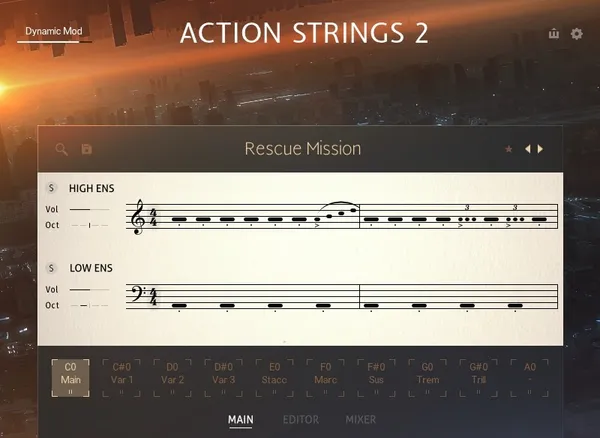
Need strings that can keep up? We review the best libraries for driving action cues, featuring NI Action Strings 2, aggressive spiccatos, and run engines.
Best Chamber Strings (2026): Intimate Detail
Small sections, big emotion. We review the best chamber string libraries (Spitfire, Tokyo Scoring) for intimate, detailed scoring.
The Best Cinematic String Libraries for 2026
We tested the top string libraries for film scoring. From the lush legatos of CSS to the intimacy of Spitfire, find the best VSTs for emotional writing.
Frequently Asked Questions
What is the machine gun effect?
It is the mechanical rattle you hear when the same audio sample is retriggered rapidly, which the ear recognises as a loop rather than as a player. Real repeated notes differ slightly every time in attack, pitch and tone, and an identical waveform repeating exposes the recording as a recording. It is most obvious on short bowed and struck articulations at speed.
How many round robins do I need for ostinatos?
Four is the common minimum and it is not really enough at speed. At 150bpm playing semiquavers you are triggering ten notes a second, so four round robins cycle back to the first sample roughly every 0.4 seconds, which is well inside the window where the ear notices repetition. Six to eight holds up considerably better, and libraries that advertise this usually say so on the product page.
Does velocity variation fix the machine gun effect?
Partly, and only if the library maps velocity to different recordings rather than to volume. Where velocity crossfades between genuinely different dynamic layers, moving it around pulls in different samples and helps a lot. Where velocity only changes gain, you get the same sample at different levels, which sounds like a machine gun with a fader on it.
Why does my ostinato sound worse after I quantise it?
Because quantising removes the timing variation that was masking the sample repetition. Exactly even spacing makes the repeating waveform periodic, and periodic repetition is exactly what the ear locks onto. If you need the rhythm tight, quantise and then apply a small random offset of three to six milliseconds rather than leaving it exact.
Is it better to use a dedicated ostinato library?
For fast repeated patterns, often yes. Phrase-based ostinato libraries record the pattern as a continuous performance, so there is no retriggering to expose, and they solve the problem by avoiding it. The trade is control: you get the pattern the players recorded, at the speeds they recorded it, and writing around that is its own constraint.
More Guides
All Guides →The Complete Guide to Mixing Cinematic Strings
A massive, comprehensive masterclass on arranging, routing, EQing, and mixing cinematic string samples for modern film and media production.
Divisi Strings Explained, and Why Your Chords Sound Like a Wall
Sixteen violins playing one line is a section. Sixteen violins split four ways is four thin sections. When divisi helps, when it costs you, and how to fake it in samples.
Why Your Strings Sound Fake, and It Is Not the Library You Bought
Sampled strings give themselves away on note starts, not on tone. How to measure a legato patch's attack delay, set negative track delay per articulation, and stagger section entries.
New reviews, no noise
Occasional email when we publish something worth your time. No daily digest, no vendor press releases.
We store only your address, never sell it, and delete it as soon as you unsubscribe. See our privacy policy.

Tobias Reed
Tobias is a classically trained percussionist who transitioned into trailer music composition. He has an encyclopedic knowledge of world rhythm instruments and has recorded samples for several boutique libraries. He judges VSTs by their dynamic layers and round-robin authenticity.