
Do This Now
- 1 Keep a chord inside a four-fret span. A hand covers four frets comfortably, and your piano voicing almost certainly does not.
- 2 Write in guitar keys. E, A, D, G and C give you open strings, and open strings are most of what makes a guitar sound like a guitar.
- 3 Never write six notes a semitone apart. One string plays one note, so any voicing needs six separate strings and a hand that can reach them.
- 4 Use a capo instead of transposing. A part written in G and capoed at 3 keeps its open strings in B flat, which a barre chord version loses.
- 5 Leave a gap when the position shifts. A hand moving up the neck takes time that a sampler does not need and a listener notices.
Playing connects you to YouTube, which may set cookies.
Sample libraries removed the last mechanical check on guitar writing. A real player would have looked at your part and said this cannot be done. A sampler renders it and says nothing.
The result is a specific kind of wrong that people notice without diagnosing. The harmony is right, the rhythm is right, and the part sounds like nobody is playing it, because nobody could be.
Fit the Chord Inside a Four-Fret Span
A hand covers about four frets comfortably. Low on the neck, where the frets are wider apart, a stretch to five is possible and uncomfortable. Above the twelfth fret, where they narrow, five or six becomes easy.
So a voicing is legal or illegal based on the distance between its lowest and highest fretted note, and that constraint has nothing to do with how the chord looks on a piano roll.
This is why guitar voicings sound the way they do. The physical shape forces wide intervals at the bottom of the chord and close ones at the top, which is close to the opposite of what a keyboard player naturally writes. A chord voiced evenly across two octaves is a piano chord, and playing it through a guitar library makes it a piano chord played on a guitar sample.
- Comfortable fret span
- 4 frets
- Possible with effort
- 5 frets
- Maximum simultaneous notes
- 6, one per string
- Guitar-friendly keys
- E, A, D, G, C
The friction is that checking this is genuinely tedious if you do not play. A fretboard diagram open on a second screen, or any chord dictionary, turns it into a ten-second check per voicing, and it is worth doing on every chord in an exposed part.
Playing connects you to YouTube, which may set cookies.
Remember That One String Plays One Note
This sounds too obvious to state and it is the single most common impossible voicing.
Six strings means six notes maximum, and each note has to sit on a different string. Two notes a semitone apart in the same octave usually need two adjacent strings at very different fret positions, which frequently puts them outside the four-fret span.
Clusters are the giveaway. A close voicing that a piano handles without comment, three notes inside a whole tone, is either awkward or impossible on a guitar, and writing it produces a chord that sounds thick and unplaceable rather than harmonically interesting.
The correction is usually to spread the voicing and drop the doubled note. Guitar harmony leans on open fifths, added ninths and suspended shapes precisely because those fall under the hand, and reaching for them is how the part starts sounding idiomatic rather than merely correct.
Write in Keys That Give You Open Strings
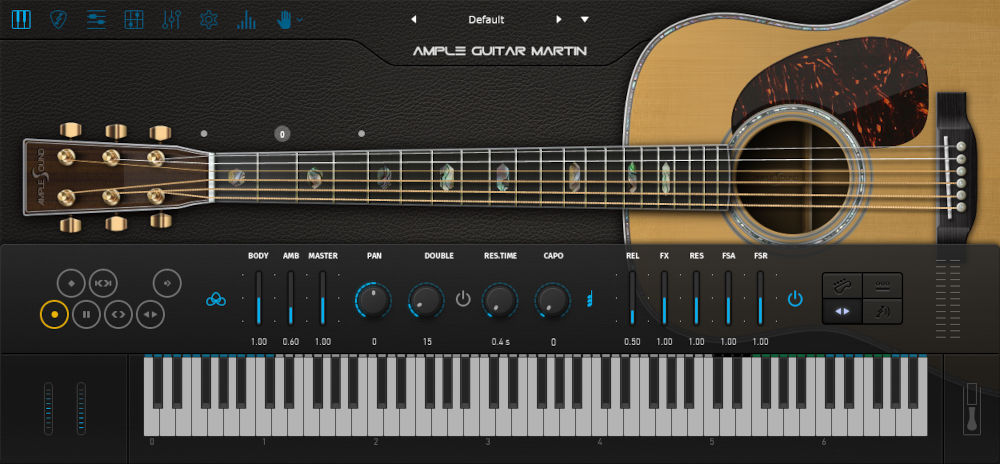
An open string rings longer than a fretted one, keeps sounding after the hand moves, and adds the sympathetic resonance that makes a guitar sound like a guitar rather than like a plucked sample.
That resonance is only available in keys where the open strings belong to the chord. E, A, D, G and C give you most of it. E flat, A flat and B give you almost none, and a part written there will sound closed and effortful however cleanly it is played.
This matters more than it sounds, because it is the difference between a guitar that sits in a cue with air around it and one that sounds like it is being played with a mute on.
The catch is that your cue's key is usually decided by something else, often a vocal range or a synth patch you already committed to. That is what capos are for, and it is the next section.
Use a Capo Rather Than Transposing
A capo clamps across the neck and raises every string, so the player keeps their open-string shapes and the whole thing sounds higher.
That distinction is the point. A part written in G shapes with a capo at the third fret sounds in B flat and keeps its open strings. The same part transposed to B flat in your DAW is played in barre chords with no open strings at all, and it loses the ring that made it work.
Several sampled guitars model this properly, which means choosing a capo position in the interface rather than transposing the MIDI. Where the library offers it, use it, because the difference is audible and free.
Where it does not, write in the guitar key and transpose the rest of the arrangement instead. That sounds backwards and it is frequently the right call when the guitar carries the identity of the cue.
Leave Time for the Hand to Move
The last one is about timing rather than pitch, and it is what separates a part that sounds performed from one that sounds assembled.
A guitarist moving from a chord at the second fret to one at the ninth needs time, and the movement is audible: strings ring on, the fingers leave, sometimes there is a slide. A sampler jumps instantly and silently.
So put a small gap before any chord that requires a large position change, and let the previous chord ring into it rather than cutting it. Thirty to sixty milliseconds is usually enough, and it reads as a player rather than as an edit.
The same logic applies to fast single-note lines. A run that crosses the neck twice in a bar is not impossible, and it is hard, and writing it as though it were effortless is how a part starts sounding synthetic even when every note is legal.
The Check That Costs Two Minutes
Before you commit an exposed guitar part, do this once.
Open a chord dictionary and look up each voicing you wrote. If it exists as a named shape, it is playable. If it does not appear at all, work out what you actually wanted from the chord and find the nearest shape that delivers it.
Then play the part back at half speed and listen for position jumps you did not leave time for. Those two checks catch most of what makes a programmed guitar part sound programmed, and neither requires you to play the instrument.
What they will not fix is the arrangement thinking behind the part, which is a longer conversation. But a part that could be played is the floor, and a surprising amount of MIDI guitar never clears it.
Related Articles
Best Acoustic Guitar VSTs and Plugins
Can a virtual guitar sound real? We tested the best acoustic guitar VSTs and plugins for strumming, fingerpicking and exposed solo lines.
Best Cinematic Guitars (2026): Post-Rock & Ambient
Explosions in the Sky style. We review the best guitar libraries for creating washed-out, emotional post-rock swells and textures.
Best Electric Guitars (2026): Virtual Strat & Les Paul
No amp needed. We review the best virtual electric guitars (Ample Sound, Shreddage) for authentic strat, tele, and humbucker tones.
Frequently Asked Questions
Why does my programmed guitar part sound wrong even with a good library?
Usually because the part could not be played. A sampler will render any six simultaneous notes, including voicings that need seven strings or a hand spanning eight frets, and the result sounds harmonically correct and physically impossible. Listeners who play guitar hear it immediately, and listeners who do not still register that something is off without being able to name it.
What is the widest chord a guitarist can reach?
About four frets for most hands, measured from the lowest fretted note to the highest, with a fifth possible low on the neck where the frets are wider. That constraint is what makes guitar voicings sound different from piano voicings, because it forces wide intervals at the bottom and close ones at the top rather than the even spacing a keyboard invites.
Which keys work best for guitar?
E, A, D, G and C, because each gives you open strings that ring on. Guitar music gravitates to those keys for the same reason string writing gravitates to sharp keys, and a part written in E flat will sound noticeably more closed and effortful than the same part in E. If the cue is locked to an awkward key, a capo is usually the answer.
Does capo position matter in a sampled guitar?
It does if the library models it, and several do. A capo raises the pitch while keeping the open-string shapes, so a part played in G shapes with a capo at the third fret sounds in B flat and still rings. Transposing the same part in your DAW gives you B flat with no open strings at all, which is a duller and more closed sound.
Can I write guitar parts on a piano roll?
Yes, provided you check them against the instrument afterwards. The piano roll shows pitches and hides everything about how they are produced, so it will happily let you write a chord needing seven strings. Get a chord chart or a fretboard diagram open alongside and confirm each voicing exists before committing to it.
More Guides
All Guides →Programming a Strum That Sounds Like a Hand, Not a Chord
A real strum is six notes arriving at different times with different velocities, in a direction. Stroke spread, up-down logic, chord-change noise and the muting nobody programs.
Advanced Saturation and Distortion in Mixing
A technical breakdown of harmonic generation, comparing tube, tape, and solid-state topologies with actionable routing strategies for modern production.
Workflow Tricks for Film Composers: Speeding Up MIDI Production
Practical DAW organization strategies, macro setups, and routing techniques to dramatically increase composition and mixing speeds.
New reviews, no noise
Occasional email when we publish something worth your time. No daily digest, no vendor press releases.
We store only your address, never sell it, and delete it as soon as you unsubscribe. See our privacy policy.

Felix Ward
Felix is an indie-folk songwriter and session guitarist who values vibe over perfection. He looks for tools that potentialize 'happy accidents' and offer immediate inspiration. If a plugin requires reading a 100-page manual, he's probably already moved on.