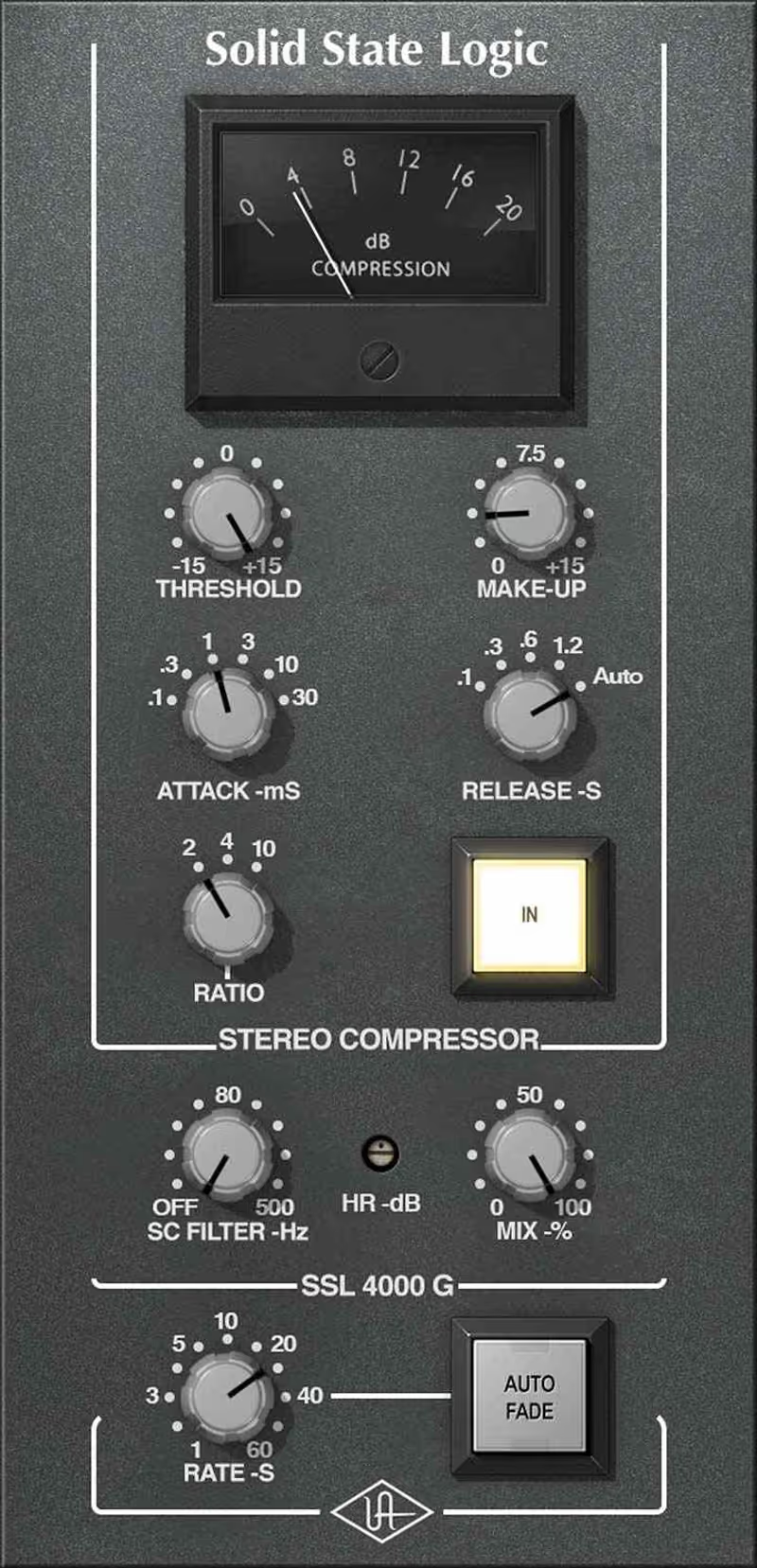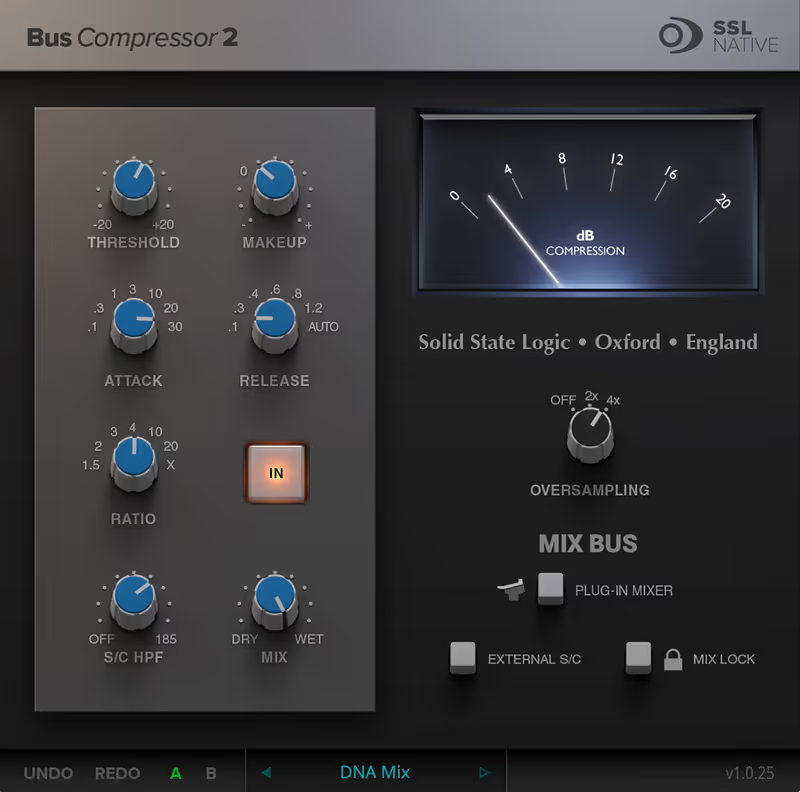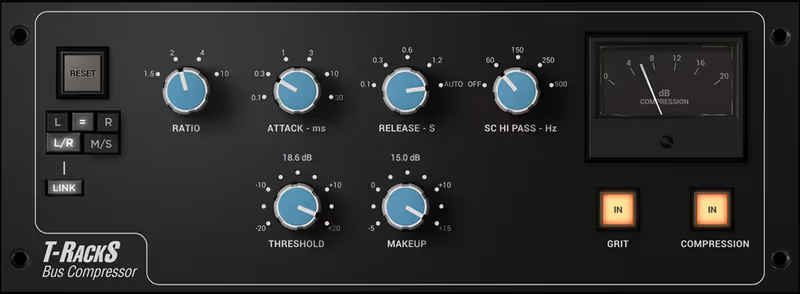

Not tested by us, assessed from specs and documented behaviour
The punch pick here, and the one with the most ways to shape how the two sides of a stereo bus move together.
How it scored
- Punch 8.8
Thrust filters the detector, so low end does not drive the gain reduction.
- Harmonic Saturation 7.5
Transformers and op amps modelled, with no dedicated drive control listed.
- Glue 8.5
Designed for the stereo bus, with feedback and feed-forward modes.
- Routing Depth Best in list 7.5
Percentage L/R link, Shape, three knees and Mix. No mid-side.
Why we picked it
Best for punchy drum buses because Thrust stops the kick from steering the gain reduction across the whole kit.
Who should skip it
Avoid if you want a three-knob SSL workflow, or mid-side compression for treating the centre of a mix separately.
The good
- Thrust keeps the kick from pumping
- Variable percentage stereo linking
- Feedback and feed-forward modes
The bad
- Busy panel for a bus stage
- No mid-side mode listed
- Managed through UA Connect
- Format
- VST3/AU/AAX
- Protection
- iLok / UA Connect
Why it scored that way · 1 min read The American counterpart to the SSL bus compressor. Thrust keeps the low end from steering the gain reduction, so the kick survives it.
The American counterpart to the SSL bus compressor. Thrust keeps the low end from steering the gain reduction, so the kick survives it.
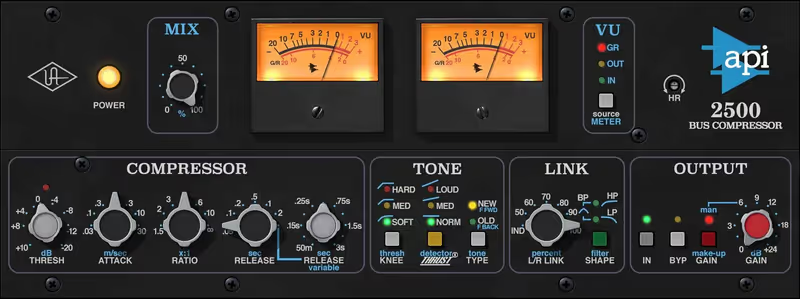
The API 2500 is the other half of the classic bus compressor pairing, and the reason it sits on this page is Thrust. Universal Audio describes it as a filter ahead of the RMS detector that evens out high and low frequency energy, so neither triggers the compressor more than the other. On a drum bus that means the kick no longer pulls the whole kit down with every hit, which is how a bus compressor most often makes drums sound smaller.
The control set goes further than the SSL designs on this page. There are three knee settings, Soft, Medium and Hard, and an Old and New switch that chooses between feedback and feed-forward compression. The Link section sets left and right linking as a percentage rather than on or off, with a Shape control alongside it, and Universal Audio has added Mix and Headroom controls that the hardware never had.
The friction is the number of decisions. Two compression types, three knees, Thrust and a link section are a lot to settle for a stage that the SSL-style units here finish in three moves, and there is no mid-side mode listed for treating the centre of a mix separately from the sides. It runs as a UAD Native plug-in without UA hardware, but it is managed through UA Connect with an iLok account, which is one more installer to maintain.
Playing connects you to YouTube, which may set cookies.