Kilohearts · Review

Kilohearts Phase Plant Review

A full review of Phase Plant: what a genuinely open architecture buys you, why the blank canvas puts people off, and who should learn it.

Verdict

Buy it if you design sounds rather than play presets. Phase Plant removes the ceiling that fixed-architecture synths impose, and charges you a learning curve for it. If you want to load a patch and write, buy something else.

ModWheel is reader-supported. When you buy through links on this page we may earn an affiliate commission, at no extra cost to you. This never influences which products we recommend, read our testing methodology.

01 Kilohearts

Phase Plant

Best for Modular Synths

The deepest routing available here and a blank page to start from, which is the whole appeal and the whole cost.

Score
7.7
out of 10

How it scored

  • Modulation Depth 9.8

    Audio-rate modulation between any two generators. Best on the page.

  • Oscillator Character 8.5

    Clean and neutral, so the character comes from what you build.

  • CPU Efficiency 7.0

    Scales with the patch, and a heavy one is genuinely heavy.

  • Workflow Speed 5.5

    An empty rack every time you open it. Lowest here.

Why we picked it

Best for complex sound design because of its limitless modular routing and audio-rate modulation capabilities.

Who should skip it

Avoid if you prefer a traditional, fixed-architecture layout with immediate visual feedback.

The good

  • Limitless routing possibilities
  • Incredible audio-rate modulation
  • Integrates perfectly with Kilohearts snapins

The bad

  • Blank canvas can be intimidating
  • Requires purchasing additional effects
  • Interface lacks visual character
Format
VST/AU/AAX
Protection
Kilohearts Center
Price
$199
Why it scored that way

This is arguably the most flexible sound design environment currently available for modern bass music.

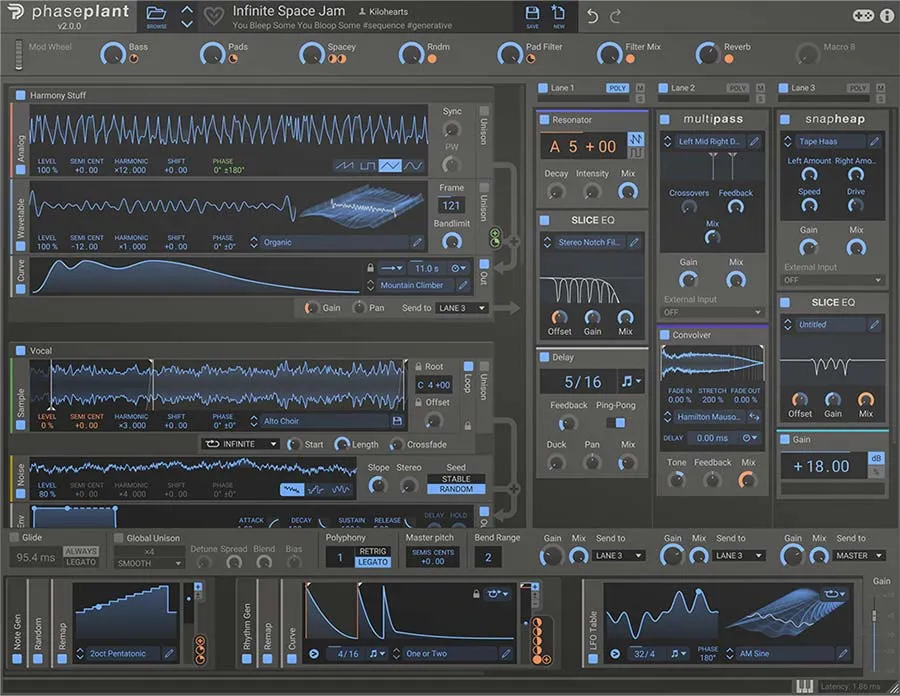
Phase Plant has completely redefined my approach to designing heavy bass sounds by offering a truly limitless semi-modular workspace. The ability to route audio-rate modulation between any number of oscillators, samplers, and wavetable generators is hard to match anywhere else. I regularly use it to create complex FM neurobass patches that would otherwise require multiple plugin instances and complicated DAW routing.

The completely blank canvas approach can be intimidating if you just want to load a preset and start writing immediately. However, once you understand the signal flow, it becomes the ultimate alternative to rigid, fixed-architecture synthesizers. If you are serious about heavy electronic sound design it belongs on the shortlist, though you should budget for the Kilohearts effects separately because the core plugin ships without them.

Playing connects you to YouTube, which may set cookies.

Heard on
Virtual Riot Skrillex Noisia
Check price $199

Phase Plant turns up in our roundups more than any other synth, across FM, wavetable and granular. That is not an accident. It is not really a wavetable synth at all, it is a workspace that can become one.

The architecture is the product

Most synths give you a signal path and let you modulate points along it. Phase Plant gives you a blank canvas and lets you patch any oscillator directly into another as an FM modulator, route audio-rate modulation between oscillators, samplers and wavetable generators, and connect multipoint envelopes to effectively any parameter.

The practical consequence is that patches which would need several plugin instances and DAW routing collapse into one window. For complex FM and neurobass work that is the entire argument, and nothing else in the category is close.

What it is genuinely good at

Dense FM routing on percussive material. Running sterile drum loops through it adds character without the constrained, obviously-processed quality that fixed architectures tend to impose.

Heavy bass design, where the audio-rate modulation between arbitrary sources is what separates a patch that sounds designed from one that sounds preset.

The friction point

The blank canvas is intimidating, and that is a real cost rather than a personality quirk. If you want to load something and start writing immediately, Phase Plant actively works against you.

There is also no meaningful visual feedback on signal flow. You hold the routing in your head. Experienced sound designers do that without noticing. Everyone else stalls, and the honest advice is to learn modulation somewhere friendlier first.

Specs

FormatVST / AU / AAX
ProtectionKilohearts Center
ArchitectureSemi-modular, open

Who should buy it

Sound designers, bass producers, and anyone who has started working around their current synth rather than with it. That last one is the real signal.

If you are still learning how modulation shapes a sound, this is the wrong first synth. Come back to it when you know what you want to build and cannot build it.

Written By

Ewan Clarke

Ewan is a sound designer whose patches have appeared in major wavetable synths and cinematic scoring libraries. A self-confessed modular addict, he bridges the gap between West Coast experimentation and pop-ready polish. He believes every preset should tell a story.

Related Guides

All Guides →

New reviews, no noise

Occasional email when we publish something worth your time. No daily digest, no vendor press releases.

We store only your address, never sell it, and delete it as soon as you unsubscribe. See our privacy policy.