
5 Best Wavetable Synths for Bass Music (2026)

If you cannot visually see your modulation routing, you are literally designing sounds blind.

Ewan Clarke
By Ewan Clarke Synth Specialist & Sound Designer

What changed: Every pick now carries a verdict line and scores for modulation depth, oscillator character, CPU and workflow, and there is a decision router at the top. It also answers the questions readers ask about the category.

ModWheel is reader-supported. When you buy through links on this page we may earn an affiliate commission, at no extra cost to you. This never influences which products we recommend, read our testing methodology.

Prices come from the store's own feed and were last checked 8 September 2026. We don't issue discount codes — the price you see is the store's own.

Pick one in 10 seconds

Short version
  • The patch needs routing a fixed architecture will not give you Phase Plant
  • You want to see what every modulator is doing while it does it Pigments 7
  • You want the thickest raw oscillator on the page and will fight the interface MASSIVE X
  • You are running dozens of instances in one session Hive 2
  • The budget is the constraint rather than the feature list SynthMaster One

Compare all 5

Phase Plant
1. Phase Plant Kilohearts
7.7
Protection
Kilohearts Center
Pigments 7 8.0
Protection
Arturia Software Center
MASSIVE X
3. MASSIVE X Native Instruments
7.2
Protection
Native Access
SynthMaster One 7.4
Protection
Serial Key
Hive 2 8.4
Protection
Serial Key

Finding the best wavetable synths is the most critical step for any producer looking to create modern electronic bass music. Traditional subtractive analog synthesis simply cannot generate the complex, evolving harmonics required for modern dubstep growls and neurobass reeses. The top wavetable VST plugins solve this by allowing you to import custom waveforms and morph through them in real time.

You need a digital synthesizer that provides instantaneous visual feedback for every single modulation assignment. A powerful wavetable engine replaces the tedious process of layering dozens of static audio samples manually. The right instrument depends heavily on your workflow, such as preferring a limitless modular canvas or a streamlined, single-page interface.

Several of these picks also appear in our 7 Best Neurobass Synths for Heavy Dubstep (2026) roundup, which is worth a look if you are weighing up both.

Top Picks

01 Kilohearts

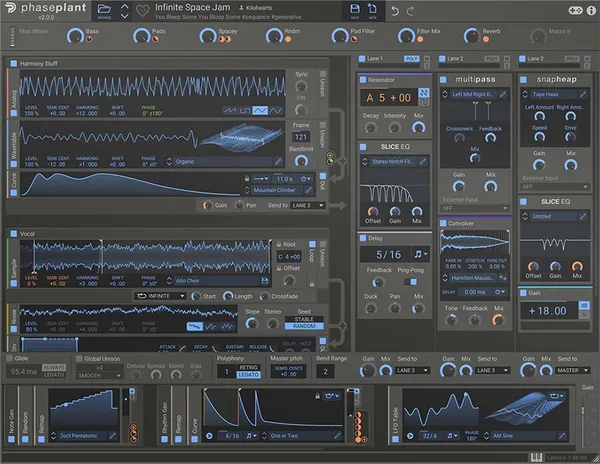
Phase Plant

Best for Modular Synths

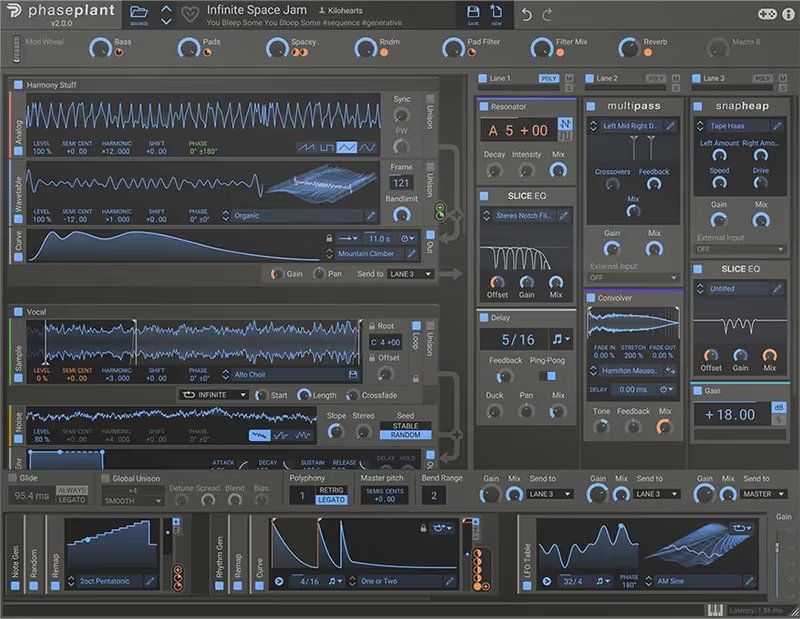
The deepest routing available here and a blank page to start from, which is the whole appeal and the whole cost.

Score
7.7
out of 10

How it scored

  • Modulation Depth 9.8

    Audio-rate modulation between any two generators. Best on the page.

  • Oscillator Character 8.5

    Clean and neutral, so the character comes from what you build.

  • CPU Efficiency 7.0

    Scales with the patch, and a heavy one is genuinely heavy.

  • Workflow Speed 5.5

    An empty rack every time you open it. Lowest here.

Why we picked it

Best for complex sound design because of its limitless modular routing and audio-rate modulation capabilities.

Who should skip it

Avoid if you prefer a traditional, fixed-architecture layout with immediate visual feedback.

The good

  • Limitless routing possibilities
  • Incredible audio-rate modulation
  • Integrates perfectly with Kilohearts snapins

The bad

  • Blank canvas can be intimidating
  • Requires purchasing additional effects
  • Interface lacks visual character
Format
VST/AU/AAX
Protection
Kilohearts Center
Price
$199
Why it scored that way

This is arguably the most flexible sound design environment currently available for modern bass music.

Phase Plant has completely redefined my approach to designing heavy bass sounds by offering a truly limitless semi-modular workspace. The ability to route audio-rate modulation between any number of oscillators, samplers, and wavetable generators is hard to match anywhere else. I regularly use it to create complex FM neurobass patches that would otherwise require multiple plugin instances and complicated DAW routing.

The completely blank canvas approach can be intimidating if you just want to load a preset and start writing immediately. However, once you understand the signal flow, it becomes the ultimate alternative to rigid, fixed-architecture synthesizers. If you are serious about heavy electronic sound design it belongs on the shortlist, though you should budget for the Kilohearts effects separately because the core plugin ships without them.

Playing connects you to YouTube, which may set cookies.
Heard on
Virtual Riot Skrillex Noisia
Check price $199
02 Arturia

Pigments 7

Best for Visual Synths

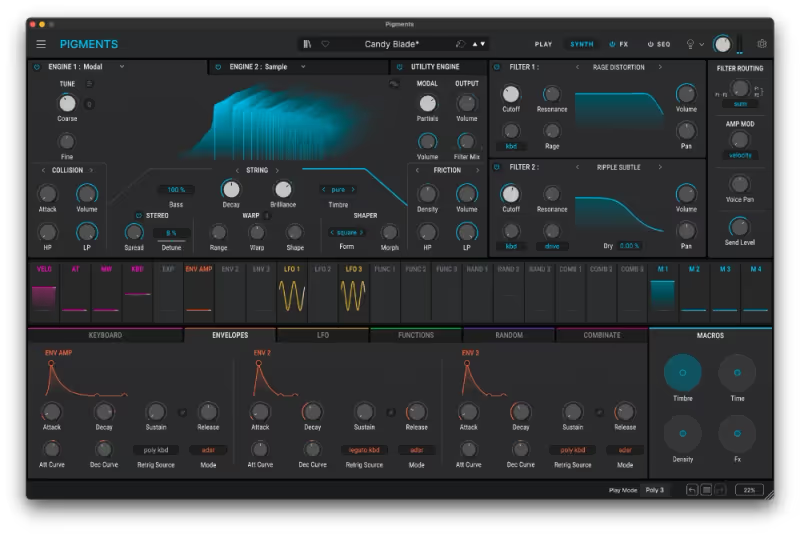
The most legible complex synth on the market, at a CPU cost that is mostly the interface drawing itself.

Score
8.0
out of 10

How it scored

  • Modulation Depth 9.0

    Every routing is visible and animated, which changes how fast you learn it.

  • Oscillator Character 8.5

    Four engines, and the granular layer is the one that earns its place.

  • CPU Efficiency 5.5

    Animations plus dense patches. The heaviest thing here. Lowest on the page.

  • Workflow Speed 8.8

    Colour-coded routing means you are never hunting for a modulator.

Why we picked it

Best for visual sound design because every modulation routing is clearly animated and color-coded.

Who should skip it

Avoid if you have an older computer that struggles with heavy GUI animations.

The good

  • Incredible visual feedback
  • Four diverse synthesis engines
  • Excellent built-in effects

The bad

  • GUI animations can cause lag
  • High CPU usage on complex patches
  • Factory presets lean toward cinematic
Format
VST/AU/AAX
Protection
Arturia Software Center
Price
$199
Why it scored that way

Pigments offers the most intuitive visual feedback of any complex synthesizer on the market today.

Arturia Pigments excels at making complex modulation patching visually understandable through its brilliant color-coded interface and animated routing matrix. The dual engine architecture allows you to easily combine a gritty granular sample layer with a heavy wavetable bass patch. I frequently rely on its deep randomization features to generate unexpected metallic textures for heavy tearout bass fills.

While the visual feedback is outstanding, the sheer amount of animation can occasionally cause interface lag on older operating systems. Despite this minor friction point, it remains one of the best Serum alternatives for producers who need intense visual confirmation of their sound design. The included effects rack is robust and full of vintage emulations, though the CPU load climbs once several engines and effects run together.

Playing connects you to YouTube, which may set cookies.

Heard on
Zedd Feed Me Pegboard Nerds
Check price $199
03 Native Instruments

MASSIVE X

Best for Heavy Bass

The thickest oscillators on the page behind the least legible routing, which is a straight trade rather than a flaw.

Score
7.2
out of 10

How it scored

  • Modulation Depth 8.0

    Performer envelopes are genuinely different, with nothing to see while they run.

  • Oscillator Character 9.4

    Noticeably heavier raw than anything else here. Best on the page.

  • CPU Efficiency 7.0

    Middling, and predictable under load.

  • Workflow Speed 4.5

    Routing without visual feedback, and no custom wavetable import. Lowest here.

Why we picked it

Best for thick modern basslines because the raw wavetable oscillators have incredible depth.

Who should skip it

Avoid if you rely heavily on clear, animated visual feedback for your modulation routing.

The good

  • Incredibly thick raw sound quality
  • Unique performer modulation system
  • Excellent sounding analog-style filters

The bad

  • Convoluted visual routing interface
  • No visual feedback for modulation
  • Cannot import custom wavetables
Format
VST/AU/AAX
Protection
Native Access
Price
$199
Why it scored that way

Massive X delivers an incredibly thick, modern sound character despite its controversial user interface.

Massive X provides an undeniably heavy, punchy sound engine that sits perfectly in a dense, modern electronic mix. The specialized performer envelopes and unique voice routing options allow for creating highly complex, evolving rhythmic basslines effortlessly. I still rely on it heavily for mid-bass growls because the raw oscillator quality is noticeably thicker than most competing wavetable synthesizers.

The primary frustration is the convoluted visual routing interface, which lacks the immediate clarity of its famous predecessor. It takes significant time to master the signal flow, but it remains a fantastic Phase Plant alternative for raw audio quality. If you can overcome the steep learning curve the sonic rewards are worth the effort, but you cannot import your own wavetables, which rules out bespoke oscillator work.

Playing connects you to YouTube, which may set cookies.

Heard on
Excision Subtronics Kill The Noise
Check price $199
04 KV331 Audio

SynthMaster One

Best for Fast Design

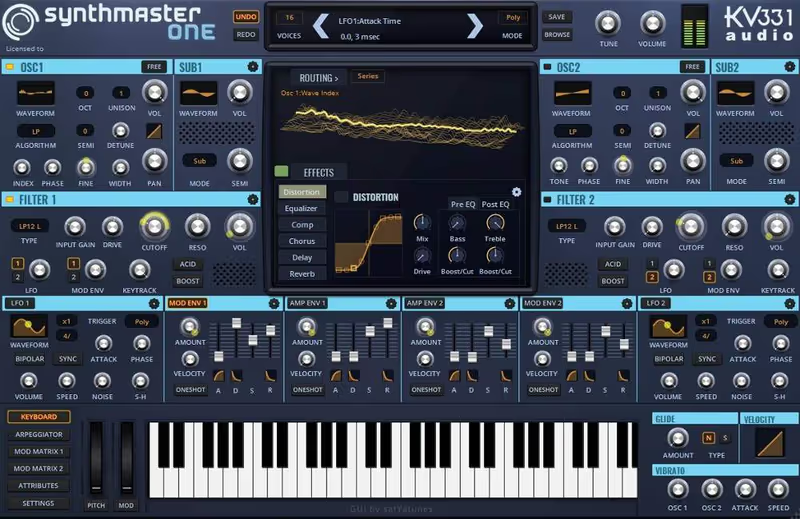
More synthesis than the price suggests, in an interface that shows you all of it at once.

Score
7.4
out of 10

How it scored

  • Modulation Depth 8.0

    Drawable waveforms and modulation shapes, all on one page.

  • Oscillator Character 7.5

    Capable rather than distinctive.

  • CPU Efficiency 8.0

    Comfortable across a template.

  • Workflow Speed 6.0

    Everything visible at once is its own kind of slow.

Why we picked it

Best for budget-conscious producers because it offers flagship synthesis power at an extremely accessible price.

Who should skip it

Avoid if you prefer highly polished, minimalist user interfaces with sparse parameter layouts.

The good

  • Incredible value for the price
  • Brilliant single-page user interface
  • Massive library of factory presets

The bad

  • Interface can feel extremely cluttered
  • Workflow is occasionally unintuitive
  • Visual feedback is slightly limited
Format
VST/AU/AAX
Protection
Serial Key
Price
$49
Why it scored that way

SynthMaster One provides an absurd amount of synthesis power at a very accessible price point.

SynthMaster One introduces an impressive new wavetable engine alongside its already massive array of virtual analog capabilities, all contained within a brilliant single-page layout. The deeply customizable architecture allows you to draw your own custom oscillator waveforms and intricate modulation shapes effortlessly. I find it highly effective for designing complex neurobass reeses when I need to work extremely fast without menu diving.

The user interface can feel somewhat cluttered and overwhelming initially due to the sheer number of available parameters packed into single panels. Despite the dense layout, it stands as an excellent budget-friendly alternative to more expensive flagship synthesizers like Serum. The factory preset library is large enough to cover most electronic genres, and authorisation is a plain serial key, so installation stays painless.

Heard on
Armin van Buuren Martin Garrix Zedd
Check price $49
05 u-he

Hive 2

Best for Efficient Synths

The lightest synth here by a wide margin, which matters more on a large template than another synthesis engine would.

Score
8.4
out of 10

How it scored

  • Modulation Depth 7.0

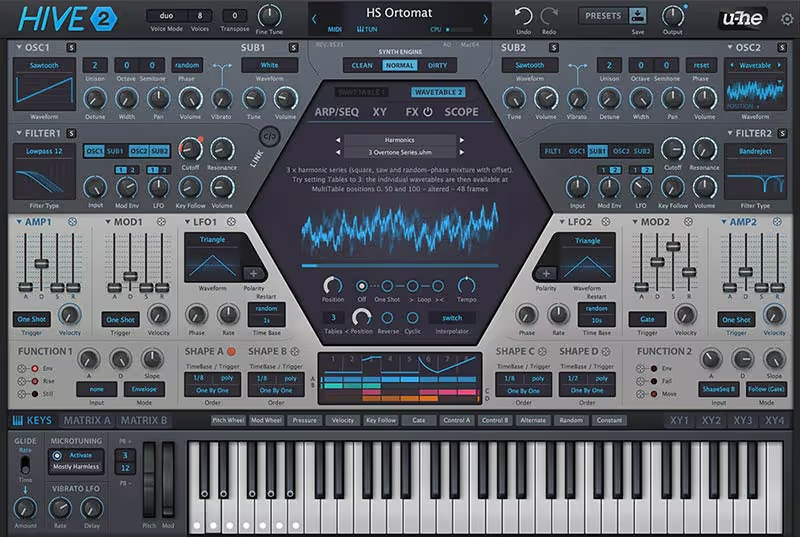
    The hexagon matrix covers the ground, and custom wavetable import is limited.

  • Oscillator Character 8.0

    Hard sync and internal distortion do most of the work.

  • CPU Efficiency 9.6

    Dozens of instances without a problem. Best on the page.

  • Workflow Speed 8.8

    Fast to a result, and the window is small on a large display.

Why we picked it

Best for high track counts because its incredibly low CPU footprint allows you to run dozens of instances simultaneously.

Who should skip it

Avoid if you strictly require importing massive custom wavetables or using complex granular synthesis engines.

The good

  • Incredibly low CPU consumption
  • Great sounding internal distortion
  • Brilliantly fast user interface

The bad

  • Hexagon modulation requires learning
  • Limited custom wavetable import options
  • Interface feels slightly small
Format
VST/AU/AAX
Protection
Serial Key
Price
$149
Why it scored that way

Hive remains the undisputed king of fast, aggressive electronic synth sounds that do not melt your CPU.

Hive 2 is widely famous for its trance leads, but its newly updated wavetable engine is absolutely perfect for thick, distorted basslines. The hard-sync oscillators and robust internal distortion algorithms allow you to create piercing neurobass sounds with minimal effort. I frequently reach for it when I need a bass patch that will cut directly through a highly saturated, dense mix without overloading my computer.

The modulation system is somewhat unique, utilizing a drag-and-drop hexagon matrix that requires a slight learning curve. However, it is an excellent alternative to modern wavetable synths when you need classic analog aggression paired with deep digital modulation. The sound quality of the built-in effects, particularly the chorus and delay, is consistently top-tier u-he quality.

Heard on
Hardwell Armin van Buuren Ferry Corsten
Check price $149
Read more →

Methodology

Who is this for

Working composers and producers who need reliability, speed, and character for professional scoring tasks.

Our testing process

Where we have tested a product, we do it in actual production scenarios, ranging from rapid sketches to commercial pitches, and we evaluate it in a dense template rather than in isolation. Where we have not, the product card says so and the assessment is drawn from specifications and documented behaviour instead.

Why you should trust us

We buy most reviewed plugins ourselves. Occasionally we receive NFRs for evaluation, but this never guarantees a review or positive verdict. We may earn commissions from links, but our editorial choices are never for sale.

Also considered

For every category, we audition the top 8 to 15 standard options, discarding any that suffer from poor scripting, slow load times, or uninspiring sampling.

Frequently Asked Questions

What actually is a wavetable?

A wavetable is an ordered set of single cycle waveforms, and the synth plays one position in that set at a time. Moving the position control scans through them, which is why a wavetable synth can morph from a sine to something aggressive in one gesture. The table itself is the sound design, and the position control is how you perform it.

How is a wavetable different from a sample?

A sample is a recording played back over time, while a wavetable is one cycle repeated at whatever pitch you play. That means a wavetable holds still until you move it and never has the timing of the original recording baked in, which is what makes it playable across a keyboard without the artefacts you get from stretching a sample.

Why does my wavetable bass vanish when the mix is summed to mono?

Almost always unison detune. Spreading voices across the stereo field puts them slightly out of phase, and summing to mono cancels part of the signal, which hits the low end hardest. Keep everything below roughly 120 hertz in mono, and run the wide detuned layer only above that.

Do I need to import custom wavetables?

Rarely. The factory tables in any of these synths cover far more ground than most projects use, and the position and modulation controls change the sound more than a new table does. Importing matters when you want a specific resynthesised source, such as a voice or a field recording, turned into an instrument.

Written By

Ewan Clarke

Ewan is a sound designer whose patches have appeared in major wavetable synths and cinematic scoring libraries. A self-confessed modular addict, he bridges the gap between West Coast experimentation and pop-ready polish. He believes every preset should tell a story.

Related Guides

All Guides →

New reviews, no noise

Occasional email when we publish something worth your time. No daily digest, no vendor press releases.

We store only your address, never sell it, and delete it as soon as you unsubscribe. See our privacy policy.