
Do This Now
- 1 Move the line, do not raise the fader. A flute written a fifth above the violins is audible at the same level that buried it in unison.
- 2 Two flutes are not twice as loud as one. Doubling a woodwind line buys about 3dB and a thicker tone, not a solved balance.
- 3 Carve 1.5kHz to 3kHz on the strings, not on the woodwinds. The masking energy belongs to the section that has plenty to spare.
- 4 Keep the close mic on woodwinds and the hall mic on strings. Same reverb, opposite mic balance, and the winds step forward.
- 5 Check the balance with the strings muted first. If the wind line is not interesting alone, no amount of EQ will make it interesting together.
Playing connects you to YouTube, which may set cookies.
Every composer hits this in the same order. You write a flute line you are pleased with, the strings enter, and the flute is gone. So you raise the fader, and the mix gets louder while the flute stays gone.
The fader was never going to work, and it is worth understanding why before reaching for EQ, because the EQ move most people make next is also wrong.
Understand What Is Actually Happening
A flute in its middle register and a first violin section in its middle register occupy almost the same frequency range. That is not a mixing accident, it is how the instruments were built.
The difference is energy. One flute against sixteen violins is not a close contest, and the ratio in a large template is worse than most people assume. You are not mixing two comparable sources, you are mixing a soloist against a wall.
Masking is the technical name for what follows. When a loud signal and a quiet signal share a frequency band, the ear stops hearing the quiet one entirely rather than hearing it at reduced volume, which is why the flute does not sound faint. It sounds absent.
The friction here is that your monitors will lie to you about it at low volume. Masking gets worse as level rises, so a balance that works at conversation volume can collapse when the director plays it loudly, and you will not have heard it happen.
Move the Line Before You Move a Fader
The cheapest fix costs no plugins and no level. Write the wind line somewhere the strings are not.
A fifth above the top string line is roughly where a flute stops competing and starts sitting on top of the texture. An octave above is safer still. The line does not have to change shape, only register, and in most cues you can transpose it up and lose nothing.
Where a transposition would ruin the melody, invert the problem instead. Drop the violins an octave and leave the flute where it was, which frees the same space from the other direction and often improves the string writing as a side effect.
- Flute clear above
- A fifth over the top string line
- Oboe cuts through
- Same octave, reedier tone
- Clarinet low register
- Fights violas directly
- Piccolo
- Audible almost anywhere, easily shrill
The annoyance is that this is the fix people skip, because it means editing the composition rather than the mix, and by the time you are mixing you have stopped thinking of the notes as changeable. They are. Changing them is faster than the three plugins you were about to open.
Playing connects you to YouTube, which may set cookies.
Double for Character, Not for Volume
Two flutes in unison give you about 3dB. That is a real number and it is a small one, and if you are doubling in the hope of solving a balance you will be disappointed.
What doubling actually buys is character. Two players are never exactly together or exactly in tune, and that small imprecision is what makes the ear hear a section rather than a soloist. A doubled line holds its identity in a texture where a single line gets absorbed.
Better still, double across families. A flute doubled by a clarinet an octave below, or by a solo violin in unison, creates a composite colour that no single instrument in the string section can mask, because no single instrument in the string section sounds like that.
The catch in samples: most libraries record a single player and offer an ensemble patch built from the same recordings, so stacking two instances of the same patch gets you phase problems rather than two players. Detune one by three or four cents and nudge it a few milliseconds late, or use a different library for the second part.
Carve the Strings, Not the Winds
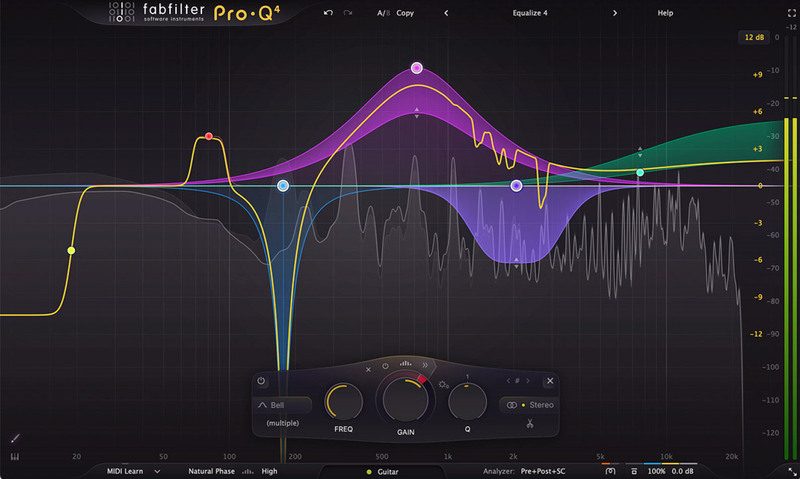
Now, and only now, reach for EQ. Put it on the string bus.
A dip of 2 to 3dB between 1.5kHz and 3kHz on the strings opens the region where woodwind presence lives. It is a wide, gentle cut, one to one and a half octaves of Q, and at that depth nobody will hear it as an effect on the strings.
The instinct is to boost the flute in the same region instead. Do not. A woodwind's identity lives in its breath noise and its attack, and a broad boost raises the sustained tone without raising either, which is why boosted woodwinds sound like a synth patch pretending to be a flute.
The friction is that this cut fights your string tone if you go past about 3dB, and the point where it starts to matter varies with the library. Automate it in only where the winds are actually playing rather than leaving it across the cue, which costs you a minute and keeps the strings intact everywhere else.
Use the Mic Positions Against Each Other
Most orchestral libraries ship several microphone positions, and most people set them once for the whole template. That is a wasted lever.
Put the woodwinds on a close-weighted balance and the strings on a hall-weighted one, in the same reverb. The winds get their attack and breath, the strings keep their space, and the two sections separate without either changing level.
This works because distance and level are separate cues in hearing. Something can be quiet and close, and the ear reads close as important, which is exactly the impression a wind solo needs.
The cost is RAM. Loading two mic positions on the woodwind section roughly doubles its memory, and on a large template that is a real constraint rather than a theoretical one. Do it for the sections that carry a line, not for the whole family.

Test It With the Strings Muted
The last check takes ten seconds and it catches the thing none of the above can fix.
Mute the strings and listen to the wind line alone. If it is dull, aimless or rhythmically flat on its own, it was never going to survive company, and no register change or EQ move will rescue it. A line that is interesting alone usually survives a texture. A line that is filler usually does not, and hearing it naked is the fastest way to tell the difference.
Then unmute and listen once at a genuinely loud level, because that is where masking is worst and where the director will play it.
If it holds at both, it holds.
The Order Matters More Than the Moves
Register, then doubling, then EQ, then mic positions. Every one of those is a real tool and the sequence is the part people get wrong, because EQ is the one that feels like mixing and it is the one with the least room in it.
Fixing this in the notes costs an edit. Fixing it at the fader costs a mix that never quite works and that you will keep returning to.
Related Articles

Best Fantasy Orchestras (2026): Magic & Wonder
Score your RPG. We review the best orchestral libraries (Albion One, Fantasy Orchestra) specifically designed for magic and wonder.
Best Free Orchestral VSTs for Composers on a Budget
The free orchestral libraries actually worth your disk space, and an honest account of where each one stops being enough.
Best Orchestral EQs (2026): Clean & Surgical
Don't color the sound. We look at the most transparent EQs (Pro-Q 4, Oxford EQ) for carving out space in dense orchestral templates.
Frequently Asked Questions
Why can I not hear my woodwinds even at full volume?
Because volume is not the problem. A flute and a violin section playing the same octave occupy nearly the same frequency range, and the strings have twenty times the acoustic energy, so the flute is masked rather than quiet. Raising its fader makes the mix louder without making the flute more audible, which is why the fix is register and orchestration rather than level.
Should I EQ the woodwinds or the strings?
The strings, almost always. Boosting a flute at 2kHz thins it and pushes it toward sounding like a synth patch, while a 2dB dip in the same region on the string bus opens a hole the flute walks straight into. Cut the section that has energy to lose, not the one that is already losing.
How high should I write woodwinds to keep them audible?
In practice, a fifth or more above the top string line is where a flute stops fighting and starts floating. Oboes cut through lower because their tone is reedier and more harmonically dense, so an oboe can hold its own in the same octave as first violins where a flute cannot. Clarinets in their low register are the hardest to place, because that is exactly where violas live.
Does doubling woodwinds make them louder?
Only by about 3dB, and that is not the reason to do it. Two flutes in unison sound thicker and slightly less precise than one, which reads to the ear as a section rather than a soloist, and that change in character is often what actually makes the line hold its place. If you need 10dB you need a different octave, not more players.
Why do my woodwinds sound synthetic when I boost them?
Because most of a woodwind's identity lives in the breath noise and the attack, and a broad boost at 2 to 4kHz raises the sustained tone without raising either. The result is loud and characterless. Reach for the close mic position instead, which brings up the breath along with the note.
More Guides
All Guides →Divisi Strings Explained, and Why Your Chords Sound Like a Wall
Sixteen violins playing one line is a section. Sixteen violins split four ways is four thin sections. When divisi helps, when it costs you, and how to fake it in samples.
Layering Two String Libraries Usually Makes Things Worse
Stacking two libraries on one line gives you comb filtering and two halls fighting. The four conditions that make layering work, and the alignment step everyone skips.
EQ Strategies for Virtual Orchestras: Surgical Frequency Carving
An advanced guide to removing resonant mud, harsh brass buildup, and masking frequencies from dense orchestral mockups.
New reviews, no noise
Occasional email when we publish something worth your time. No daily digest, no vendor press releases.
We store only your address, never sell it, and delete it as soon as you unsubscribe. See our privacy policy.

Louis Raveton
Louis works across immersive scores (Venice Biennale, LVMH) and animation (Canal+), while producing Downtempo and Electro-Dub as Monsieur Shwill and Flagada. He treats his sample drive like a record collection, constantly hunting for the perfect 'imperfect' texture