Best Free Orchestral VSTs for Composers on a Budget

Free orchestral libraries used to mean unusable. That changed. Three of them are good enough to keep on a professional template, and knowing exactly where each one runs out of road matters more than the price.

Louis Raveton
By Louis Raveton Composer & Lead Editor at MODWHEEL

ModWheel is reader-supported. When you buy through links on this page we may earn an affiliate commission, at no extra cost to you. This never influences which products we recommend, read our testing methodology.

Prices come from the store's own feed and were last checked 1 September 2026. We don't issue discount codes — the price you see is the store's own.

Pick one in 10 seconds

Short version
  • You want a real scoring stage sound and will accept ensemble patches Layers
  • You want to pick individual colours and keep the download small LABS
  • You need every section of the orchestra and will do the mixing VSCO 2 Community Edition

Compare all 5

1. LABS Spitfire Audio
7.8
Format
Spitfire Player
Format
Spitfire Player
Format
Kontakt Player
4. Layers Orchestral Tools
8.2
Format
SINE Player
5.8
Format
SFZ / Kontakt

Free orchestral sampling has improved enormously, largely because the big developers now use free libraries as a route into their ecosystems. That is a fair trade if you go in knowing it.

What matters when judging a free library is not whether it sounds expensive. It is whether it does one job well enough that you would not replace it, and whether the limitations are the kind you can write around.

These five are the ones worth the download. Every one is genuinely free with no time limit, and every one has a ceiling described plainly rather than buried.

Best Cinematic String Libraries for 2026 covers the paid libraries these are measured against.

Top Picks

01 Spitfire Audio

LABS

Best for Sketching

Not tested by us, assessed from specs and documented behaviour

The widest range of usable colour available for nothing, provided you never need a second microphone position.

Assessed score
7.8
out of 10

How it scored

  • Tone 8.5

    Characterful rather than complete, and several packs stand up against paid libraries.

  • Playability 7.0

    One mic, minimal articulation switching, and one dynamics control.

  • Mix Readiness 8.0

    Sits with very little work, because the packs are curated rather than raw.

Why we picked it

Composers who need usable orchestral colour immediately and want to choose packs individually rather than commit disk space up front.

Who should skip it

You need deep articulation control or multiple microphone positions for detailed orchestral mockups.

The good

  • Genuinely free, no upsell
  • Wide range of instrument colours
  • Small download per pack

The bad

  • One microphone position only
  • Minimal articulation switching
  • Requires the Spitfire player
Format
Spitfire Player
Price
Check site
Size
Varies by pack
Why it scored that way

The widest range of usable colour available for nothing.

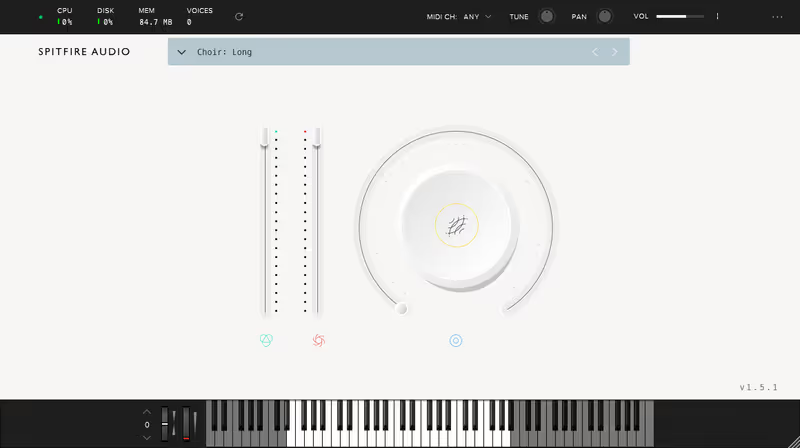
LABS is a series rather than a single library, and that is the point. Each pack is small, focused and free, covering everything from soft strings and choir through to prepared piano and more experimental textures. The download size per pack is modest, so you can take only what you need instead of committing 40 GB to find out whether you like it. For a composer building a first sketch template, that is a genuinely different proposition to the all-or-nothing paid libraries.

The constraint is depth rather than quality. Each pack gives you one microphone position and minimal articulation switching, so a LABS string patch will hold a sustained pad convincingly but will not carry an exposed melodic line the way a paid legato engine does. That is a reasonable trade at the price, and the honest way to use LABS is as colour and texture underneath better-sampled lead parts rather than as the foundation of an orchestral mockup.

Playing connects you to YouTube, which may set cookies.
Check price
02 Spitfire Audio Best Overall

BBC Symphony Orchestra Discover

Best for First Orchestra

Not tested by us, assessed from specs and documented behaviour

The single best starting point here, because it is a complete orchestra from the same sessions as the paid editions rather than a selection of colours. The one mic position is the ceiling, and it is a reasonable one.

Assessed score
8.3
out of 10

How it scored

  • Tone 8.8

    The same Maida Vale sessions as the Core and Professional editions, at one mic position.

  • Playability 7.5

    47 techniques across 34 instruments, switched rather than crossfaded.

  • Mix Readiness 8.5

    A single curated mix signal, so it sits without much work and cannot be reshaped.

Why we picked it

Best as a first orchestral library, for sketching, and for learning orchestration against a real orchestra rather than a selection of patches.

Who should skip it

Skip it if you need to rebalance the room, because one mic position and one mix signal is the whole ceiling here.

The good

  • Complete orchestra, not a selection
  • Real Maida Vale recordings
  • Straight upgrade path to paid

The bad

  • One mic position only
  • No room rebalancing
  • Requires the Spitfire app
Format
Spitfire Player
Price
Check site
Size
240 MB
Why it scored that way

A whole orchestra, recorded at Maida Vale, in 240 megabytes.

This is the free library most orchestral writers should install first, and the reason is scope rather than sound. LABS gives you excellent individual colours and Layers gives you a convincing blend, where Discover gives you an actual orchestra: 34 instruments across strings, brass, woodwinds and percussion, with 47 playing techniques between them, all from the same Maida Vale sessions that produced the paid editions of the same library.

At 240 MB that is a remarkable ratio, and the reason it fits is the ceiling. There is one mic position and one curated mix signal, so the room is baked in and cannot be rebalanced later. For sketching, for learning orchestration, and for any cue where the orchestra is not the featured element, that is a trade worth making. For a finished score it is the point at which you upgrade, which is precisely what Spitfire built it to lead to.

The other thing it buys is a straight upgrade path, and that is worth more than it sounds. Core and Professional are the same recordings with more microphone positions and more techniques, so a sketch built in Discover transfers into them rather than needing to be rebuilt. Moving between two different developers' libraries offers no such continuity, because the rooms, the players and the articulation names all change at once.

Playing connects you to YouTube, which may set cookies.

Check price
03 ProjectSAM

The Free Orchestra

Best for Cinematic Gestures

Not tested by us, assessed from specs and documented behaviour

The one here aimed at trailer and cue writing rather than at orchestration, and the only one that runs in Kontakt Player, which matters if your template already lives there.

Assessed score
8.0
out of 10

How it scored

  • Tone 8.0

    ProjectSAM's cinematic character, drawn from their paid libraries.

  • Playability 7.5

    Multis and an all-in-one browser, built for reaching a gesture quickly.

  • Mix Readiness 8.5

    Processed for cues rather than neutral, so it sits immediately.

Why we picked it

Best for trailer and cue work, and for anyone whose template is already built around Kontakt rather than a proprietary player.

Who should skip it

Skip it if you want neutral orchestral instruments to orchestrate with, because this is pre-shaped cinematic material.

The good

  • Runs in free Kontakt Player
  • Real ProjectSAM cinematic character
  • Multis reach a sound fast

The bad

  • Gestures, not an orchestra
  • Heavily processed already
  • Needs Kontakt Player 6.2.1
Format
Kontakt Player
Price
Check site
Size
Varies by instrument
Why it scored that way

Cinematic gestures rather than an orchestra.

This one is a different proposition from the rest of the page. Where Discover and VSCO 2 give you instruments to orchestrate with, The Free Orchestra gives you gestures: risers, stabs, ensemble hits and the kind of pre-shaped cinematic material that ProjectSAM's paid libraries are known for. It is closer to a trailer toolkit than to an orchestra.

That makes it complementary to the rest of this page rather than competing with it. A composer with Discover installed for the orchestra and this installed for the gestures has covered two genuinely different jobs for nothing, and neither one makes the other redundant. It is the rare case where installing two free libraries is better than choosing between them, because they are answering different questions about what a cue is missing.

The practical argument for it is the player. It runs in the free Kontakt Player, which means it lands in a library list most composers already have open rather than requiring another application and another account. Against that, the material is processed rather than neutral, so it is harder to fit into a cue that is not already going in a cinematic direction. ProjectSAM also ship a second volume under the same name, so check which one you are downloading if you want the larger set.

Check price
04 Orchestral Tools

Layers

Best for Ensemble Sketching

Not tested by us, assessed from specs and documented behaviour

Teldex for nothing, which buys you a convincing blend and no ability to separate the sections afterwards.

Assessed score
8.2
out of 10

How it scored

  • Tone 9.0

    A real scoring stage, which is the thing a free library almost never has. Best here.

  • Playability 6.5

    Ensemble patches only, with no divisi and a limited dynamic sweep. Lowest here.

  • Mix Readiness 9.2

    Blends out of the box, so no reverb work is needed to place it. Best on the page.

Why we picked it

Composers who want a professionally recorded ensemble sound for quick orchestral sketches without buying into the Berlin range first.

Who should skip it

You need individual sections you can balance and edit independently of each other.

The good

  • Recorded on a real scoring stage
  • Blends convincingly out of the box
  • No cost, no time limit

The bad

  • Ensemble patches only, no divisi
  • Requires the SINE player
  • Limited dynamic range on tap
Format
SINE Player
Price
Check site
Recorded
Teldex Scoring Stage
Why it scored that way

Teldex room tone, for nothing.

Layers gives you combined ensemble patches recorded at Teldex, the same room behind Berlin Strings and much of the Orchestral Tools catalogue. That matters more than the patch count. A free library recorded in a real scoring space blends convincingly out of the box, where a dry free library needs reverb work before it sits anywhere. If you have heard the Berlin libraries and wondered what the room does, Layers is the cheapest way to find out.

The limitation is structural. These are ensemble patches, so you get the sections playing together rather than instruments you can balance independently. That rules out real orchestration work, where the whole point is controlling the relationship between sections. Treat Layers as a fast way to sketch a full orchestral texture, not as something you can voice properly, and it earns its place on the drive.

Playing connects you to YouTube, which may set cookies.
Check price
05 Versilian Studios

VSCO 2 Community Edition

Best for Full Orchestra

Not tested by us, assessed from specs and documented behaviour

The only free library that covers the whole orchestra, at a consistency you will spend real time fixing.

Assessed score
5.8
out of 10

How it scored

  • Tone 6.0

    Varies section by section, which is what a community recording effort produces. Lowest here.

  • Playability 7.5

    Full coverage in SFZ, so it runs without a Kontakt licence at all.

  • Mix Readiness 4.0

    Needs significant mixing before anything sits. Lowest on the page.

Why we picked it

Composers who want full orchestral coverage and are comfortable working around inconsistent recording quality.

Who should skip it

You need consistent quality across every section without doing significant mixing work.

The good

  • Covers the whole orchestra
  • Public domain, no usage limits
  • Runs in free SFZ players

The bad

  • Recording quality varies by section
  • Sparse dynamic layers throughout
  • Needs heavy mixing to sit
Format
SFZ / Kontakt
Price
Check site
Licence
Public domain
Why it scored that way

The only free library that covers the whole orchestra.

VSCO 2 Community Edition is the outlier here because it covers the entire orchestra rather than a curated slice of it. Strings, brass, woodwinds and percussion are all present, released into the public domain, and available in SFZ so you can run it in a free player without any Kontakt licence at all. For a student, a hobbyist, or anyone who needs to hear their orchestration rather than sell it, nothing else free comes close on breadth.

Breadth is also the problem. Recording quality varies noticeably between sections, dynamic layers are sparse, and a good deal of mixing is needed before it sounds like one ensemble rather than several separate recordings. Anyone expecting the polish of LABS or Layers will be disappointed. Anyone who needs every instrument represented and is willing to work will find it does a job the other two cannot.

Check price
Read more →

Methodology

Who is this for

Working composers and producers who need reliability, speed, and character for professional scoring tasks.

Our testing process

Where we have tested a product, we do it in actual production scenarios, ranging from rapid sketches to commercial pitches, and we evaluate it in a dense template rather than in isolation. Where we have not, the product card says so and the assessment is drawn from specifications and documented behaviour instead.

Why you should trust us

We buy most reviewed plugins ourselves. Occasionally we receive NFRs for evaluation, but this never guarantees a review or positive verdict. We may earn commissions from links, but our editorial choices are never for sale.

Also considered

For every category, we audition the top 8 to 15 standard options, discarding any that suffer from poor scripting, slow load times, or uninspiring sampling.

Frequently Asked Questions

Can you write a real score with free libraries?

You can write and demonstrate one, and you will hit a ceiling on delivery. Free libraries are enough to hear your orchestration, pitch an idea and learn the craft, and they generally lack the dynamic layers and articulation depth that a final mockup needs. Many working composers still keep one or two loaded for colours their paid libraries do not cover.

What is the real limitation of a free orchestral library?

Dynamic layers, more than anything else. Paid libraries record the same note at several intensities so the timbre changes as you push, where a free library often has one or two, which is why crescendos sound like volume rather than effort. A single microphone position is the second limitation and matters much less.

Can I use free libraries in commercial work?

Usually yes, and you have to check each one. Most free orchestral libraries allow the music you make with them to be sold and licensed, while forbidding redistribution of the samples themselves. Anything released into the public domain removes the question entirely, so read the licence before a client delivery rather than after.

What should I buy first when I outgrow free libraries?

Strings. They carry the majority of most cues and they are the section where limited dynamics and missing legato show up soonest, so the upgrade changes more than any other single purchase. Brass and percussion are easier to fake for longer.

Written By

Louis Raveton

Louis works across immersive scores (Venice Biennale, LVMH) and animation (Canal+), while producing Downtempo and Electro-Dub as Monsieur Shwill and Flagada. He treats his sample drive like a record collection, constantly hunting for the perfect 'imperfect' texture

Related Guides

All Guides →

New reviews, no noise

Occasional email when we publish something worth your time. No daily digest, no vendor press releases.

We store only your address, never sell it, and delete it as soon as you unsubscribe. See our privacy policy.