Heavyocity · Review

Heavyocity FORZO Modern Brass Review

A full review of FORZO Modern Brass: what the Evolve engine and Loop Designer actually do, where the core orchestral patches fall short, and who should buy it.

Verdict

Buy it if you write trailer and hybrid cues and want brass that behaves like a synthesizer. Skip it if you need noble, traditional legato. FORZO is not built for that and does not pretend to be.

ModWheel is reader-supported. When you buy through links on this page we may earn an affiliate commission, at no extra cost to you. This never influences which products we recommend, read our testing methodology.

01 Heavyocity

FORZO Modern Brass

Best for Trailer Design

The fastest route to trailer tension here and no help at all if the cue needs a tune.

Score
7.8
out of 10

How it scored

  • Dynamic Range 9.2

    Built to be pushed. Aggressive all the way to the top.

  • Attack Speed 8.8

    Shorts are sharp, and the loop engine adds rhythm you did not program.

  • Tone 7.5

    Very specific and very modern. Traditional writing will fight it.

  • Footprint 5.5

    16 GB and demanding once the sound design layers are running.

Why we picked it

Best for trailer composers who need to generate tension and braaams quickly.

Who should skip it

Skip this if you need to write a traditional John Williams-style melody.

The good

  • Incredible sound design tools
  • Rhythmic loop engine
  • Very aggressive tone

The bad

  • Not for traditional melody
  • Very specific sound
  • CPU intensive
Engine
Kontakt Player
Type
Hybrid Brass
Size
16 GB
Price
$549
Why it scored that way

Half orchestra, half synthesizer.

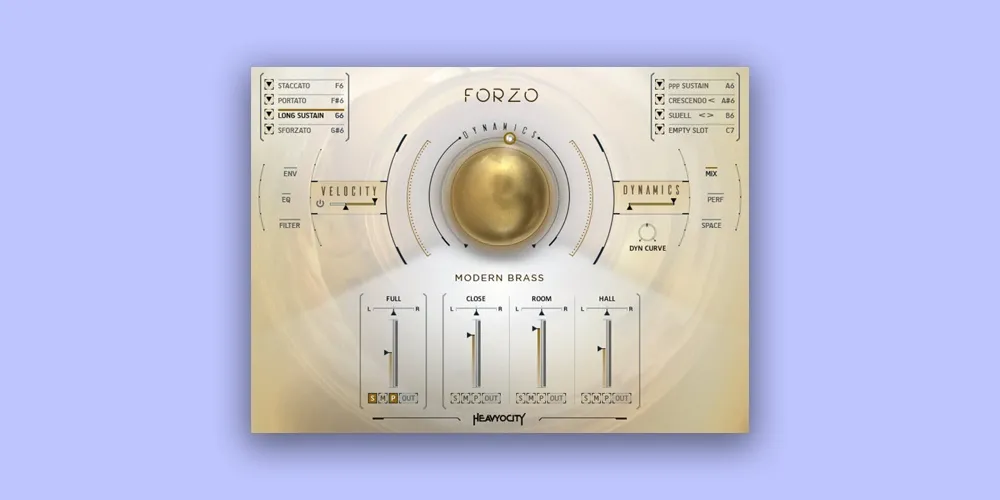
My Experience: Heavyocity doesn't make "traditional" instruments. They make weapons. Forzo captures a massive brass section, but then runs it through their "Evolve" engine. This allows you to mangle the organic samples into rhythmic pulses, distorted pads, and cinematic risers. It is my secret weapon for "hybrid" scores where orchestral brass needs to blend with synths. It essentially turns the brass section into a massive, breathing synthesizer that retains organic weight.

Deeper Look: The core orchestral patches are surprisingly good. Very punchy and aggressive. They lack the noble legato of CineBrass, but they make up for it with sheer aggression. But the "Loop Designer" is the star. You can instantly create complex, syncopated brass rhythms that would take hours to program manually. It fills the frequency spectrum in a way standard libraries can't. It is designed for maximum impact with minimal fuss, perfect for modern trailer workflows.

Playing connects you to YouTube, which may set cookies.

Heard on
Sci-Fi Scores Horror Trailers Hybrid Action
Check price $549

FORZO sits in an odd place in the brass category. It is not competing with CineBrass or the Hollywood series on realism, and reviewing it as though it were misses the point. Heavyocity built a hybrid instrument, and it should be judged as one.

What it actually is

A large brass section, sampled properly, then routed through Heavyocity’s Evolve engine. That engine is what separates FORZO from a conventional library: it lets you mangle the organic recordings into rhythmic pulses, distorted pads and risers without leaving the instrument.

The practical effect is that the brass section behaves like a synthesizer while keeping the weight of real players. That is a genuinely useful thing to own when a cue needs orchestral brass and synths to occupy the same space without fighting.

The Loop Designer is the reason to buy it

The core orchestral patches are punchy and aggressive, and better than you might expect from a library sold on its sound design. But they are not the selling point.

The Loop Designer is. It builds complex, syncopated brass rhythms in minutes that would otherwise be a long programming session, and it fills the frequency spectrum in a way standard sustains and shorts do not. If you write to picture on trailer deadlines, that is the feature that earns the money back.

Where it falls short

FORZO lacks the noble legato that CineBrass and the traditional libraries are built around. It compensates with aggression, which works for the material it is designed for and does not work at all for the material it is not.

If your next cue is a broad, singing melodic brass line in the John Williams tradition, FORZO is the wrong instrument. That is not a defect (it is a scope decision Heavyocity made deliberately), but it does mean FORZO is rarely the only brass library on a template.

Specs and footprint

EngineKontakt Player
TypeHybrid Brass
Size16 GB

16 GB is modest for a brass library of this size, and it runs in the free Kontakt Player, so it does not require a full Kontakt licence.

Who should buy it

Trailer composers, hybrid scorers, and anyone whose work sits between orchestral and electronic. If you already own a traditional brass library and keep reaching for distortion and rhythmic processing to make it sit in a modern cue, FORZO does that job properly and faster.

If you own no brass at all, buy a traditional library first and add FORZO second.

Written By

Louis Raveton

Louis works across immersive scores (Venice Biennale, LVMH) and animation (Canal+), while producing Downtempo and Electro-Dub as Monsieur Shwill and Flagada. He treats his sample drive like a record collection, constantly hunting for the perfect 'imperfect' texture

Related Guides

All Guides →

New reviews, no noise

Occasional email when we publish something worth your time. No daily digest, no vendor press releases.

We store only your address, never sell it, and delete it as soon as you unsubscribe. See our privacy policy.