
Do This Now
- 1 The mod wheel sends MIDI CC1 and nothing else. Everything it appears to do is decided by the instrument receiving it.
- 2 On a synth CC1 usually adds vibrato. On an orchestral sample library it usually changes dynamics. Same wheel, unrelated jobs.
- 3 Pitch bend springs back to centre, the mod wheel stays where you leave it. That is why the wheel suits sustained shaping and the bender does not.
- 4 A mod wheel that does nothing is almost always an unmapped patch, not broken hardware. Check the instrument first, the cable second.
- 5 Any fader, knob or expression pedal set to CC1 is a mod wheel. The wheel has no special status in the protocol.
Playing connects you to YouTube, which may set cookies.
The mod wheel is the wheel or lever sitting to the left of the keys on almost every MIDI keyboard, usually next to a second, spring-loaded one. It does exactly one thing: it sends MIDI CC1, a value between 0 and 127, and it keeps sending it as you move.
That is the whole of what the hardware does. Everything else people attribute to the mod wheel, vibrato, swells, filter sweeps, dynamics, is decided by the instrument on the receiving end. The wheel is a message, not an effect.
Why It Is Called Modulation
The name is a historical accident that stuck. On early synthesisers there was essentially one thing worth putting on a spare controller: the depth of a low-frequency oscillator, which wobbles pitch or volume to produce vibrato or tremolo. That is modulation in the literal sense, one signal modulating another, and the wheel that controlled its depth became the modulation wheel.
The MIDI specification, published in 1983, wrote that convention into the protocol as CC1 and named it Modulation Wheel. The name has outlasted the assumption behind it by four decades. Very little of what CC1 controls today is modulation in the original sense.
The Same Wheel Means Two Different Things
This is the part that confuses people coming to sample libraries from synths, and it is worth being blunt about because nothing in the interface warns you.
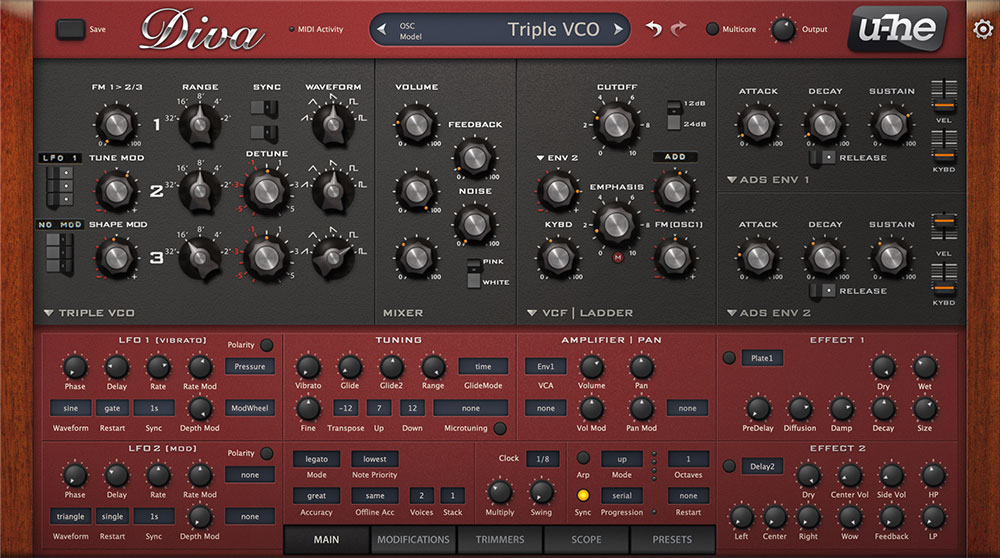
On a synthesiser, CC1 is almost always routed to LFO depth. Push the wheel up and the note starts to waver. It is an ornament you add to a note that already sounds the way you want.
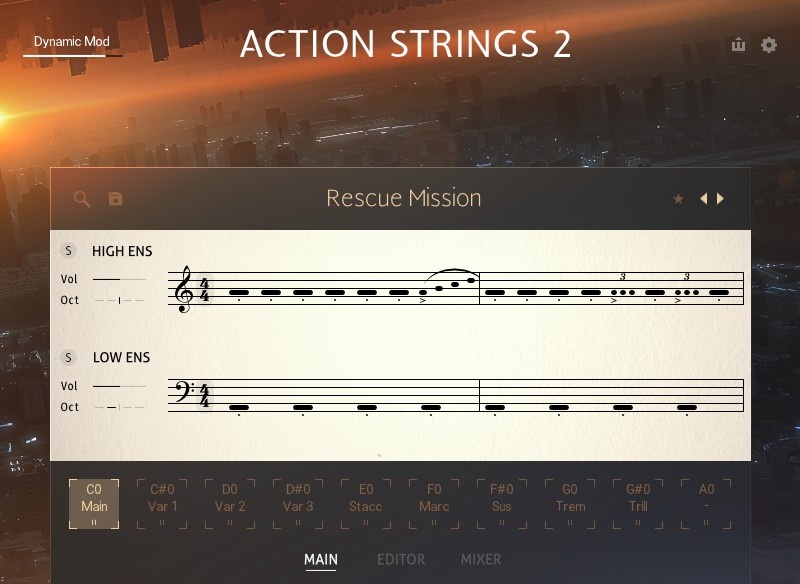
On an orchestral sample library, CC1 almost always controls dynamics. The library contains the same note recorded several times at different playing intensities, and the wheel crossfades between those recordings. At the bottom you get the quietest take, at the top the loudest, and the tone changes along with the volume because a real player pushing harder does not simply get louder. Leave the wheel down and a string section will sound like it is asleep, no matter how hard you hit the keys.
- On a synth
- LFO depth, adds vibrato
- On a sample library
- Dynamics, crossfades recorded layers
- MIDI message
- CC1, values 0-127
- Position
- Holds where you leave it
Neither behaviour is more correct. They are two conventions that grew up in different places and now share a controller number.
Playing connects you to YouTube, which may set cookies.
Why Velocity Cannot Do This Job
Velocity is fixed at the instant a note begins. For a piano or a drum that is fine, because the whole event happens at the attack and nothing about it changes afterwards.
A bowed or blown note is not like that. A cello can start quiet and swell for four seconds, and the timbre at the end is genuinely different from the timbre at the start, not just louder. Velocity has no way to express that, because by the time the swell happens the velocity value is already history. The mod wheel can, because it keeps transmitting for as long as the note lasts.
That is the entire reason orchestral libraries adopted CC1 for dynamics rather than leaving it on velocity.
When the Mod Wheel Appears to Be Broken
Almost every "my mod wheel does nothing" turns out to be a mapping problem rather than a hardware one. Work through it in this order:
- Check the DAW is receiving CC1 at all. Every DAW has a MIDI monitor or an input meter. Move the wheel and watch for the value changing. If nothing arrives, the problem is the cable, the port or the keyboard's own MIDI channel setting.
- Check the patch listens for it. A synth preset with no modulation routing, or a library patch whose dynamics run on velocity, will ignore a perfectly working wheel. Load a patch you know responds and compare.
- Check nothing else has claimed it. A track that already has CC1 automation drawn on it will fight your hand in real time, and the automation usually wins.
Only after all three should you suspect the hardware. Wheels do wear out, and a mod wheel that jitters or sticks at a value with nothing touching it is a genuine fault, but it is far rarer than a patch that was never mapped.
You Do Not Need an Actual Wheel
Nothing in MIDI privileges the wheel. Any control set to send CC1 is functionally a mod wheel, and for sustained writing most people end up preferring something else.
A fader has a longer physical throw than a wheel, which makes a slow eight-bar swell far easier to perform smoothly. An expression pedal frees both hands, which matters if you are playing the part rather than drawing it. A breath controller maps CC1 to actual breath pressure, which is as close as sampled writing gets to phrasing a wind line the way a player would.
The wheel's real advantage is that it is already there, under your left hand, on the keyboard you own.
Where to Go Next
If you have got this far, the useful next step is learning how CC1 combines with the other controllers a library listens for, particularly CC11 for expression and CC21 for vibrato, and how to record all of them in a single performance pass rather than drawing curves afterwards. Our guide to MIDI CCs for orchestral programming covers that in detail.
Related Articles
Best Analog Emulations (Jupiter-8, Juno-106) for Producers
Warm, fat, and vintage. We review the top analog modeling plugins (Arturia, u-he Diva) that capture the behavior of real hardware.
The Best Cinematic String Libraries for 2026
We tested the top string libraries for film scoring. From the lush legatos of CSS to the intimacy of Spitfire, find the best VSTs for emotional writing.
Best Emotional Cellos (2026)
Reviewing the most expressive cello VSTs. We compare Tina Guo, Emotional Cello, and others to find the perfect solo sound.
Frequently Asked Questions
What MIDI CC is the mod wheel?
CC1, defined as Modulation Wheel in the MIDI specification. It transmits a value from 0 to 127, where 0 is the wheel fully down and 127 is fully up. The number is fixed across every manufacturer, which is why a mod wheel on any keyboard reaches any instrument that listens for CC1.
What is the difference between the mod wheel and pitch bend?
Pitch bend is spring-loaded and returns to centre when you let go, and it is not a CC at all but its own MIDI message with much finer resolution. The mod wheel stays wherever you leave it and sends CC1. That difference in behaviour is the point: bends are gestures you release, modulation is a state you hold.
Why does my mod wheel do nothing?
Nine times out of ten the patch has nothing mapped to CC1. A synth preset with no LFO routed to the wheel, or a sample library patch whose dynamics run on velocity, will both ignore it completely while the hardware works perfectly. Check that your DAW is receiving CC1 on the track's MIDI monitor before assuming the keyboard is at fault.
Is the mod wheel the same as expression?
No. Expression is CC11 and typically controls output level only. CC1 on a sample library usually crossfades between differently recorded dynamic layers, so it changes tone as well as volume. A crescendo on CC11 sounds like someone moving a fader; the same crescendo on CC1 sounds like a player pushing harder.
Can I use a fader instead of a mod wheel?
Yes, and for long sustained lines most people prefer one. Assign any fader, knob or expression pedal to CC1 and the receiving instrument cannot tell the difference. A fader gives you a longer physical throw than a wheel, which makes slow dynamic swells easier to perform smoothly.
Why is the mod wheel on the left of the keyboard?
It is a convention inherited from the Minimoog, which put a pitch wheel and a modulation wheel to the left of the keys so a right-handed player could shape a note with their left hand while playing the melody. Almost every keyboard since has copied the layout.
More Guides
All Guides →Why Your Strings Sound Fake, and It Is Not the Library You Bought
Sampled strings give themselves away on note starts, not on tone. How to measure a legato patch's attack delay, set negative track delay per articulation, and stagger section entries.
Building a Hybrid Scoring Template: Merging Orchestra and Synths
A technical walkthrough of routing, stemming, and balancing orchestral sample libraries with modern analogue synthesizers.
Divisi Strings Explained, and Why Your Chords Sound Like a Wall
Sixteen violins playing one line is a section. Sixteen violins split four ways is four thin sections. When divisi helps, when it costs you, and how to fake it in samples.
New reviews, no noise
Occasional email when we publish something worth your time. No daily digest, no vendor press releases.
We store only your address, never sell it, and delete it as soon as you unsubscribe. See our privacy policy.

Louis Raveton
Louis works across immersive scores (Venice Biennale, LVMH) and animation (Canal+), while producing Downtempo and Electro-Dub as Monsieur Shwill and Flagada. He treats his sample drive like a record collection, constantly hunting for the perfect 'imperfect' texture