Modartt · Review

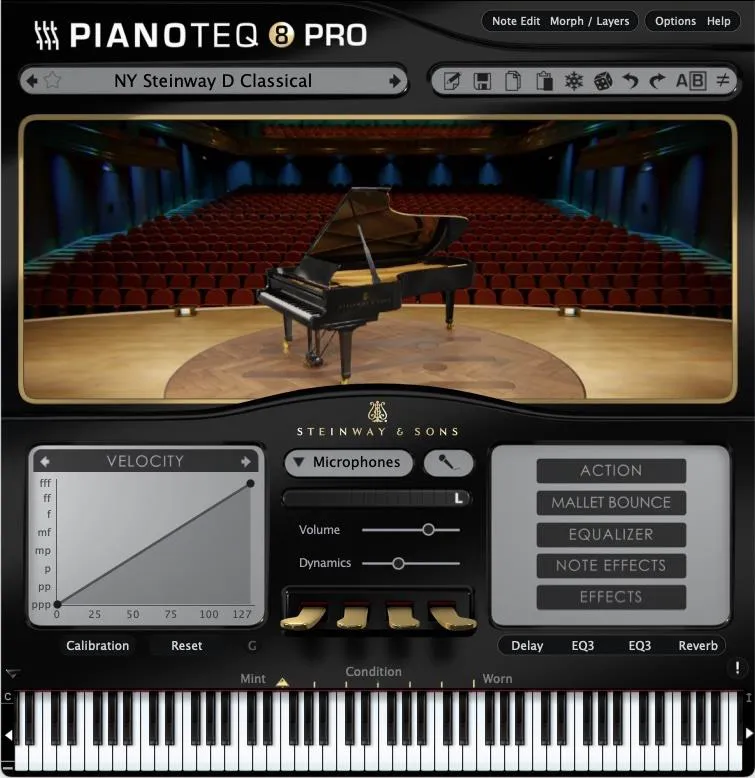
Modartt Pianoteq 8 Review

Fifty megabytes that outplay libraries a thousand times the size. What modelling gives Pianoteq 8 that sampling cannot, and the tonal cost of getting it.

Verdict

Buy it for how it plays. Nothing sampled responds like this, it installs in fifty megabytes and it loads instantly, which changes what you reach for at two in the morning. Do not buy it if you need one specific vintage recording — a model gives you an instrument, not a document.

Playing connects you to YouTube, which may set cookies.

A tour of what is new in Pianoteq 8 with lots of playing, including the classical guitar model, the electric pianos and the add-on piano packs. “PIANOTEQ 8 | Comprehensive Demo | All The New Features” by Woody Piano Shack, on YouTube. Playing it loads the video from Google.

ModWheel is reader-supported. When you buy through links on this page we may earn an affiliate commission, at no extra cost to you. This never influences which products we recommend, read our testing methodology.

01 Modartt

Pianoteq 8

Best for Live Performance

Fifty megabytes that play better than libraries a thousand times the size, provided you can accept a modelled rather than sampled tone.

Score
8.9
out of 10

How it scored

  • Realism 7.5

    Modelled throughout, and the absent release samples are audible.

  • Playability 9.5

    The most responsive instrument here. Nothing else is close.

  • Articulation Range 8.8

    Effectively unlimited, once you learn the parameter set.

  • Footprint 9.8

    50 MB and zero load time.

Why we picked it

Best for expressive playability and extremely low disk usage.

Who should skip it

Avoid if you demand the exact static 1:1 tone of a specific vintage recording.

The good

  • Unmatched playability
  • Zero load time
  • Infinite customization

The bad

  • Can sound synthetic to some
  • Interface is complex
  • No release samples
Engine
VST/AU/AAX
Type
Acoustic Modeling
Size
50 MB
Price
Check site
Why it scored that way

The living instrument.

Pianoteq uses acoustic modeling, meaning there are no samples at all. The file size is laughable: about 50MB. But the sound is serious business. Because it generates sound in real-time, the connection between your fingers and the sound is instantaneous. There is no layer switching, no machine-gun effect. It feels incredibly liquid to play. You can modify parameters that would be impossible on a real Clavinet, like changing the string length or the hammer hardness.

I love taking the Clavinet model and morphing it into something else entirely using the morphing features. You can make a Clavinet that sounds like it's made of glass. For sound design, this is a playground. As a pure emulation, some argue it lacks a specific 'grain' that samples have, but for responsiveness and shaping your own unique tone, it is unmatched. It feels like a synthesizer disguised as a keyboard.


Heard on
Jazz Fusion Forward-Thinking Pop Live Rigs
Check price

Pianoteq is the argument that a piano is a system rather than a set of recordings. Every note is computed from a model of strings, hammers, soundboard and the interactions between them, which is why the whole thing fits in less space than a single velocity layer of a sampled grand.

Playability is the reason

This is the part that does not come across in a demo and is obvious within a minute of playing.

A sampled piano has a finite number of recorded velocities and crossfades between them. A modelled one has none, because there is nothing to cross-fade — the hammer strikes with whatever force you gave it and the model responds continuously. Repeated notes do not retrigger the same sample. Sympathetic resonance is calculated from what is actually sounding rather than approximated from a resonance layer.

For anyone who plays rather than programmes, that responsiveness is the product, and it is why the instrument turns up in live rigs where load time and disk space also matter.

The tonal trade

It is audible. The absence of release samples is the specific thing people notice: the way a real note stops carries information about the room and the mechanism, and modelling that tail is the hardest part of the problem. To some ears the result reads as slightly synthetic, particularly on solo, close-miked material where nothing else is competing.

This is a real objection and not a matter of setting. If your reference is a specific recording of a specific instrument in a specific hall, sampling is the technology built to give you that.

Customisation, and the interface

Because the instrument is parametric, almost everything is adjustable — hammer hardness, string length, unison detune, soundboard behaviour, microphone placement. You can build instruments that do not exist.

The cost is a parameter set that takes real time to learn, and an interface that presents a lot of it at once. The presets are good enough that this can be deferred indefinitely, and the depth is there when a part needs something the presets do not cover.

Specs

TypePhysical modelling, acoustic and electric keyboards
FormatsVST, AU, AAX
Size50 MB
Load timeEffectively instant

Who should buy it

Players. Anyone whose relationship with a piano is through a weighted keyboard rather than a piano roll will notice the difference immediately and will not go back.

Anyone building a mockup that has to sound like a particular record should sample instead. And anyone here for the electric keyboards specifically should read the clavinet roundup first, because Pianoteq covers them as add-ons rather than as its main event.

Written By

Ewan Clarke

Ewan is a sound designer whose patches have appeared in major wavetable synths and cinematic scoring libraries. A self-confessed modular addict, he bridges the gap between West Coast experimentation and pop-ready polish. He believes every preset should tell a story.

Read Next

More Keys →

Related Guides

All Guides →

New reviews, no noise

Occasional email when we publish something worth your time. No daily digest, no vendor press releases.

We store only your address, never sell it, and delete it as soon as you unsubscribe. See our privacy policy.