XLN Audio · Review

XLN Audio RC-20 Retro Color Review

A full review of RC-20 Retro Color: what the six modules do, why the Magnitude slider is the best idea in the plugin, and where its broad-strokes approach runs out.

Verdict

Buy it if you want a complete vintage character in one window and value speed over precision. Skip it if you need surgical control, because every module here is deliberately broad.

Playing connects you to YouTube, which may set cookies.

An independent engineer goes through each of RC-20's six modules on real audio, then the presets, and closes with a verdict. “RC-20 by XLN Audio: Why Is Everyone In Love With This Thing?” by Geoff Manchester, on YouTube. Playing it loads the video from Google.

ModWheel is reader-supported. When you buy through links on this page we may earn an affiliate commission, at no extra cost to you. This never influences which products we recommend, read our testing methodology.

01 XLN Audio

RC-20 Retro Color

Best for Lo-Fi Keys

The fastest route to a finished lo-fi character, and it is on so many records that it can date a cue.

Score
7.4
out of 10

How it scored

  • Sound Quality 8.5

    Consistently musical across all six modules.

  • Workflow Speed 9.2

    The quickest plugin here to a usable result.

  • CPU Footprint 6.5

    500 MB and noticeably heavy for what it does.

  • Metering & Control 5.5

    Broad strokes only. No control over aliasing frequencies.

Why we picked it

Lo-Fi and Chillhop producers who need a complete "vibe" solution in one plugin to glue their tracks.

Who should skip it

You want surgical control over aliasing frequencies. It is designed for broad strokes.

The good

  • Fast workflow
  • Sounds musical
  • Versatile FX

The bad

  • Used by everyone
  • CPU heavy
  • Limited routing
Engine
VST/AU/AAX
Type
Multi-FX
Size
500 MB
Price
$29
Why it scored that way

It’s a cliché because it works. The instant Lo-Fi button.

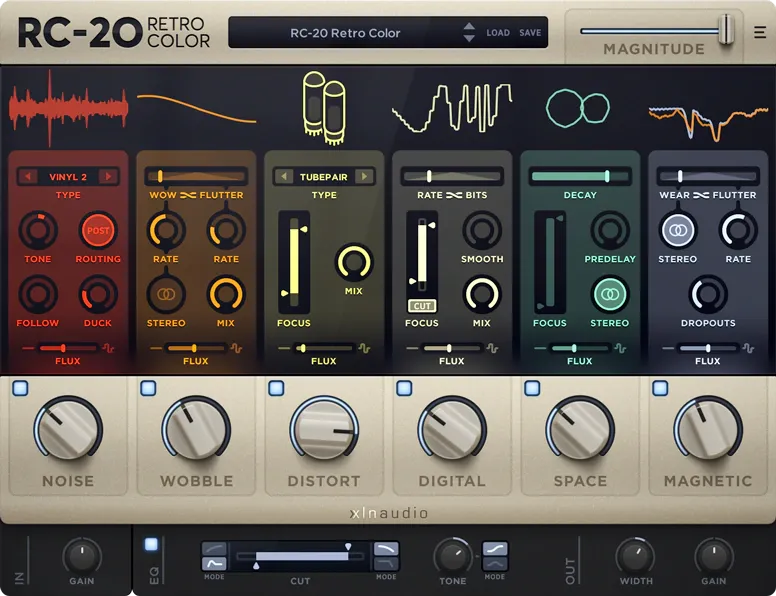
RC-20 is on every single Lo-Fi track for a reason. Its 'Digital' module is a simplified but highly musical bitcrusher that focuses on sound over specs. While it lacks the deep, surgical editing of Decimort, it compensates with incredible context and speed. Being able to combine bitcrushing with tape wobble, magnetic wear, and vinyl noise in a single cohesive interface makes dialing in a specific nostalgic vibe incredibly fast and intuitive. It focuses on the musicality of the degradation rather than the technical settings.

The "Magnitude" slider is genius-it’s a global dry/wet knob that controls the intensity of every enabled module at once. I use this for transitions. Automating the magnitude up during a breakdown makes the whole track feel like it's continuously disintegrating into dust, then snapping back to crystal clarity for the drop. It adds a dynamic performative element to what is usually a static insert effect, breathing life into the arrangement.

Heard on
Lofi Girl Modern Trap Indie Pop
Check price $29 (was $99)

RC-20 is on a very large proportion of lo-fi records, and the reason is not that any single module is best in class. It is that they are all in one place and they agree with each other.

Six modules, one decision

Tape wobble, vinyl noise, magnetic wear, digital degradation, distortion and space. Each is competent rather than exceptional, and the value is in combining them without leaving the interface or matching settings across four plugins.

The Digital module is a simplified bitcrusher that prioritises musicality over specification. It lacks the surgical editing of a dedicated tool like Decimort, and in exchange it is much faster to land on something usable.

Magnitude is the best idea in it

A global control that scales the intensity of every enabled module at once. That sounds like a convenience and functions as a creative control: you dial in a character, then decide how much of it the track can take, without rebalancing six things by hand.

It is the feature most likely to change how you work rather than just what you can do.

What it does not do

There are no internal LFOs or step sequencers, so rhythmic modulation is out. Nothing here is automatable into a performance in the way a Cableguys-style tool would be.

It is also broad by design. If you want control over specific aliasing frequencies, this is the wrong plugin and always will be.

Where it earns its place

Drum buses, where it glues transients while adding dust. Whole-mix character passes, where its coherence across modules keeps things sounding like one decision rather than four.

Specs

FormatVST / AU / AAX
ModulesSix, independently switchable
Global controlMagnitude

Who should buy it

Lo-fi, chillhop and beat producers who want a vibe solution rather than a toolkit of separate processors. Also anyone who owns four specialist plugins and never opens them because the setup cost is too high.

Skip it if precision is the point.

Written By

Henry Foster

Henry is a mixing engineer with a background in broadcast and post-production. He obsesses over signal flow, gain staging, and the subtle coloration of analog-modeled plugins. His reviews focus on technical precision, CPU efficiency, and UI workflow.

Related Guides

All Guides →

New reviews, no noise

Occasional email when we publish something worth your time. No daily digest, no vendor press releases.

We store only your address, never sell it, and delete it as soon as you unsubscribe. See our privacy policy.