Soundtoys · Review

Soundtoys Decapitator Review

A full review of Decapitator: why the Mix knob matters more than the Punish button, which saturation style to reach for, and when it is the wrong tool.

Verdict

Buy it. Decapitator is the most reliable cure for digital sterility available, it is very hard to make it sound bad, and it earns its place on almost every mix. Look elsewhere only if you need genuinely transparent warming.

ModWheel is reader-supported. When you buy through links on this page we may earn an affiliate commission, at no extra cost to you. This never influences which products we recommend, read our testing methodology.

01 Soundtoys

Decapitator

Best for Saturation

The fastest way to make a sterile track sound expensive, with no way to aim it at the band that needs it.

Score
7.0
out of 10

How it scored

  • Sound Quality 9.0

    Five analog models, all convincing, none of them subtle by accident.

  • Workflow Speed 9.3

    Drive, tone, mix, Punish. You are done in seconds.

  • CPU Footprint 6.5

    Spikes under oversampling, which is where you want it running.

  • Metering & Control 3.0

    A drive meter and nothing else. Lowest here.

Why we picked it

Best for adding character, warmth, and grit to sterile digital tracks.

Who should skip it

Skip this if you want pristine, glassy clean tones.

The good

  • Sounds expensive
  • Simple interface
  • Versatile tones

The bad

  • No multi-band
  • Fixed GUI on older versions
  • CPU spikes
Engine
VST/AU/AAX
Type
Saturator
Size
Plugin
Price
$199
Why it scored that way

Make digital sound analog.

My Experience: Digital recording is often too clean and sterile. Decapitator fixes that instantly. It models the behavior of driving high-end analog hardware inputs into the red. I use it on drums to shave off transients and add punch, on bass to add growl and upper harmonics, and on vocals to add "hair" and attitude. It sits the sound in the mix instantly, giving it a perceived loudness and weight that EQ alone cannot achieve.

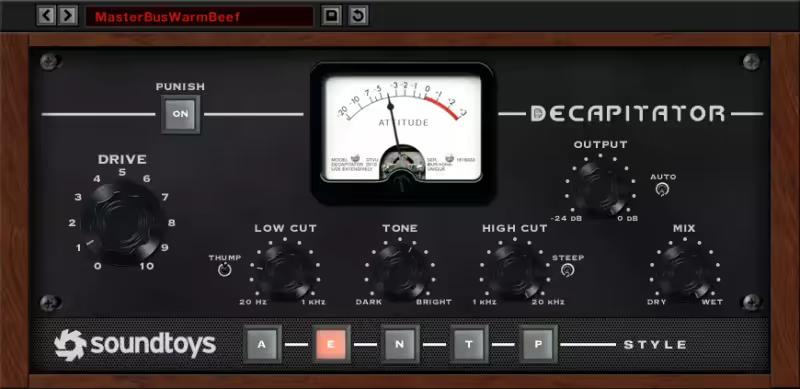
Deeper Look: The "Punish" button is famous for extreme distortion, but the real magic is in the subtlety. Using the "E" style (Chandler) with just a touch of Drive brings disparate elements together beautifully. It acts as a glue. The Mix knob is essential for parallel processing, allowing you to blend the destroyed signal with the clean one without complicated routing setups. It is the sound of "expensive."

Playing connects you to YouTube, which may set cookies.
Heard on
Tame Impala Rock Drums Vocal Sauce
Check price $199

Decapitator appears in four of our roundups, which tells you something. It is not a specialist tool that occasionally solves a problem, it is a default.

What it models

Vintage console and tape machine preamps, with enough accuracy that it holds signal depth rather than flattening it the way cheap digital clippers do. That distinction is the whole reason it survives on a mix bus.

There are several saturation styles. The E setting, modelled on the Chandler/EMI TG channel, is the one to reach for when thin bass or drum loops need thick, creamy low mids. The Tone control is a gentle tilt EQ, which is more useful than it sounds when you are matching character across a bus.

The Mix knob is the real feature

Punish gets the attention. It adds a large chunk of extra gain instantly, and it is genuinely fun for blowing something up.

But in daily use the Mix knob does the work. Parallel saturation gives a drum bus punch and vocals a grit that cuts through without committing the whole signal to distortion. Most of the time Decapitator is not a distortion plugin at all, it is a parallel weight plugin.

Where it is wrong

If you need subtle, transparent warming, this is not it. Decapitator wants to be heard, and it is at its worst when asked to be invisible.

It is also a broad-strokes tool. There is no multi-band modulation here. Reach for something else when you need surgical control rather than character.

Specs

FormatVST / AU / AAX
TypeAnalog saturation
Key controlsStyle, Drive, Tone, Punish, Mix

Who should buy it

Anyone mixing in the box who finds their material sterile, which is most people. It is also a good first saturation plugin precisely because it is difficult to make it sound bad, even pushed hard.

Skip it if your existing chain already has character you like and you need precision instead.

Written By

Henry Foster

Henry is a mixing engineer with a background in broadcast and post-production. He obsesses over signal flow, gain staging, and the subtle coloration of analog-modeled plugins. His reviews focus on technical precision, CPU efficiency, and UI workflow.

Related Guides

All Guides →

New reviews, no noise

Occasional email when we publish something worth your time. No daily digest, no vendor press releases.

We store only your address, never sell it, and delete it as soon as you unsubscribe. See our privacy policy.