Valhalla DSP · Review

Valhalla VintageVerb Review

Why a $50 reverb outperforms plugins ten times its price, what the three era modes actually change, and the one job VintageVerb is wrong for.

Verdict

Buy it. At $50 it is the best value in audio software, it runs at effectively no CPU cost, and it makes almost anything sit better in three clicks. The only reason to look elsewhere is if you specifically need convolution.

ModWheel is reader-supported. When you buy through links on this page we may earn an affiliate commission, at no extra cost to you. This never influences which products we recommend, read our testing methodology.

01 Valhalla DSP

Valhalla VintageVerb

Best for Reverb

The cheapest plugin on the list and the last one you would give up, which is the whole argument for it.

Score
7.5
out of 10

How it scored

  • Sound Quality 9.0

    Lush and wide without piling into the low mids the way cheap reverbs do.

  • Workflow Speed 9.5

    Mode, decay, mix. Three clicks to a usable space.

  • CPU Footprint 8.8

    One algorithmic engine with nothing to oversample.

  • Metering & Control 2.5

    Knobs and a mode list. Nothing to look at, by design. Lowest here.

Why we picked it

Best for lush, musical reverb on synths, vocals, and drums.

Who should skip it

Skip this if you need hyper-realistic room convolution (use Spaces II).

The good

  • Sounds amazing
  • Very affordable ($50)
  • Simple UI

The bad

  • Not realistic spaces
  • UI is flat
  • No dynamic ducking
Engine
VST/AU/AAX
Type
Algorithmic Reverb
Size
Plugin
Price
Check site
Why it scored that way

The $50 reverb that beats the $500 ones.

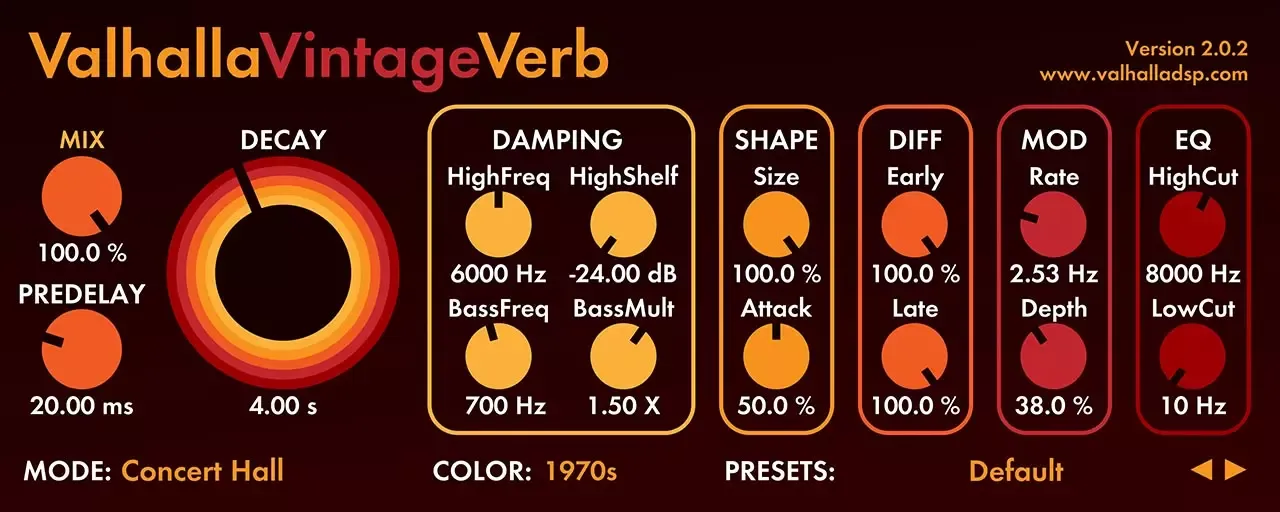
My Experience: Valhalla VintageVerb is a phenomenon in the industry. It accurately models the "artifacts," noise, and darker tone of vintage 1970s and 80s hardware digital reverbs. It sounds lush, wide, deep, and musical. It sits in a mix incredibly well without muddying up the low mids, which is a common problem with cheap reverb plugins. It has a "glue" factor that brings elements into the same space effortlessly.

Deeper Look: The specific "1970s", "1980s", and "NOW" modes change the internal downsampling and bandwidth behavior, allowing for different eras of fidelity. The "Concert Hall" and "Plate" algorithms are legendary for a reason. It is arguably the most popular reverb in the world right now purely because it makes everything sound simply "better" with three clicks. It punches way above its price class.

Playing connects you to YouTube, which may set cookies.

Heard on
Everyone EDM Pop Vocals
Check price

There is not much suspense in this one. VintageVerb has been the default recommendation for years, and the reasons hold up. What is worth explaining is why, and where the limits actually are.

What it models

VintageVerb reproduces the artifacts, noise and darker tone of 1970s and 80s hardware digital reverbs rather than aiming for clean modern accuracy. That choice is the whole product. The imperfection is what makes it sit in a mix.

The practical result is a reverb that adds depth without muddying the low mids, which is where cheaper plugins fall down. It has a glue quality that pulls separate elements into one space with very little effort.

The era modes are not cosmetic

The 1970s, 1980s and NOW modes change internal downsampling and bandwidth behaviour, so they are genuinely different fidelity models rather than EQ presets. Reaching for 1970s on a synth pad and NOW on a lead vocal is a real decision with a real result.

Concert Hall and Plate are the algorithms most people live on, and both deserve their reputation.

CPU cost, which is the underrated part

VintageVerb uses close to nothing. That changes how you work: you stop rationing reverb instances and start putting one on a channel because you want the character, not because you budgeted for it. On a large template that is a workflow difference, not just a benchmark number.

Valhalla were also among the first developers to ship Apple Silicon native builds, and the interface benefits from Metal acceleration, so it stays responsive on modern Macs.

Where it is the wrong tool

If you need a real, specific room reproduced accurately, VintageVerb is not that. It is an algorithmic reverb with a deliberate character, and character is the opposite of neutral. For hyper-realistic room reproduction you want a convolution reverb.

That is the only genuine caveat. It is not a limitation so much as a category boundary.

Specs

EngineVST / AU / AAX
TypeAlgorithmic Reverb
Apple SiliconNative

Who should buy it

Everyone, more or less. If you own no reverb, buy this one. If you own an expensive reverb and never reach for it, buy this one anyway and see which you use in a month.

The only composer who should skip it is one who already owns a convolution library and works exclusively in realistic acoustic spaces, and even then it is cheap enough that the argument is thin.

Written By

Henry Foster

Henry is a mixing engineer with a background in broadcast and post-production. He obsesses over signal flow, gain staging, and the subtle coloration of analog-modeled plugins. His reviews focus on technical precision, CPU efficiency, and UI workflow.

Related Guides

All Guides →

New reviews, no noise

Occasional email when we publish something worth your time. No daily digest, no vendor press releases.

We store only your address, never sell it, and delete it as soon as you unsubscribe. See our privacy policy.