
3 Best Mastering Plugin Bundles (2026)

A bundle only undercuts separate purchases if you would have bought most of it anyway. These three give completely different answers to how much of the chain you should be allowed to touch, and the cheapest is the one that lets you touch least.

Henry Foster
By Henry Foster Mixing Engineer & Studio Tech

What changed: Rewritten against the editorial standards, and three factual corrections. The Weiss entry now covers Complete Collection 3, which is what the store sells. The FabFilter bundle is four plugins including Pro-Q 4, not two. The Lurssen chain can be opened in its Chain view, which the previous version denied.

ModWheel is reader-supported. When you buy through links on this page we may earn an affiliate commission, at no extra cost to you. This never influences which products we recommend, read our testing methodology.

Prices come from the store's own feed and were last checked 27 September 2026. We don't issue discount codes — the price you see is the store's own.

Pick one in 10 seconds

Short version
  • You want the loudest transparent master and will build the chain yourself Four separate processors you order and configure, with the best metering here. Mastering Bundle
  • You are working to a standard someone else will check Ported from the hardware a mastering house uses, and priced accordingly. Weiss Complete Collection 3
  • A client demo has to go out in half an hour Pick a Style, set the input drive, done. Nothing here is close on speed. Lurssen Mastering Console

Compare all 3

Chain
You build it, four plugins
Protection
Serial key
Chain
You build it, eight plugins
Protection
iLok
Chain
Fixed order, settings editable
Protection
IK Product Manager

Mastering a cue is a different job from mastering a record. The material is already dynamic by design, the delivery specification usually arrives from somebody else, and the mix was made by the person now judging it. A bundle buys a chain whose stages were built to interact.

The axes below score what separates these three. How much the chain adds, how much level it reaches before the cue suffers, how quickly it gets there, and how much of the signal path you can arrange yourself. That last one varies far more than the other three.

Nothing here was tested in a studio and every card says so. The scores come from published specification and documented behaviour. 6 Best Mastering Plugins, Stage by Stage (2026) covers the same job one tool at a time, which is the fair comparison to make before committing to a suite.

Top Picks

01 FabFilter Best Overall

Mastering Bundle

Best for Transparent Mastering

Not tested by us, assessed from specs and documented behaviour

The most loudness per decibel of damage on this page, and no help at all if the mix needed warming rather than finishing.

Assessed score
9.1
out of 10

How it scored

  • Transparency 9.5

    Nothing is added. That is the entire design brief.

  • Loudness Control 9.4

    Pro-L 2 holds transients at levels where most limiters start pumping.

  • Workflow Speed 8.8

    One consistent layout across four resizable interfaces.

  • Flexibility 8.5

    Four separate plugins you order yourself, rather than a fixed chain.

Why we picked it

Best for composers who want to build and understand their own mastering chain, with metering they can deliver from.

Who should skip it

Skip it if the mix needs warmth rather than control, because nothing here adds any colour at all.

The good

  • Best metering in the category
  • Four plugins, ordered however you like
  • Every one useful outside mastering

The bad

  • Adds no warmth or colour anywhere
  • Highest price per processor here
  • No guidance on chain order
Format
VST/AU/AAX
Protection
Serial key
Chain
You build it, four plugins
Price
$519
Why it scored that way

Four processors that add nothing you did not ask for. The metering is why they get reached for rather than the sound.

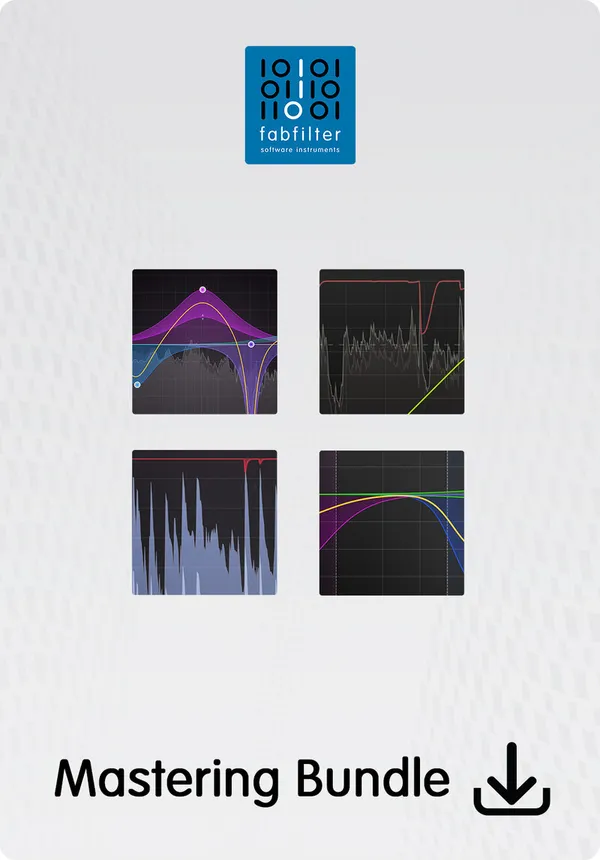
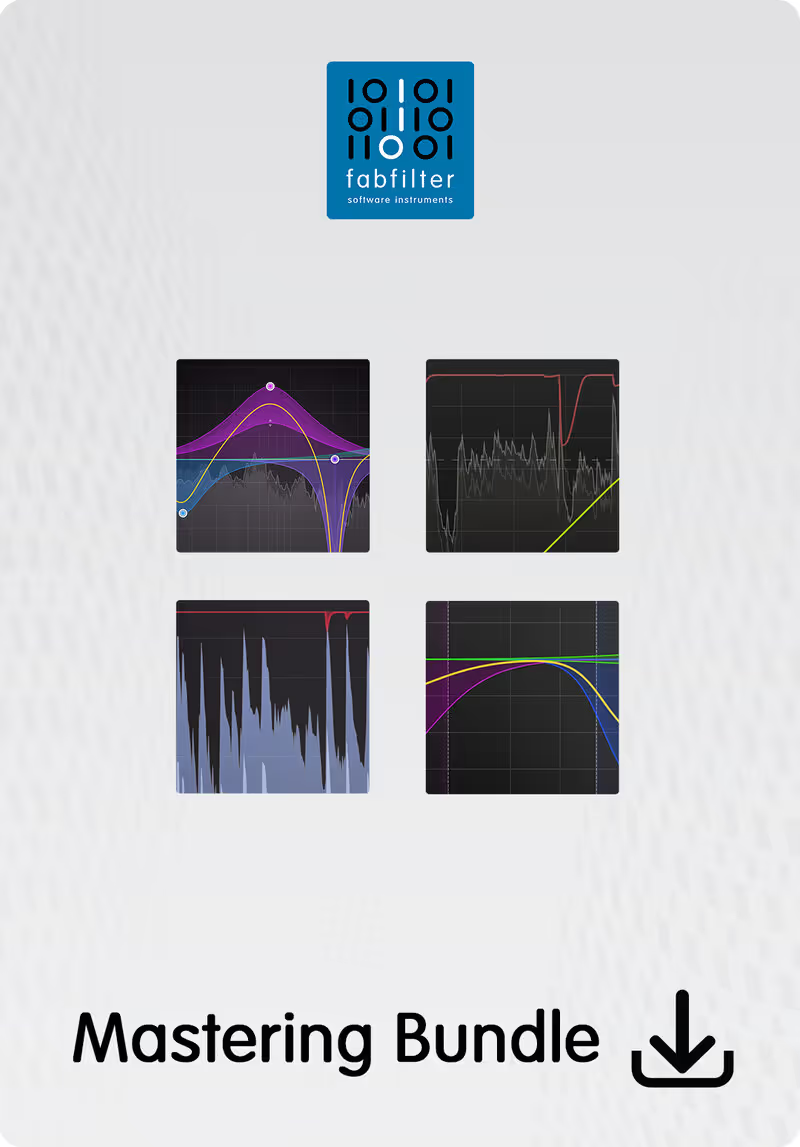
The bundle is four plugins rather than a suite, which is the distinction that decides whether it suits you. There is no single window and no master control. You place Pro-Q 4, Pro-C 3, Pro-MB and Pro-L 2 in whatever order the material needs, and nothing is deciding anything on your behalf.

For a composer that cuts both ways. A cue with a full string section and low brass frequently needs the multiband before the limiter rather than after, and this is the bundle that lets you find that out. It is also the bundle that will let you build a chain in the wrong order and hear nothing obviously wrong.

The metering is the part worth paying for and the part hardest to appreciate from a feature list. Pro-L 2's loudness and true peak displays are detailed enough to deliver from, which matters when a client specification names a figure. Pro-Q 4 shows the collision between two instances, which is a mixing capability that happens to arrive in a mastering purchase.

What it will not do is add weight. There is no saturation stage and no transformer modelling anywhere in the four, so a thin mix comes out of this chain exactly as thin as it went in. That is a real limitation on cues that needed warming rather than finishing, and the usual answer is to own a coloured processor alongside it.
Heard on
Film Scoring Library Music Game Audio
Check price $519
02 Softube Best Quality

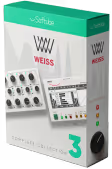
Weiss Complete Collection 3

Best for Elite Mastering

Not tested by us, assessed from specs and documented behaviour

The tools a mastering house uses, at a price that only makes sense if mastering is what you do rather than something you finish a cue with.

Assessed score
8.3
out of 10

How it scored

  • Transparency 9.6

    Ported from the hardware rather than modelled after it. Best on the page.

  • Loudness Control 8.5

    MM-1 reaches competitive level without a limiter in the Pro-L class.

  • Workflow Speed 7.0

    Hardware screens reproduced at hardware size. Cramped on a large display.

  • Flexibility 8.0

    Eight processors, each aimed narrowly. Nothing here is a general tool.

Why we picked it

Best for engineers mastering other people's work against a specification, where provenance and metering have to be defensible.

Who should skip it

Skip it if you only master your own cues, because the price assumes mastering is the job rather than the last hour of it.

The good

  • Ported from the hardware directly
  • Eight processors covering the chain
  • Metering detailed enough to deliver from

The bad

  • Several times the price here
  • iLok account and manager required
  • Hardware-sized screens do not resize
Format
VST/AU/AAX
Protection
iLok
Chain
You build it, eight plugins
Price
$1199
Why it scored that way

The processors an actual mastering house runs, ported rather than modelled. The price reflects that and so does the metering.

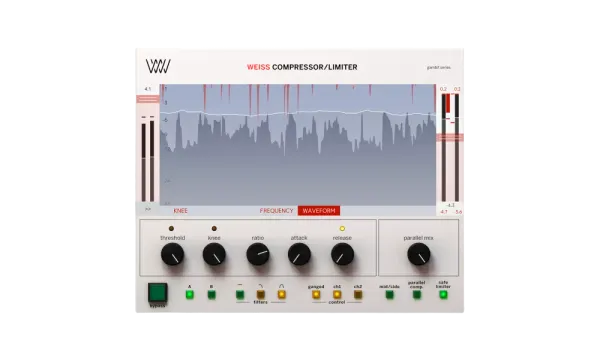
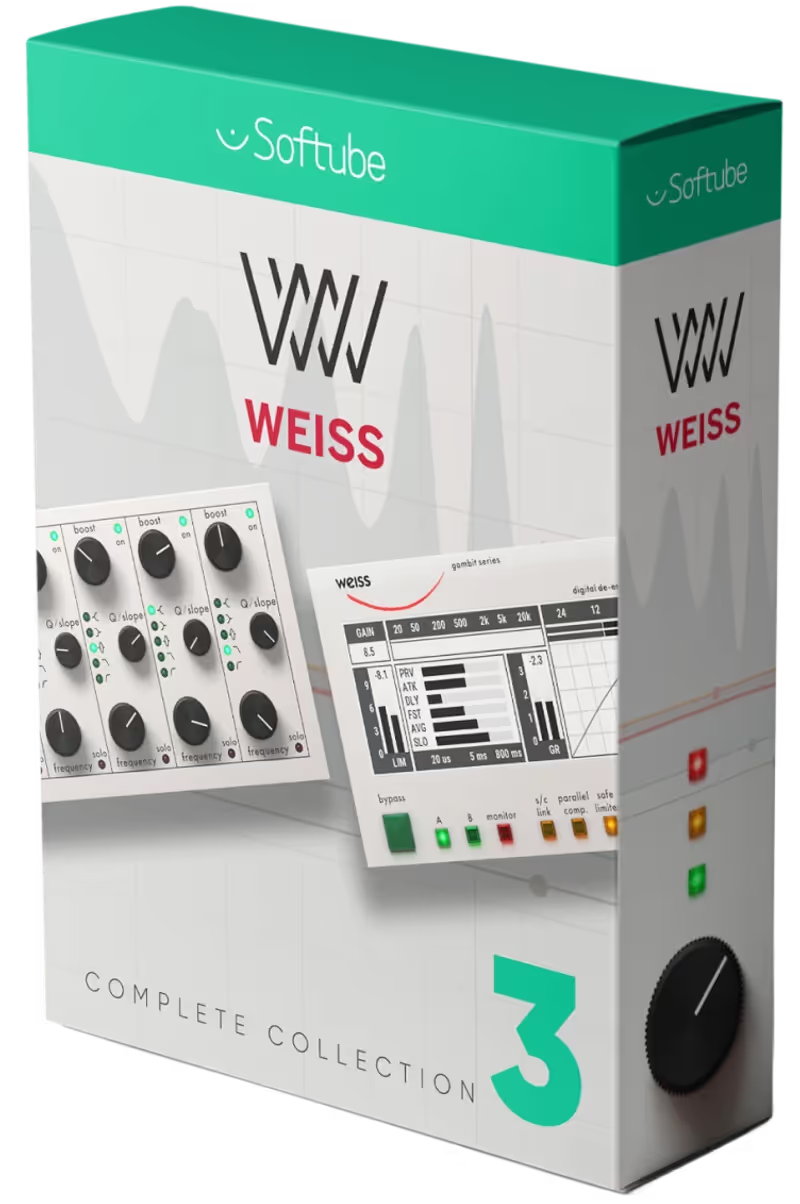
Eight plugins is a lot of collection, and the breadth is the argument here rather than any single unit within it. The EQ1 handles minimum phase correction, the DS1-MK3 covers dynamics and de-essing, the DS5 does multiband work and the MM-1 is the maximiser that gets the level up. An Exciter, a Deess and the Gambit series fill in around them.

What is unusual is where the code came from. These are ports rather than emulations, which removes the question of how closely a model tracks the original because there is no model. For an engineer delivering against a specification somebody else will check, that provenance is most of the value.

Two frictions are documented rather than incidental. The interfaces reproduce the hardware screens at roughly hardware size, so on a large display they sit small and dense with no resizing to fall back on. Authorisation runs through iLok, which means an account, the licence manager and a decision about whether to buy a dongle for a machine that travels.

The price is the other one and it is not subtle. This costs several times the FabFilter bundle at list, and the honest test is whether mastering is a service you provide or the last hour of your own cue. For the second case the money is better spent almost anywhere else.

Heard on
Mastering Houses Album Delivery Broadcast
Check price $1199
03 IK Multimedia Best Value

Lurssen Mastering Console

Best for Quick Mastering

Not tested by us, assessed from specs and documented behaviour

A finished-sounding master in thirty seconds, and a chain you can look inside but not rebuild.

Assessed score
6.5
out of 10

How it scored

  • Transparency 6.0

    Colour is the product. It sounds like a chain, not like nothing.

  • Loudness Control 7.5

    Competitive level, arrived at by Style rather than by decision.

  • Workflow Speed 9.6

    Style, input drive, one macro EQ. Best here by a distance.

  • Flexibility 3.0

    Chain view reaches some parameters. Nothing can be reordered or swapped.

Why we picked it

Best for composers who master their own cues, resent doing it, and are judged on the music rather than the master.

Who should skip it

Skip it if you want to build mastering as a skill, because the ceiling here is fixed at the level of somebody else's chain.

The good

  • Released sound in under a minute
  • Chain view opens the hood
  • Cheapest bundle on this page

The bad

  • Chain order cannot be changed
  • Modules cannot be swapped out
  • Voiced for records, not cues
Format
VST/AU/AAX
Protection
IK Product Manager
Chain
Fixed order, settings editable
Price
$99
Why it scored that way

One room's chain, in the order that room uses it. The controls you get are three, and that is the product.

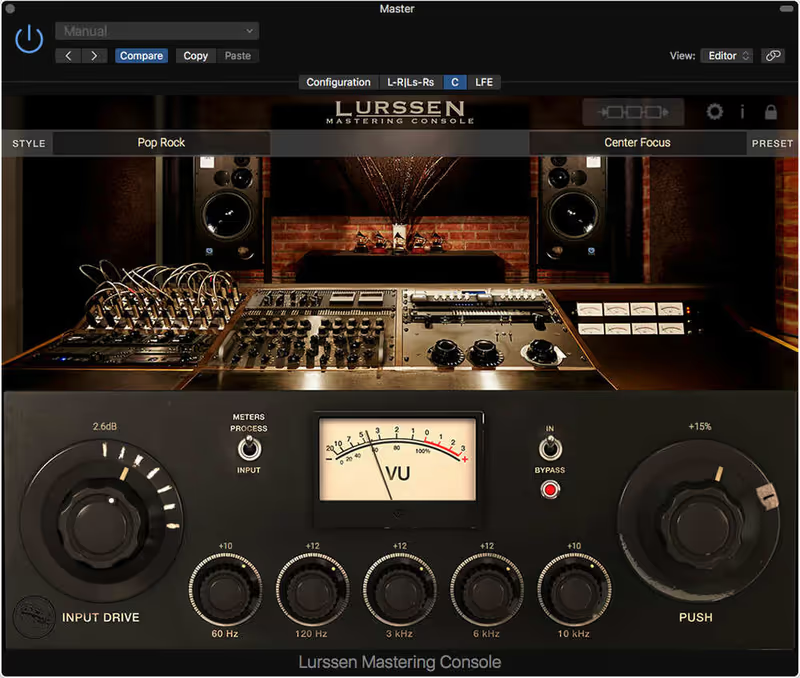
This models the chain used by Gavin Lurssen and Reuben Cohen at their mastering room in Los Angeles. The modelled units are a tube equaliser, a solid state equaliser, two tube limiters, a solid state de-esser and a solid state compressor, running in the order that room runs them. Three controls reach them: an input drive, a five band equaliser on fixed frequencies, and a Push control that nudges those bands together.

The order is the product rather than the processors. Six units of this kind are available from any developer, and what is being sold here is which one comes first and roughly where each sits, which is the part that takes a career to learn rather than an afternoon. Forty Styles configure the whole chain for different kinds of material, and choosing between them is most of the work.

The chain is not the sealed box it is often described as. A Chain view shows the individual modelled units and lets some of their settings be altered and saved back as a custom Style. What it will not do is let you reorder them, remove one, or put a plugin of your own in the middle.

Two things go wrong on orchestral material specifically. The chain was voiced for records, so on a dense cue with low brass it can add mid range weight that was not needed, and the Styles built for rock are actively unhelpful there. It also produces something that sounds released before you have checked whether it is correct, which is a real hazard on a cue that has to serve a picture rather than a playlist.

Heard on
Client Demos Library Music Songwriting
Check price $99
Read more →

Methodology

Who is this for

Working composers and producers who need reliability, speed, and character for professional scoring tasks.

Our testing process

Where we have tested a product, we do it in actual production scenarios, ranging from rapid sketches to commercial pitches, and we evaluate it in a dense template rather than in isolation. Where we have not, the product card says so and the assessment is drawn from specifications and documented behaviour instead.

Why you should trust us

We buy most reviewed plugins ourselves. Occasionally we receive NFRs for evaluation, but this never guarantees a review or positive verdict. We may earn commissions from links, but our editorial choices are never for sale.

Also considered

For every category, we audition the top 8 to 15 standard options, discarding any that suffer from poor scripting, slow load times, or uninspiring sampling.

Frequently Asked Questions

What does mastering actually do?

It sets the final tonal balance and level of a finished mix, and makes a set of tracks sound like they belong together. On a single cue that mostly means correcting broad tonal tilt and controlling peaks. Across an album or a set of library tracks it also means matching them so nothing jumps when one follows another.

Do I need a bundle or will individual plugins do?

A bundle buys you a coherent chain and one interface, which matters more in mastering than in mixing because the stages interact. Individual plugins let you pick the best limiter and the best EQ from different developers, at the cost of matching their metering and workflow yourself. Either works, and mixing and matching takes longer.

How loud should a master be?

For streaming, loudness normalisation means anything much above 14 LUFS integrated gets turned down again, so pushing further costs dynamics and gains nothing. Trailer and cinema delivery is a different world with its own specifications, and if a client has given you one it overrides every general rule.

Can I master my own mixes?

Yes, and the two real risks are your room and your ears. You have heard the mix hundreds of times, so the small tonal decisions mastering exists to make are exactly the ones you are least able to judge. Leave a day between finishing the mix and mastering it, and check on as many systems as you can.

Written By

Henry Foster

Henry is a mixing engineer with a background in broadcast and post-production. He obsesses over signal flow, gain staging, and the subtle coloration of analog-modeled plugins. His reviews focus on technical precision, CPU efficiency, and UI workflow.

Related Guides

All Guides →

New reviews, no noise

Occasional email when we publish something worth your time. No daily digest, no vendor press releases.

We store only your address, never sell it, and delete it as soon as you unsubscribe. See our privacy policy.