
Do This Now
- 1 Read every range here as sounding pitch with middle C as C4. Cubase, Logic and Kontakt call that same key C3, so a note your piano roll labels C3 is C4 in this guide.
- 2 Write inside the practical range for a section you have never met. Violins G3 to A6, cellos C2 to E5, horns sounding F2 to C5 and trumpets sounding F3 to A♭5 are safe with any professional orchestra.
- 3 Treat the top fifth of any wind or brass range as a cost, not a free note. A sample library plays it as easily as the middle, and a player cannot hold it for sixteen bars.
- 4 Transpose only at the score stage. Libraries map at sounding pitch, so a B♭ trumpet part is written a tone above what you played and a horn part a fifth above.
- 5 Check the low notes your library offers against the table before a live session. A bass clarinet down to B♭1 needs a low C instrument, and a double bass below E1 needs an extension.
Playing connects you to YouTube, which may set cookies.
Every orchestral instrument has a full range, the notes a professional can produce, and a practical range, the notes you can write for a section you have never met and get back in one take. The chart and tables below give both for the standard orchestra, at the pitch you actually hear.
Two conventions run through the whole page. Notes use scientific pitch notation, where middle C is C4 and the A above it is A4 at 440Hz. Ranges are given at sounding pitch, which is what your sample library plays, with the written pitch added for every transposing instrument.
How to Read These Ranges
Middle C is MIDI note 60. Scientific pitch notation calls it C4, and so does this guide. Cubase, Logic and Kontakt call the same key C3 by default, so if your piano roll says C3, read C4 in the tables here.
- Middle C
- C4 here, MIDI note 60
- In Cubase, Logic and Kontakt
- Labelled C3
- Pitch shown
- Sounding (concert)
- Practical range
- Safe for any pro section
The full range is the span professional players and the standard references agree on. The practical range is narrower on purpose. It leaves out the notes that only a strong player produces reliably, or that only work at certain dynamics, which is what you want when the session is booked and the players are sight-reading.
Sources disagree at the extremes, usually by a note or two at the top. Where they do, the tables say so and give the more conservative figure in the practical column.
The Range Chart
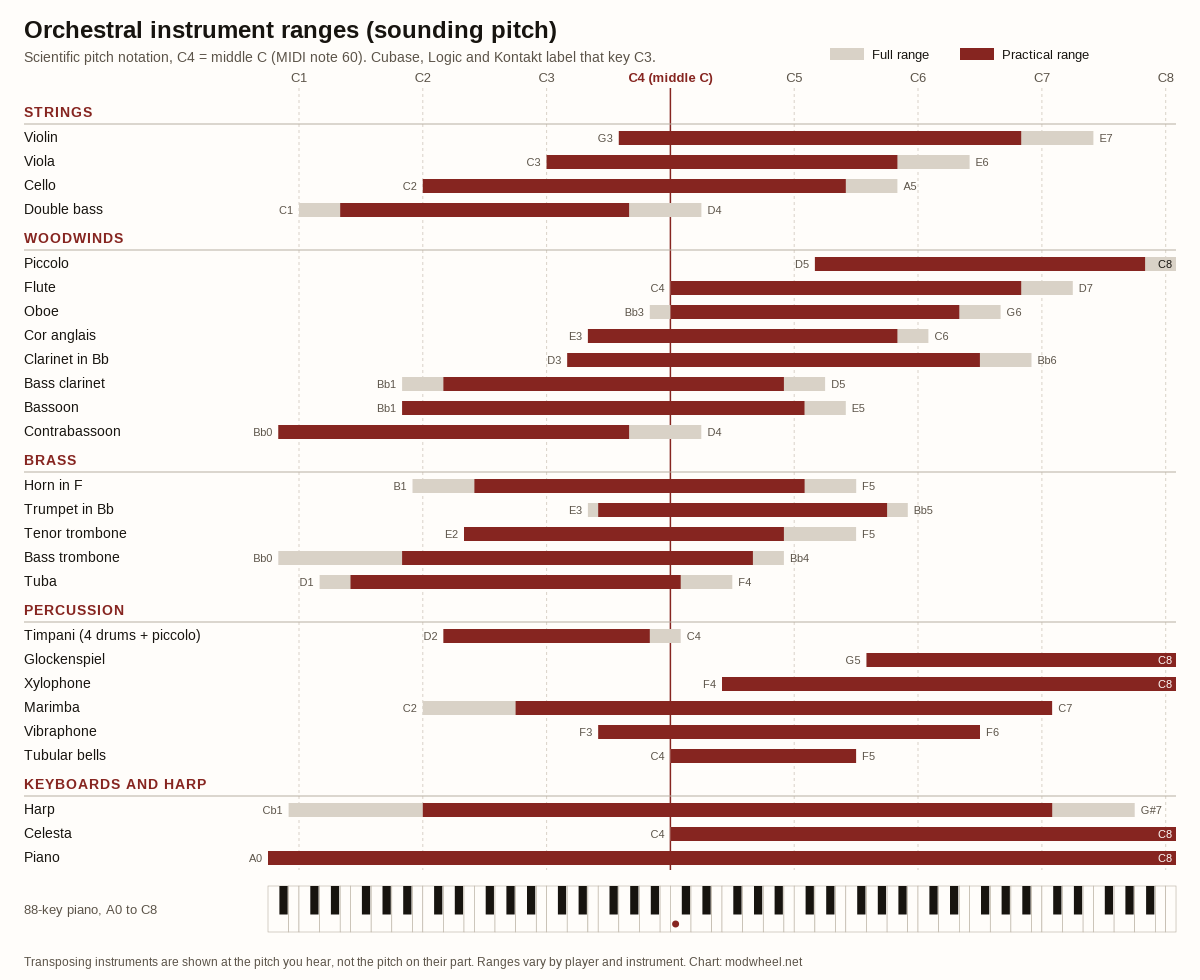
Every instrument at sounding pitch, from A0 to C8. Light bars are full ranges, dark bars practical ranges. Chart: modwheel.net, compiled from the sources listed at the end of this guide.
The chart makes two things obvious that tables hide. The orchestra is crowded between C3 and C6, where almost every instrument can play, which is why voicing and register choice decide how a cue sounds. And very few instruments live at the extremes, so a line below C2 or above C6 is a choice of colour as much as of pitch.
String Ranges
| Instrument | Full range | Practical range | Notes |
|---|---|---|---|
| Violin | G3 to E7 | G3 to A6 | Open strings G3, D4, A4, E5. The top octave is for firsts and soloists. |
| Viola | C3 to E6 | C3 to A5 | Open strings C3, G3, D4, A4. Some references stop at C6. |
| Cello | C2 to A5 | C2 to E5 | Open strings C2, G2, D3, A3. Above E5 is solo writing. |
| Double bass | E1 to D4 | E1 to G3 | Sounds an octave below written. C1 with an extension, B0 on a five-string. |
The bottom of every string range is fixed by the lowest open string. The top is not fixed at all, because it depends on how far up the fingerboard the player goes, and harmonics extend it further. That is why references agree on the lowest notes and disagree on the highest.
The cello's top is the clearest example. The HyperPhysics range table stops at E5, while orchestration texts commonly run to A5, and both are right about different things. E5 is where a section stays comfortable, and A5 is where a soloist in thumb position goes.
The double bass sounds an octave lower than written, so its part sits on the staff instead of on ledger lines. Standard orchestral writing rarely goes above G3, though twentieth-century parts reach D4 and beyond. Many orchestral basses have a C extension down to C1, which matters if your cue doubles the cellos an octave below, but you cannot assume every player has one.
For a section, more players in the top octave do not make it louder. The sound thins and intonation spreads, which is one reason high divisi needs care, covered in the divisi strings guide. A sample library plays A6 to E7 at full section size and perfect intonation, so a mockup can promise something a live section will not deliver. The solo string libraries roundup covers the libraries built for the exposed lines where this matters most.
Woodwind Ranges
Playing connects you to YouTube, which may set cookies.
| Instrument | Full range | Practical range | Notes |
|---|---|---|---|
| Piccolo | D5 to C8 | D5 to A7 | Sounds an octave above written (D4 to C7 written). |
| Flute | C4 to D7 | C4 to A6 | C7 is the classic top, D7 is common in modern scores. B3 with a B foot. |
| Oboe | B♭3 to G6 | C4 to E♭6 | Non-transposing. Sources put the top between F6 and A6. |
| Cor anglais | E3 to C6 | E3 to A5 | In F, sounds a fifth below written (B3 to G6 written). |
| Clarinet in B♭ | D3 to B♭6 | D3 to F6 | Sounds a major second below written (E3 to C7 written). |
| Clarinet in A | C♯3 to A6 | C♯3 to E6 | Sounds a minor third below written (E3 to C7 written). |
| Bass clarinet | B♭1 to D5 | D2 to B♭4 | Sounds a major ninth below written in treble clef. B♭1 needs a low C instrument. |
| Bassoon | B♭1 to E5 | B♭1 to C5 | Non-transposing. Some sources run to G5 for virtuoso writing. |
| Contrabassoon | B♭0 to D4 | B♭0 to G3 | Sounds an octave below written. Sources give the top anywhere from E♭3 to D4. |
Woodwind ranges are where the full range misleads most, because the instruments change character and volume by register. A flute's bottom fifth is soft and easily covered, so a flute line below G4 needs light accompaniment to be heard. An oboe's lowest notes are hard to play quietly, and the top of the bassoon is a thin, strained sound that composers use on purpose.
That is the main reason sampled woodwinds disappear in a full mix, which the guide on why your woodwinds disappear goes into. A library records each note at each dynamic layer as if every register were equally strong, and the real instrument is not.
The bass clarinet and contrabassoon lowest notes vary by instrument. A standard bass clarinet stops at written E3, sounding D2, and only instruments with the low C extension reach sounding B♭1. Some contrabassoons reach A0. Check before writing the bottom notes into a part.
Brass Ranges
Playing connects you to YouTube, which may set cookies.
| Instrument | Full range | Practical range | Notes |
|---|---|---|---|
| Horn in F | B1 to F5 | F2 to C5 | Sounds a fifth below written (F♯2 to C6 written, C3 to G5 practical). |
| Trumpet in B♭ | E3 to B♭5 | F3 to A♭5 | Sounds a major second below written (F♯3 to C6 written). |
| Trumpet in C | F♯3 to C6 | G3 to B♭5 | Sounds as written. Common in orchestras, chosen by the player. |
| Tenor trombone | E2 to F5 | E2 to B♭4 | Non-transposing. Pedal notes from B♭1 down. Some sources stop at D5. |
| Bass trombone | B♭0 to B♭4 | B♭1 to G4 | With two valves it is chromatic down into the pedal register. |
| Tuba | D1 to F4 | F1 to C4 | Pedal notes to B♭0 and lower. Solo writing reaches C5. |
Brass ranges come with an endurance cost that the table cannot show. A trumpet can play a written C6, and it cannot play forty of them in a row and then a soft entrance. The upper fifth of every brass range is for climaxes, not for long lines.
The horn is the instrument composers misjudge most, and the French horn guide covers its range, transposition and section writing in depth. The short version is that the practical range above, written C3 to G5, is where four horns in unison sound heroic without anyone straining.
Brass libraries are recorded loud more often than soft, and their top notes cost the sample nothing. Writing a quiet, exposed trumpet line above written G5 sounds fine in a mockup and is one of the hardest things to ask of a player. The brass programming guide covers how to make the dynamics believable, and the epic brass roundup compares the libraries.
Percussion Ranges
| Instrument | Sounding range | Written range | Notes |
|---|---|---|---|
| Timpani | D2 to C4 | As sounding | Four standard drums cover about D2 to A3. A piccolo drum reaches C4. |
| Glockenspiel | G5 to C8 | G3 to C6 | Sounds two octaves above written. |
| Xylophone | F4 to C8 | F3 to C7 | Sounds an octave above written. Four-octave models start at C4. |
| Marimba | C2 to C7 | As sounding | Five-octave instruments. The common 4.3-octave model starts at A2. |
| Vibraphone | F3 to F6 | As sounding | Three octaves. Motor and pedal give it sustain. |
| Tubular bells | C4 to F5 | C4 to F5 | Sources disagree on which octave the ear hears. Some models reach G5. |
For tuned percussion the practical range is the whole instrument, because the notes do not get harder at the edges. The limits are elsewhere. Timpani pitches are set by pedal, so a part needs time to retune between notes that are not already on a drum, and each drum covers only about a fifth.
Marimbas vary most. The bottom octave from C2 only exists on five-octave instruments, so a part written down there should be checked with the player or the hire company. The mallet libraries roundup covers the sampled versions, most of which record the full five octaves.
Keyboard and Harp Ranges
| Instrument | Full range | Practical range | Notes |
|---|---|---|---|
| Harp | C♭1 to G♯7 | C2 to C7 | 47 strings. Seven pedals set each pitch class for the whole instrument. |
| Celesta | C4 to C8 | C4 to C8 | Sounds an octave above written (C3 to C7 written). |
| Piano | A0 to C8 | A0 to C8 | 88 keys, non-transposing. |
The harp's range is huge and its limits are mechanical rather than musical. The top strings are short and dry with little sustain, and the bottom strings ring for a long time, so the fullest sound sits in the middle. The real constraint is the pedals, because each one sets every octave of a note at once, so a chromatic line is far harder than its range suggests. The harp VST roundup covers which libraries model that.
Transposing Instruments: Written vs Sounding
| Instrument | Sounds | A written C4 sounds as |
|---|---|---|
| Piccolo | An octave higher | C5 |
| Glockenspiel | Two octaves higher | C6 |
| Xylophone | An octave higher | C5 |
| Celesta | An octave higher | C5 |
| Clarinet in B♭ | A major second lower | B♭3 |
| Trumpet in B♭ | A major second lower | B♭3 |
| Clarinet in A | A minor third lower | A3 |
| Cor anglais | A perfect fifth lower | F3 |
| Horn in F | A perfect fifth lower | F3 |
| Bass clarinet in B♭ | A major ninth lower | B♭2 |
| Double bass | An octave lower | C3 |
| Contrabassoon | An octave lower | C3 |
There are two kinds of transposition here. The B♭, A and F instruments transpose because of how they are built, so the player reads the same fingering for a written note whatever the key of the instrument. The octave transposers, from piccolo to contrabassoon, only move the part an octave to keep it on the staff.
Sample libraries almost always map every instrument at sounding pitch, so you play the note you want to hear and never think about transposition while writing. It only matters when the cue goes to players. A notation program handles it if you set the instrument correctly, and the notation software roundup compares how Dorico, Sibelius and MuseScore manage transposed scores and parts.
Two older conventions catch people out. Horn parts in bass clef were traditionally written an octave lower than the modern convention, and some bass clarinet parts are written in bass clef sounding only a major second lower. If an old part looks an octave wrong, it probably is not.
Where Sample Libraries Go Past Real Players
A library maps whatever its developer recorded, and that is often more than a player can give you in a session. A note being on the keyboard in Kontakt is not evidence that it is playable. Check the top and bottom of any part against the practical column before the cue goes to an orchestra.
The bigger gap is effort. In a library, the top fifth of a trumpet's range costs exactly what the middle costs, and the quietest dynamic is as available at the top as at the bottom. Real instruments have registers where they cannot play softly, and registers where they cannot play loudly, and a mockup that ignores both is one of the reasons it sounds sampled. The orchestral mockup guide covers the rest of that list.
The octave numbering is the last trap. A cue exported from a DAW that calls middle C C3 into a score or a conversation that calls it C4 shifts everything by an octave on paper, so name the convention when you send a range to anyone.
Orchestra Seating
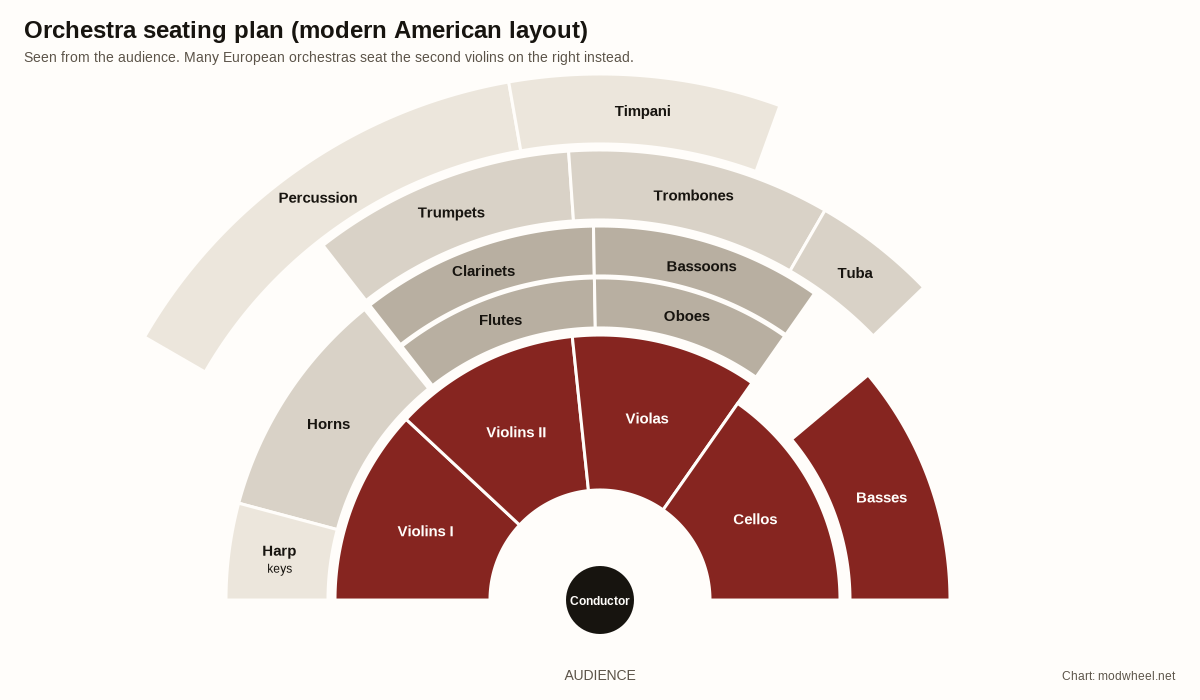
The common modern layout, seen from the audience. Chart: modwheel.net.
The layout above is the most common in modern orchestras. Strings sit in front, with first violins on the conductor's left and cellos on the right, woodwinds in the centre, brass behind them and percussion at the back. Many European orchestras use the older antiphonal layout instead, with the second violins on the right facing the firsts, and cellos and basses moved to the left.
It matters to a composer working with samples because libraries recorded on a scoring stage already carry each section's position in the room mics. Mixing a library recorded in one layout with one recorded in another puts the same section in two places, which the guide on mixing cinematic music deals with.
Sources
The ranges here were cross-checked between the HyperPhysics instrument range table from Georgia State University, the Wikipedia articles for each instrument and Alfred's Essentials of Orchestration by Dave Black and Tom Gerou, whose definition of a practical range as a safe limit for an unknown group of players is the one used here. Where the sources disagreed, the tables say so.
Related Articles
The 7 Best Harp VSTs That Actually Cut Through a Score
Glissandi that survive a busy mix. We tested seven harp libraries (CineHarps, Elysium, ha•pi) on scoring stage cues for tone, patch depth and playability.
Best Epic Brass VSTs (2026): Trailer & Action
Looking for the Hans Zimmer sound? We review the loudest, brashest brass libraries (CineBrass, Forzo, Metropolis Ark) for trailer production.
3 Best Mallet Libraries for Scoring (2026)
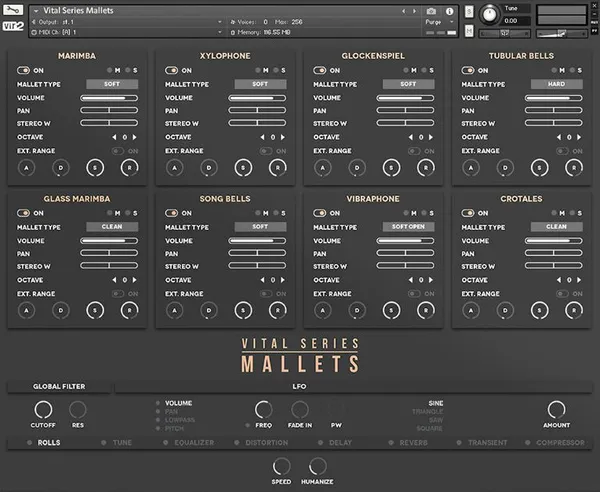
Vir2 Vital Series: Mallets, Heavyocity ASPIRE and Cinesamples' Randy's Celeste: three mallet libraries for scoring, and which covers the most instruments.

4 Best Solo String Libraries (2026)
Solo strings expose every sample. Four libraries scored from what composers report after living with them, including the vibrato and tone complaints.
Frequently Asked Questions
What is the range of the violin?
The violin's lowest note is its open G string, G3, the G below middle C. Its upper limit for orchestral writing is usually given as E7, two octaves above the open E string, and harmonics and very skilled players go higher. For a section part, staying between G3 and about A6 is safe.
What is the range of the cello?
The cello runs from its open C string, C2, two octaves below middle C, up to about A5 in solo writing. Section parts usually stay between C2 and about E5, and some references give E5 as the upper limit for that reason.
What is the range of the flute?
The concert flute plays from middle C, C4, up to C7, and modern scores often ask for D7. Flutes with a B foot add B3 at the bottom. The lowest fifth is quiet and easily covered, so the practical range for a line that must be heard is roughly G4 to A6.
What is the range of the trumpet?
A B♭ trumpet is written from F♯3 to C6 and sounds a major second lower, from E3 to B♭5. Strong players reach written D6 and above. The safe written range is G3 to B♭5, which sounds F3 to A♭5.
Which orchestral instruments are transposing instruments?
The common ones are the piccolo, clarinets in B♭ and A, bass clarinet, cor anglais, horn in F, trumpet in B♭, double bass, contrabassoon, glockenspiel, xylophone and celesta. Some transpose by a whole interval, like the horn sounding a fifth below written, and some only by octaves to keep notes on the staff, like the double bass and the piccolo.
Why does my DAW call middle C C3?
Because Yamaha's convention, which Cubase, Logic and Kontakt use by default, numbers octaves one lower than scientific pitch notation. MIDI note 60 is middle C in both systems. It is called C4 in scientific notation and in this guide, and C3 in those programs.
More Guides
All Guides →Writing for French Horn Without Making It Unplayable
The horn is the most misjudged instrument in the orchestra. Real range against sampled range, why four horns in unison is the default, and the register that ruins takes.
Layering Two String Libraries Usually Makes Things Worse
Stacking two libraries on one line gives you comb filtering and two halls fighting. The four conditions that make layering work, and the alignment step everyone skips.
The Art of Brass Programming: Heroic Solos and Menacing Chords
How to correctly ride MIDI data, voice-lead chords, and mix multiple brass virtual instruments to achieve true cinematic power.
New reviews, no noise
Occasional email when we publish something worth your time. No daily digest, no vendor press releases.
We store only your address, never sell it, and delete it as soon as you unsubscribe. See our privacy policy.

Louis Raveton
Louis works across immersive scores (Venice Biennale, LVMH) and animation (Canal+), while producing Downtempo and Electro-Dub as Monsieur Shwill and Flagada. He treats his sample drive like a record collection, constantly hunting for the perfect 'imperfect' texture